
The Story: Twelve Years, One Moment of Doubt
Hypothetical Case Study
Marcus had built something real. Over twelve years, his specialty logistics company, serving pharmaceutical cold-chain distributors across the Southeast, had grown from a two-truck operation into a $14 million EBITDA platform with 180 employees, proprietary routing software, and contracts with three of the top five regional hospital networks. He owned 100% of the equity. He had never taken outside money.
But at 51, Marcus had a problem that success had created. Nearly all of his net worth, roughly $40 million on paper, was locked inside a single, illiquid company. His daughter was starting college. His wife wanted to stop worrying about whether a bad quarter meant skipping a mortgage payment. Three private equity firms had come calling in the past eighteen months, dangling offers at 8x EBITDA: $112 million for the whole thing. Clean, fast, final.
He almost said yes. Then his M&A attorney asked him a question that changed the conversation: “What if you didn’t have to choose between liquidity and control?”
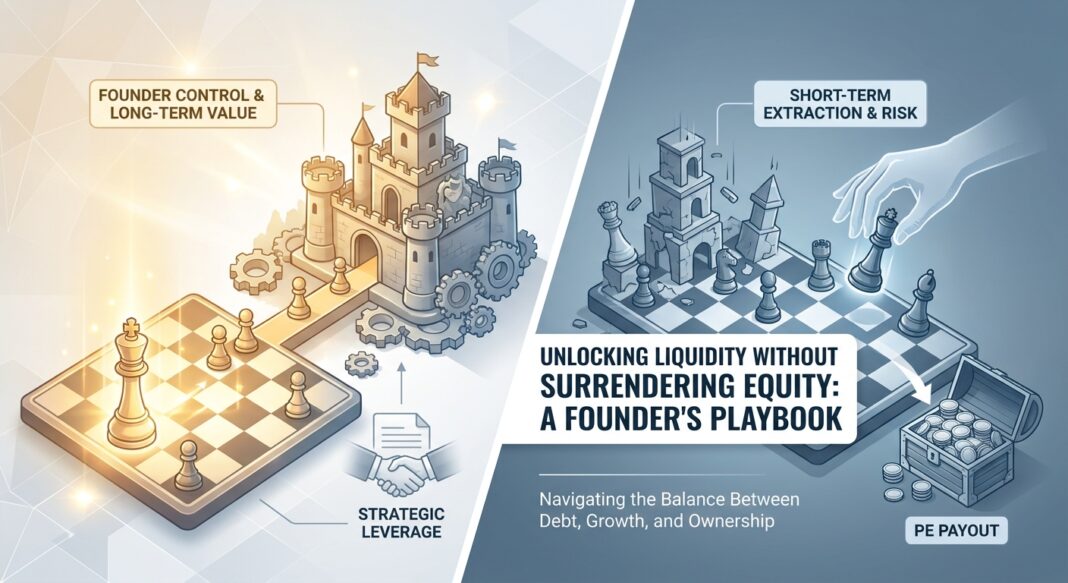
What followed was a leveraged recapitalization (not the kind Wall Street headlines lately, where PE firms load their portfolio companies with debt to pay themselves) but the founder-driven kind, where the debt works for the owner without erasing his future in the business.
The Backdrop: Two Versions of the Same Trade
Before we follow Marcus’s decision, it’s worth understanding what was happening in the broader market around him, because the structural tool he used has been wielded in very different ways depending on who sits at the controls.
In 2025, private equity-owned companies borrowed $94 billion in leveraged loans and high-yield bonds to fund their own payouts, according to a Moody’s Ratings analysis, a post-financial-crisis record. These transactions, called dividend recapitalizations, have gained popularity among PE firms looking for ways to cash in on investments as exit markets tightened. IPO windows largely stayed shut. M&A stalled. So sponsors did the next best thing: they borrowed against the companies they owned and paid themselves.
The numbers are striking. About $50 billion (or 53% of 2025 dividend recap deal volume) was distributed directly to sponsors, up from $33 billion (34%) in 2024. Total recap volume for 2024 and 2025 combined was nearly $200 billion, more than five times the combined total for 2022 and 2023.
Moody’s was pointed in its critique: “Because this behavior often coincides with challenging exit environments, it suggests sponsors are prioritizing investor distributions over long-term credit health.” The incentive is nakedly clear. Cash flow that could have gone to operations, capex, or employees now goes to debt service. The company is asked to carry more weight than when the PE firm bought it.
The structure itself, borrowing against enterprise value to create owner liquidity, is not the problem. The problem is whose interests the debt serves after it lands on the balance sheet.
The Decision: Marcus Runs the Numbers Both Ways
Hypothetical Case Study (continued)
Marcus had three choices on the table. The first was the full PE sale at 8x EBITDA, netting roughly $112 million before taxes and fees. Clean exit. Done. But Marcus believed his business would be worth considerably more in five years, a new regulatory tailwind was pushing pharmaceutical distributors toward certified cold-chain partners, and he was one of the few at his scale who already had the infrastructure.
The second option was a growth equity minority recap: sell 35% to a PE-backed minority partner at a negotiated valuation, pocket roughly $20 million, give up a board seat, and live with a shareholder agreement that included drag-along rights and a preferred return structure. Every five-year horizon, someone else’s clock was running.
The third option was the one his advisor had quietly introduced: a standalone leveraged recapitalization using unitranche private credit, with no equity partner required. A leveraged recapitalization is a capital structure transaction in which a company replaces a portion of its equity with new debt and pays the proceeds to shareholders, the owner extracts cash without selling to a third party, while the company assumes a higher debt-to-equity ratio.
The structure he ultimately used looked like this:
- Business EBITDA: $14 million (trailing twelve months)
- Unitranche facility: $56 million (4.0x EBITDA)
- Proceeds to Marcus (dividend): $50 million after fees and transaction costs
- Annual debt service: ~$5.6 million (all-in coupon approximately 9.3%, consistent with average new-issue yields in 2025)
- EBITDA coverage ratio: 2.5x (debt service well within cash generation)
- Equity retained: 100%: no dilution, no new shareholders, no board seats surrendered
According to the Pepperdine Private Capital Markets Report (2024), lower middle market leveraged recapitalizations typically close at 3x to 5x EBITDA in total debt, with pricing tied to prevailing senior secured rates plus a margin based on risk profile. Marcus’s 4x structure sat comfortably in range.
The transaction took eleven weeks from first lender conversation to closing. Marcus personally diversified $50 million. His company kept its momentum, its management team, and its strategy, without a single outside shareholder gaining a claim on either.
The Outcome: What the Counterfactual Costs
Hypothetical Case Study (continued)
Three years after the recap, Marcus’s business hit $19 million in EBITDA. Two tuck-in acquisitions, funded in part by the company’s now-restored free cash flow as the unitranche amortized, expanded his footprint into the Mid-Atlantic. The regulatory tailwind he had anticipated materialized. A strategic buyer approached; this time at 11x EBITDA.
Let’s run the comparison:
| Scenario | Liquidity Event 1 | Equity at Final Sale | Total Proceeds (Pre-Tax) |
|---|---|---|---|
| Full PE Sale (Year 0) | $112M at 8x | $0 (no roll) | ~$112M |
| Minority Equity Recap (35% sold) | ~$20M personal | 65% of $209M = ~$136M | ~$156M (subject to preferred/drag) |
| Founder Leveraged Recap + Hold | $50M personal dividend | 100% of $209M = $209M | ~$259M (net of remaining debt) |
The recap path generated roughly $147 million more in total personal proceeds than the immediate full sale, even after retiring the remaining unitranche balance at Year 3. The minority equity path, while better than selling outright, still cost Marcus 35 points of his own upside in a business he continued to operate.
This is the arithmetic of alignment. A leveraged recapitalization and an LBO both rely on significant debt financing, but they serve different purposes: in a recap, the owner stays; in an LBO, the owner exits. When the debt serves the owner who remains, the incentive to run the business well never disappears.
Contrast this with the PE dividend recap landscape described above. When a PE dividend recap goes wrong, it tends to go wrong slowly, then all at once. The company runs the extra debt for a year or two without incident, then a bad quarter hits. The sponsor has already been paid. The company absorbs the consequence.
The Lessons: A Framework for Founder Recaps
The structural logic Marcus used is not complicated, but it requires a business that qualifies. A predictable, cash-flowing business with defensible margins can absorb more leverage without trouble. A cyclical business or one that needs to invest heavily to stay competitive has less room.
Here is the decision framework that separates good recap candidates from bad ones:
1. Cash flow must be durable, not projected. Lenders underwrite to trailing EBITDA, not hockey sticks. If your margin depends on next year’s contract, the bank will find that out before you close.
2. Leverage should stay within coverage comfort. EBITDA/interest coverage across private credit transactions averages approximately 2x across all sectors. Owners who push to 5x or 6x EBITDA in debt, chasing maximum liquidity today, borrow against tomorrow’s flexibility. The 3x to 4x range preserves operational breathing room.
3. Alignment is the variable PE can’t replicate. The real control risk for founders usually comes from cumulative equity dilution and governance shifts, not from well-structured debt. A founder with 100% equity and $50 million already in their pocket has every incentive to compound. A PE firm with a ten-year fund life and an LP base demanding DPI has different priorities.
4. Timing matters more than you think. Bank lending standards for leveraged transactions tighten materially during periods of economic uncertainty, which directly affects both available proceeds and pricing. Recapping into a benign credit market, as Marcus did, is meaningfully cheaper than doing so under stress.
5. Private credit expanded the menu. As the private credit market has expanded, growing rapidly since 2008 when regulatory changes limited traditional bank lending, so have the options available to founder-led companies looking to reduce dilution without a full equity raise. Today’s unitranche structures give founders access to capital that would have required a PE partner just a decade ago.
Key Insights
- The PE recap playbook works both ways. Private equity borrowed $94 billion against its own portfolio companies in 2025 to pay LPs. Founders can execute the same structural move, with better incentive alignment, by doing it for themselves, not for a fund.
- Liquidity and control are not a trade-off. A properly structured leveraged recap at 3x to 5x EBITDA can deliver tens of millions in personal liquidity without surrendering a single share, board seat, or drag-along provision.
- Incentive alignment changes everything about default probability. When the person who borrowed the debt also runs the company and owns 100% of the upside, the operating incentive to service that debt is absolute. That’s a structural advantage the PE dividend recap structurally lacks.
- Selling too early is the most irreversible dilution. Equity sold at 8x to a buyer who re-sells at 11x three years later is equity lost forever. Debt borrowed at 9% and repaid from cash flow costs roughly 27 cents on the dollar over three years, a fraction of the equity value surrendered in a premature exit.
- The market is open, for now. Private credit fundraising globally reached $224 billion in 2025, lender appetite for founder-controlled platforms remains strong, and unitranche pricing has eased from its 2023 peaks. Founders evaluating recaps should stress-test their timing against credit cycle risk rather than waiting for the “perfect” moment that never arrives.


