
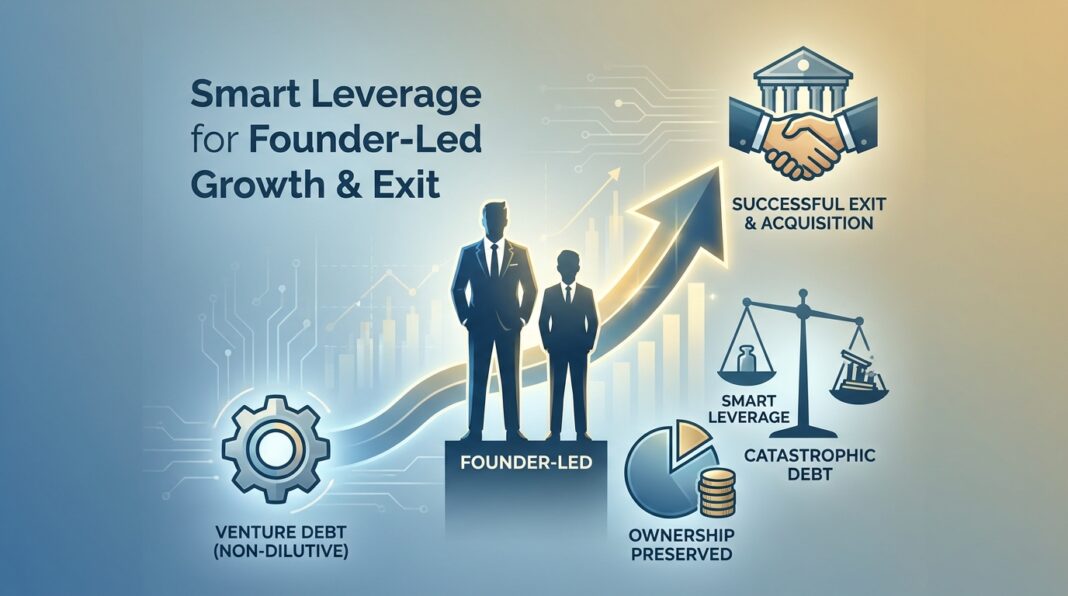
The Story: A Father, a Son, and a $1 Million Bet on Debt
Greg Holifield spent 22 years on active duty overseas. By his own account, he missed a lot: school plays, graduations, ordinary Tuesday evenings at home. When he finally came back and started building companies alongside his son Timothy, he wasn’t about to let a venture capitalist’s term sheet tell him how to run the business he’d sacrificed to build.
By 2022, the Holifields were on their fourth startup: SafePointe, a Florida-based AI-powered weapons detection company with real recurring revenue, a growing customer base, and a clear path to acquisition, if they could get the working capital to execute. The business was hardware-enabled SaaS, meaning every new customer contract required upfront hardware investment before the subscription revenue kicked in. Growth was eating cash faster than cash was being generated.
The options were familiar: bring in an equity investor, hand over a slice of the cap table, and let someone else’s clock start ticking, or find another way. Greg and Timothy had seen this movie before. On a previous startup, they’d navigated a $4 million government contract using a patchwork of bank instruments. This time, they found TIMIA Capital, which extended a $1 million venture debt facility disbursed across three tranches as SafePointe hit growth milestones.
Less than twelve months later, SafePointe was acquired by SoundThinking, Inc. (Nasdaq: SSTI), a public safety technology firm. It was the Holifields’ fourth successful exit. And crucially, the equity they hadn’t given up was fully intact at the moment of sale, according to the timiacapital.com case study.
The Decision: When “Non-Dilutive” Actually Means Something
Here is the number that crystallizes Greg Holifield’s entire capital philosophy: the equity investors who came in alongside TIMIA’s debt made 10x their money in nine months. TIMIA’s debt cost a fraction of that. The same nine-month window. The same exit. Radically different costs of capital.
“They think the interest rate is too high,” Greg said of skeptics on his own board, “but when there are no warrants associated with debt, it is truly fantastic money, and much cheaper than equity.”
This is the insight that separates sophisticated founder-operators from first-time capital raisers. Debt carries an interest rate you can see and model. Equity carries a dilution cost that only reveals itself at exit, and by then, it’s too late to renegotiate.
SafePointe’s core challenge was a cash conversion problem, not a business model problem. Hardware costs were embedded in license fees, creating heavy accounts receivable and a working capital gap between signing contracts and collecting revenue. TIMIA’s structured disbursements solved exactly that, capital deployed when it was needed, tied directly to the business’s growth cadence. SafePointe tripled its monthly recurring revenue between the first disbursement and the acquisition close.
The Holifields weren’t anti-equity ideologues. They took some equity capital too. They simply understood the instrument for what it was (expensive, permanent, and senior to nothing) and used it only where necessary.
The Outcome: What the Waterfall Looks Like When Debt Is Sized Right
The SafePointe story is the non-dilutive playbook working exactly as designed. But to understand why it worked, it helps to examine what happens when the same tool, debt, is scaled to catastrophic proportions.
In January 2025, Divvy Homes sold to Brookfield Properties for approximately $1 billion. The founders received $0. Most venture investors received $0. A company that had reached a $2.3 billion peak valuation, raised over $400 million in equity from Andreessen Horowitz and Tiger Global, and helped 2,000 families pursue homeownership, gone, with nothing left for the people who built it.
The culprit wasn’t a failed product. It was a capital structure. In October 2021, at the absolute peak of the zero-interest-rate era, Divvy took on $735 million in debt to fund its home-purchasing model. When rates surged in 2022, the model fractured. New home acquisitions halted. Three rounds of layoffs followed. By the time Brookfield stepped in, the waterfall math was irreversible: $735M in senior debt repayment, plus transaction costs, plus liquidation preferences on hundreds of millions in preferred equity, consumed the entire $1 billion before a single dollar reached common shareholders or founders, as detailed by saastr.com.
SafePointe used $1 million in debt against a business sized appropriately for that leverage. Divvy used $735 million in debt against a model that required a $2 billion+ exit just to make founders whole. The instrument was identical. The outcomes were universes apart.
The Lessons: A Framework for Founders Facing the Same Choice
The SafePointe and Divvy stories aren’t opposites, they’re the same story told at different scales. Non-dilutive capital is a precision instrument. Its effectiveness depends entirely on the hand holding it.
The pattern holds across company stages and sectors. Ken Hoppe at Modigi: a bootstrapped SaaS company serving enterprise clients inside the Salesforce ecosystem, used $400,000 in revenue-based financing from Founderpath to hire his first salesperson and customer success manager, reaching $1.7 million in ARR profitably with six employees and zero equity diluted, according to founderpath.com. He didn’t need a board. He didn’t need a Series A. He needed a specific hire at a specific moment, and he funded it without surrendering any of the company he’d built.
Meanwhile, UnityLab (formerly Unity Laundry Systems) used revenue-based financing from Sage Growth Capital at three distinct inflection points (product expansion, a strategic acquisition of Hoffman-NewYorker, and international growth into China and Europe) growing 10x over four years while preserving equity positioning ahead of a favorable Series A round at a valuation they controlled, as documented by sagegrowthcapital.com. Founder Jonathan Benjamin’s stated philosophy: delay traditional equity raises until the leverage has already proved the thesis, then raise from a position of demonstrated results rather than projected ones.
These aren’t outliers. They’re a repeating pattern.
The Decision Framework
When evaluating non-dilutive capital against equity, founders should stress-test three questions:
- At what exit price does my equity become worthless? Every dollar of debt raises that floor. Model the waterfall at your most likely exit, not your best-case one, before you sign.
- Is this a cash conversion problem or a business model problem? Debt solves timing gaps between revenue recognition and cash collection. It cannot fix unit economics that don’t work. SafePointe had a timing problem. Divvy had a model-level interest rate exposure problem dressed up as a timing problem.
- Is the debt sized against realistic outcomes? TIMIA’s $1 million against a business on track for a nine-figure exit is a rounding error. $735 million against a business whose model breaks when rates move is an existential bet disguised as a financing decision.
Key Insights
- Debt doesn’t dilute ownership; it dilutes outcomes below the payoff threshold. The Divvy Homes collapse illustrates how $735M in senior debt at a $1B exit left founders with nothing, while SafePointe’s $1M facility at the right scale preserved the entire equity upside for its founding team.
- The 10x equity benchmark is the real cost of dilution. SafePointe’s equity co-investors made 10x in nine months. TIMIA’s debt cost a fraction of that. Founders who internalize the actual cost of equity, not just the percentage given up, make fundamentally different capital decisions.
- Non-dilutive capital is most powerful when it solves a timing problem, not a business model problem. Revenue-based financing and venture debt work when the business generates predictable recurring revenue and faces a cash conversion gap, not when it needs capital to prove whether the model works at all.
- Preserving the cap table before a raise is its own form of leverage. UnityLab used revenue-based financing to complete the Hoffman acquisition and prove the thesis before approaching Series A investors, allowing it to raise at a valuation shaped by demonstrated results rather than projected potential.
- Know your waterfall before you sign any term sheet. The single most important financial exercise any founder can run is a payout cascade at multiple exit prices: $500M, $1B, $1.5B, $2B. If there is a plausible exit scenario where your equity is worth zero, that scenario needs to be on the table before you take on debt, not after.


