
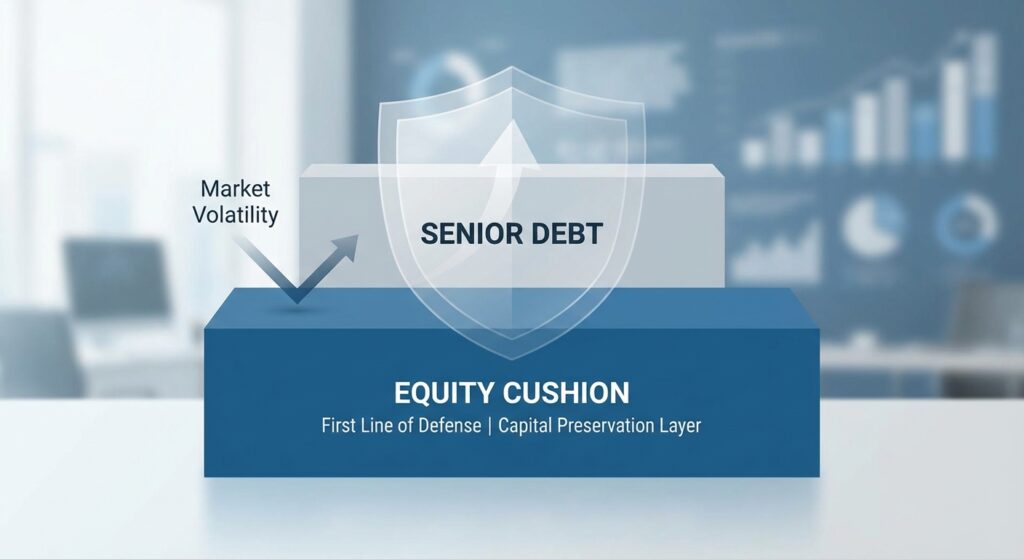
The First Line of Defense in Capital Preservation
In the world of private credit, interest rates and yield spreads often dominate the headlines. However, for sophisticated lenders and prudent borrowers, the most critical structural component of any deal is the Equity Cushion.
While yield determines the return on capital, the equity cushion determines the return of capital. It is the structural buffer that absorbs enterprise value volatility before a lender loses a single dollar of principal.
For investors, analyzing this cushion is the primary method of assessing downside risk. For business owners (operators), understanding how lenders view this cushion is essential for negotiating leverage multiples and preventing equity dilution. In the current market environment, where private credit has grown to fill the void left by traditional banks, understanding the mechanics of this protection is more vital than ever.
The Concept: What is Equity Cushion?
The equity cushion represents the percentage of a company’s total Enterprise Value (EV) that is funded by junior capital (typically common or preferred equity) sitting below the senior debt in the capital stack.
Functionally, it serves as a "first loss" trance. If a company’s value declines due to market headwinds, operational failure, or economic recession, the equity holders absorb the loss first. The senior lend’s principal is only impaired if the company’s total value falls below the outstanding loan balance.
This relationship is inversely related to the Loan-to-Value (LTV) ratio. A deal with a 40% equity cushion implies a 60% LTV. The thicker the cushion, the more enterprise value can erode before the lender is at risk.
How It Works: The $100 Million Hypothetical
To visualize the mechanism, consider a hypothetical acquisition of a mid-market manufacturing firm, Bond Capital Manufacturing (BCM).
- Enterprise Value (Purchase Price): $100 Million
- Private Credit Senior Loan: $55 Million
- Sponsor/Founder Equity: $45 Million
The Math:
In this structure, the Equity Cushion is 45% ($45M / $100M). Consequently, the LTV is 55%.
Scenario A: Stability
The company operates normally. The lender collects interest, and the equity holders benefit from any growth in value above $100M.
Scenario B: Market Contraction
A recession hits, and BCM’s valuation multiples compress by 20%. The company is now worth $80 Million.
- Loss Impact: The $20M loss is absorbed entirely by the equity holders. Their stake is now worth $25M ($80M – $55M).
- Lender Position: The lender’s $55M principal is still fully covered by asset value (1.45x asset coverage).
Without this cushion, or with a much thinner one (e.g., 90% LTV), a 20% drop would immediately breach the debt value, triggering default and potential principal loss. This demonstrates why private credit managers prioritize Senior Secured positions, they are structurally insulated from moderate valuation shocks.
Current Market Relevance
As of early 2026, the demand for robust equity cushions has intensified as the asset class matures. According to NEPC December 2025, the private debt market has swelled to approximately $1.7 trillion, driven largely by the retreat of traditional banks.
This shift has allowed private lenders to dictate more disciplined structural protections compared to the covenant-lite public markets. Recent insights from Blackstone July 2025 highlight that private loans are typically structured as senior secured instruments with a "meaningful cushion below" in the form of junior debt and equity. This structure is explicitly designed to offer "defensive income", prioritizing principal preservation over speculative growth.
Market Dynamics Data Box:
- Market Size: ~$1.7 Trillion (Source: NEPC/Preqin)
- Deal Size Context: Public high-yield deals average >$700M; Private credit fills the middle market gap where equity cushions are often subjected to stricter due diligence (Source: NEPC).
- Strategic Focus: Defensive income generation through senior positioning (Source: Blackstone).
The data suggests a bifurcation: while public markets often tolerate higher leverage (thinner cushions) for massive issuers, the middle-market private credit space demands substantial skin in the game from business owners to align interests.
Decision Framework
Whether you are allocating capital or seeking it, the equity cushion is a primary lever in the negotiation.
For Investors (Lenders/Allocators)
Evaluate the quality of the cushion, not just the quantity. A 40% cushion based on an inflated Enterprise Value (e.g., 20x EBITDA in a 10x sector) is "phantom equity." Investors should stress-test the entry valuation. If the valuation multiple compresses to historical averages, does the cushion disappear? If yes, the risk is significantly higher than the headline LTV suggests.
For Operators (Borrowers)
Operators often view high equity contributions as "expensive" because they lower the Return on Equity (ROE) in the short term. However, a thicker equity cushion allows for:
- Lower Cost of Debt: Lenders charge lower spreads for lower LTVs.
- Covenant Flexibility: Lenders are more likely to offer looser covenants if they are well-insulated by equity.
- Survival Capital: In a downturn, a healthy equity buffer provides time to work through challenges without an immediate lender takeover.
Key Takeaways
- First Loss Protection: Equity cushion acts as a shock absorber; lenders only lose money after the cushion is fully eroded.
- Inverse of LTV: A 40% equity cushion equals 60% Loan-to-Value. Lower LTV implies higher safety.
- Valuation Matters: The percentage cushion is only as real as the underlying Enterprise Value. Investors must scrutinize the purchase multiple.
- Alignment of Interest: a significant equity check ensures the operator/sponsor is financially committed to the business’s success.
- Defensive Nature: Current market trends favor senior secured structures with thick cushions to navigate economic ambiguity.


