
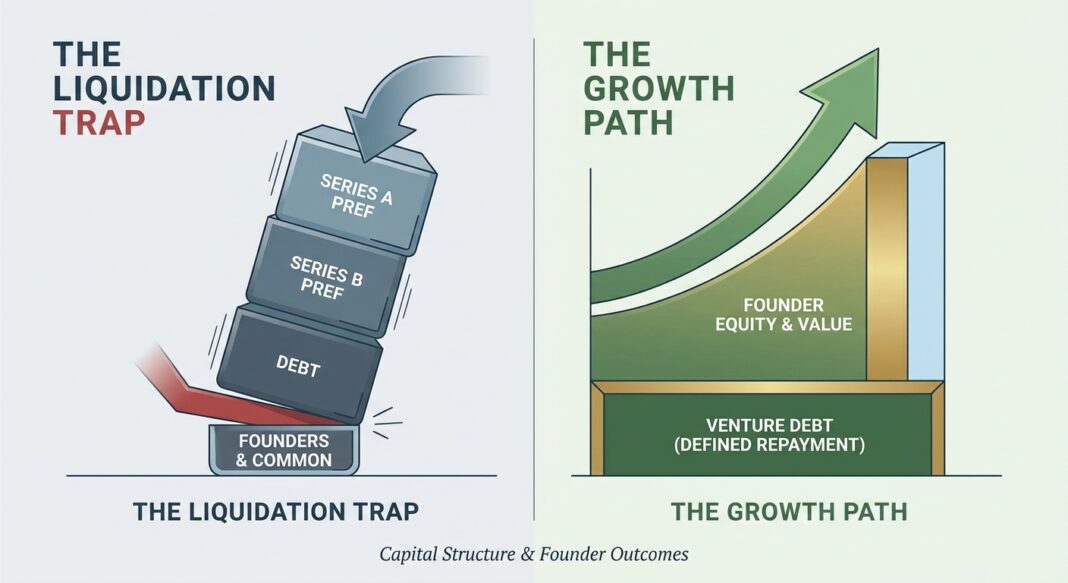
The Story: A Billion-Dollar Exit. Zero for the Builders.
In January 2025, a letter arrived in the inboxes of everyone who had ever poured time, money, or hope into Divvy Homes. It was written by co-founder and CEO Adena Hefets. The news it carried was the kind that stops your breath mid-sentence.
Divvy (the San Francisco-based rent-to-own startup that had once been valued at $2.3 billion, that had been backed by Andreessen Horowitz, Tiger Global, and GIC, that had helped thousands of American families inch toward homeownership) was being sold to Brookfield Properties for approximately $1 billion. On paper, that is a unicorn exit. The kind of number that fills glossy magazine profiles and inspires conference keynotes.
But Hefets’ letter, later reviewed and reported by TechCrunch, contained a devastating coda. After repaying outstanding debt, covering transaction costs, and fulfilling liquidation preferences for preferred shareholders, neither common shareholders nor founders would receive any consideration. Not a reduced payout. Not a partial recovery. Zero.
A billion dollars crossed the table. The people who built the company watched it flow straight through, absorbed by a capital structure that had been silently stacking claims above their heads for years. This was not a product failure. It was not a fraud. It was not even a bad exit by market standards. It was a capital structure story. And understanding it is one of the most important things any founder, operator, or growth company executive can do.
The Decision: How a Stack of Capital Became a Ceiling on Founder Value
To understand what happened to Divvy, you need to understand what the company chose to build, and how it chose to fund it.
Divvy’s model was capital-intensive by design. The company purchased homes directly, held them on its balance sheet, and leased them back to renters building toward a down payment. Scaling that model required enormous amounts of capital. And between 2016 and 2021, Divvy raised it aggressively: more than $700 million in combined debt and equity from some of the most prominent names in venture capital. In October 2021 alone, the company took on roughly $735 million in debt financing: a massive facility to fund its home acquisition engine at the peak of the market.
The equity rounds, meanwhile, each came with liquidation preferences. Preferred investors, the VCs who funded Series A through Series D, held structured rights to get their capital back first in any exit. These preferences are standard in venture term sheets. But they compound. Each subsequent round adds another layer to the payout waterfall, each one senior to common equity. Founders typically sit at the bottom of that stack.
When interest rates surged in 2022, Divvy’s model broke. Rising mortgage rates meant fewer renters could convert their leases into purchases, the core mechanism that made the business work. The company conducted three rounds of layoffs in a single year. By 2023, new home acquisitions had stopped entirely. The $735 million debt facility, raised to fuel growth, became an anchor. And when Brookfield arrived with its $1 billion offer, the waterfall was unambiguous: debt holders first, preferred liquidation preferences second, and what remained for common shareholders and founders: nothing.
The lesson is not that Divvy raised too much. The lesson is that the structure of what they raised (combined with the model mismatch between interest-rate-sensitive assets and floating-rate debt) created a payout architecture where founders were always last in line, with nothing left by the time the exit actually came.
The Outcome: What Cohesity Did Instead, and Why It Mattered
Now consider a different story, unfolding at almost exactly the same time in enterprise software.
Cohesity, a data security and management platform, had already raised a substantial equity round of more than $1 billion when it came back to the capital markets in 2024. Rather than raise another equity round (which would have further diluted founders and early investors) Cohesity structured a $3.1 billion debt financing. The deal was highlighted in the 2024–2025 Venture Debt Review, produced by Runway Growth Capital in partnership with PitchBook, as a leading example of how debt can power ambitious growth plans without forcing founders to surrender equity.
The structural difference is profound. Venture debt comes with a repayment schedule, an interest rate, and defined terms. It does not come with a liquidation preference. It does not come with a board seat. It does not add another layer to the payout waterfall sitting above founder equity. When Cohesity grows and eventually transacts, at whatever valuation the business achieves, the debt gets repaid first, but founders and early equity holders retain their proportional share of everything above that line.
Compare this to the Divvy waterfall. In Cohesity’s case, the debt was matched to the company’s durable, subscription-based cash flows, a critical distinction. The business generates recurring revenue capable of servicing the debt. The capital was deployed to fuel growth, not to fund asset acquisition in a model structurally exposed to interest rate risk.
The broader market validated this approach: according to PitchBook data released in early 2025, total venture debt deal value hit a record $53 billion in 2024, even as deal count declined. Founders are making fewer but more deliberate debt transactions, choosing capital that carries a repayment obligation rather than a permanent claim on exit proceeds. And the macro environment has supported it: all-in new-issue yields in private credit fell to approximately 9.3% in 2025, down from 10.5% in 2024, as spread compression and lower base rates made debt capital meaningfully cheaper for high-quality borrowers.
The Lessons: What Separates a Capital Structure That Compounds from One That Extracts
The Divvy and Cohesity stories are not simply a tale of two funding styles. They are a reminder that capital structure is the silent co-author of every outcome, and that founders who do not read that co-author’s terms before signing are often the last to discover what those terms actually mean.
Here is the framework for thinking through capital decisions with this lens:
1. Model-Capital Fit Comes Before Structure
Divvy’s mistake was not raising debt. It was raising floating-rate, high-volume debt to fund fixed assets in an interest-rate-sensitive model. Cohesity’s debt was matched to subscription revenue: predictable, recurring, serviceable. Before choosing any instrument, ask: what does my cash flow look like in a stress scenario, and can it service this obligation?
2. Liquidation Preferences Stack Silently
Each equity round with a liquidation preference adds a senior claim on exit proceeds. In a downside scenario, this stack can consume the entire exit value before common equity sees a dollar. Debt, by contrast, has a defined payoff. Once the loan is repaid, everything above belongs to equity holders in proportion. Know the difference (and know your stack) before you price any round.
3. Debt That Grows the Business Is Different From Debt That Extracts From It
There is a meaningful difference between debt raised to fund growth and debt loaded onto a company primarily to extract a cash distribution. The former compounds equity value. The latter mortgages it. As one framework puts it plainly: one structure compounds, the other extracts. Know which one you are being offered before you sign.
4. The Private Credit Environment Remains Founder-Friendly for the Right Profiles
The private credit market (estimated at $1.5 trillion in early 2024 and projected to reach $2.8 trillion by 2028) has created a deep, competitive lending environment where founder-owned companies can access institutional capital on genuinely competitive terms. Non-sponsor direct lending went mainstream in 2025, with founder-owned companies driving growth in bespoke structures including delayed-draw term loans and hybrid overlays. However, the market is bifurcating: founders with strong EBITDA and clean balance sheets remain well-positioned, while those with irregular cash flows or higher operating risk may find terms less accommodating than they would have seen in 2024.
5. Recapitalization as a Middle Path
For founders sitting on built equity who want partial liquidity without a full exit, the leveraged recap offers a third option. In a minority recap structure, a founder can monetize 20–40% of their equity stake while retaining control and participating in future value creation. This approach, taking chips off the table through a debt-funded recapitalization rather than a dilutive equity sale, has grown significantly: recapitalization activity more than doubled in Q4 2025 relative to earlier quarters, reflecting just how mainstream the instrument has become for founder-owned businesses seeking liquidity without relinquishing the driver’s seat.
Key Insights
- Capital structure, not valuation, determines founder payout. Divvy sold for $1 billion. Founders received nothing. The number on the press release is irrelevant if the payout waterfall consumes it entirely before it reaches equity.
- Liquidation preferences are a hidden tax on the exit. Every venture equity round with a liquidation preference adds a senior claim that must be satisfied before founders see a dollar. In a compressed exit, that stack can be terminal for common shareholders.
- Debt matched to cash flow is a tool for equity preservation, not destruction. Cohesity’s $3.1 billion debt raise, structured against subscription revenue, funded aggressive growth without surrendering additional equity. The debt gets repaid; the equity compounds.
- The private credit market has never been more accessible, but quality matters. With U.S. direct lending volumes reaching $380 billion in 2025 and spreads continuing to compress, founders with strong EBITDA and predictable cash flows can access institutional debt capital on competitive terms. The window is real, but it is not unconditional.
- The leveraged recap is the founder’s middle path. Between the binary of VC dilution and a full exit lies the recapitalization: a tool that allows founders to monetize built equity, retain control, and remain positioned for continued value creation. In the right structure, it is not a compromise. It is the most aligned outcome available.


