
The Story: Twenty Years of Equity, Trapped in One Illiquid Asset
Dusty DeVore started Core Roofing Systems out of Alpharetta, Georgia in 2002 with a ladder, a phone, and a conviction that commercial property owners deserved a roofing partner who showed up the same way every single time. For two decades, he built exactly that.
By late 2022, Core Roofing had grown to more than 180 employees, serving commercial and industrial property owners across Georgia, Florida, Alabama, Arkansas, Mississippi, North Carolina, South Carolina, and Virginia. The company carried a reputation that opened doors long before any sales call. It was, by every measure, a genuine success story, a regional market leader built on two decades of compounded execution.
But there is a specific and uncomfortable tension that every successful founder eventually confronts: the more valuable the business becomes, the more of your net worth is trapped inside a single, illiquid asset. Every roof replaced, every client retained, every employee trained; it all sat locked inside the company’s balance sheet, entirely inaccessible without a sale that would mean walking away from the thing DeVore had spent twenty years building.
DeVore didn’t want to walk away. He wanted to stay. He wanted to keep building. He just also needed to unlock some of what he had earned, without handing the keys to a buyer who would install new management and run a PE playbook that had nothing to do with why Core Roofing won in the market.
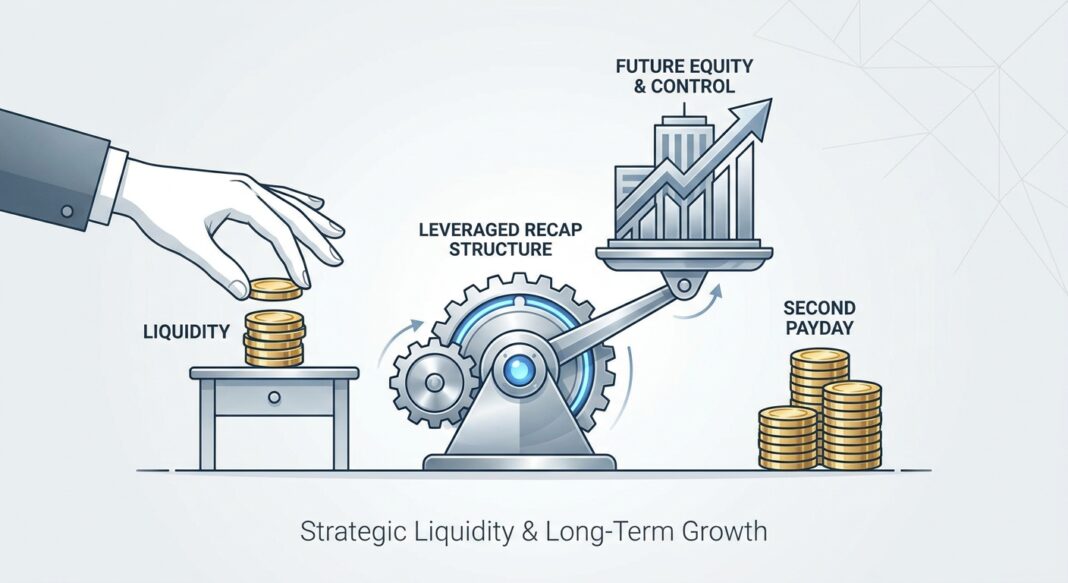
This is the problem that a well-structured leveraged recapitalization is designed to solve. And in November 2022, DeVore executed one.
The Decision: Three Paths, One Clear Winner
At DeVore’s stage (profitable, operationally mature, with strong regional brand equity and a platform positioned for M&A) the options were familiar. They are the same three options that face almost every founder of a cash-flowing lower-middle-market business at a similar inflection point.
Option 1: Full Sale. Hire a banker, run a process, maximize headline valuation, and exit completely. Clean. Simple. One check. But one check is also one outcome. Once you close, the compounding stops. You don’t benefit from the national platform you spent two decades building the foundation for.
Option 2: Growth Equity. Bring in an institutional equity partner at a minority stake. Keep control, but dilute meaningfully on a cap table that now carries investor board seats, liquidation preferences, and a fund lifecycle clock that may not align with how a founder thinks about building for the long term.
Option 3: Leveraged Recapitalization. Bring in a structured equity and debt partner, extract partial personal liquidity today, and continue running the business with a retained equity stake, while accessing institutional capital and acquisition firepower to accelerate what comes next.
DeVore chose the third path. He partnered with Shoreline Equity Partners, a Jacksonville-based lower middle market private equity firm with over $750 million of committed capital under management, focused on equity investments in businesses with enterprise values between $50 million and $350 million.
The structure was purpose-built: Shoreline made a recapitalization investment that provided DeVore with meaningful personal liquidity, diversifying a net worth that had been entirely concentrated in one illiquid asset, while DeVore retained a significant ownership stake and continued to lead the company as Founder and CEO. He didn’t exit. He didn’t cede control. He de-risked his personal balance sheet while keeping both hands on the wheel of a business that was about to shift into a higher gear.
The capital injected through the recap wasn’t just for personal liquidity either. The new partnership gave Core Roofing both the acquisition experience and access to capital needed to partner with other leading commercial roofing businesses across the U.S., a buy-and-build mandate DeVore could not have executed at the same pace on a single-founder balance sheet.
The Outcome: The Founder Who Earned Two Paydays
The post-recap trajectory of Core Roofing Systems tells the story more clearly than any term sheet.
Within the first year of the partnership, Core acquired McCurdy-Walden, a respected Florida-based operator, expanding the platform’s presence in North Florida. The acquired company’s leadership, consistent with the model, reinvested proceeds and stayed to run their business as a regional sub-platform within Core.
In June 2024, Core announced its partnership with PB Roofing (Peck Brothers, LLC), a Northeast and Mid-Atlantic commercial roofing firm with a 17-year track record. This deal extended Core’s footprint from the Southeast into a new geographic corridor, a move that would have been capital-prohibitive without the institutional backing unlocked by the recap.
Then, in early 2026, Core announced a third acquisition: Norman Roofing, extending the platform’s reach into the Gulf Coast region. DeVore remained publicly in the CEO seat, setting the growth agenda. The business had transformed from a respected 180-person Southeast operator into a multi-regional commercial roofing platform executing a deliberate buy-and-build strategy.
Now consider the counterfactual. Had DeVore sold the business outright in November 2022, he would have received a single check reflecting the value of a 180-person regional roofing company, a meaningful number, but a fixed one. By retaining a significant stake through the recapitalization, he holds equity in a platform that now spans four distinct geographic corridors, with multiple add-on acquisitions completed, and a track record of disciplined M&A execution that commands meaningfully higher exit multiples than a standalone regional operator.
The math of the "second bite at the apple" is the central engine of the leveraged recap model. The founder who takes partial liquidity and retains meaningful equity through a growth cycle may receive a far larger total payout across two events, with full operational control of the value creation between them. Liquidity and ownership are not mutually exclusive. DeVore proved it.
The Lessons: A Framework for Founders Facing the Same Decision
The Core Roofing story is not an anomaly. It is a repeatable structure available to any founder with a profitable, cash-flowing business and a clear growth thesis. But extracting the right lessons requires precision.
Lesson 1: Illiquidity Is a Risk, Not a Virtue
Founders who treat personal concentration as a form of conviction are conflating faith in their business with sound personal financial management. A leveraged recap is not a signal of doubt; it is a signal of sophistication. Diversifying personal wealth while retaining operational control is the rational move.
Lesson 2: The Recap Clock Is Different From the VC Clock
Venture capital operates on fund lifecycles, typically 10-year vehicles with pressure to return capital by Year 7 or 8. That creates structural misalignment with founders who think in decades. The leveraged recap with an aligned lower-middle-market PE partner, by contrast, is designed around a shared growth thesis, not a fund distribution schedule. PE firms favor recaps over full acquisitions because founder alignment typically compounds returns.
Lesson 3: Private Credit Has Fundamentally Shifted the Landscape
The structural availability of this option has never been stronger. Private debt accounted for 77% of global leveraged buyout financing in 2024, its highest annual share since at least 2015, and continued to dominate into 2025. Banks have retreated from leveraged lending due to regulatory pressure, and private credit funds have filled that gap with flexible, bespoke structures. The market that enables recapitalizations at the lower middle market level is deeper and more competitive than it has ever been, which means better terms for borrowers.
Lesson 4: Know When This Doesn’t Work
The leveraged recap is not a universal solution. It requires stable, predictable EBITDA to service the debt component of the structure. Businesses with lumpy revenue, high customer concentration, or significant operational risk do not fit the profile. The private credit market has become selective, strong businesses with clean cash flows command the best terms; weaker profiles face higher pricing or are simply declined. The structure rewards operators, not storytellers.
The Decision Framework
When evaluating whether a leveraged recapitalization is the right path, founders should ask four questions: (1) Is my EBITDA stable and predictable enough to service structured debt? (2) Do I genuinely want to remain operationally involved for the next 3–7 years? (3) Is there a credible growth thesis (organic or M&A) that a capital partner can accelerate? (4) Is my personal financial concentration reaching a level where the next major risk in my life is binary? If the answer to all four is yes, the recap deserves serious consideration before any full-sale process begins.
Key Insights
- Liquidity and ownership are not mutually exclusive. A well-structured leveraged recapitalization allows founders to extract real, diversified wealth today while retaining meaningful upside exposure to the company’s next chapter, producing two distinct liquidity events instead of one.
- The private credit market is structurally deeper than at any prior point. Private debt accounted for 77% of global LBO financing in 2024 and over 83% of early-2025 transactions, making bespoke debt structures more accessible than ever for qualified lower-middle-market borrowers.
- The "second bite at the apple" compounds dramatically with platform M&A. A founder who retains equity through a buy-and-build strategy holds a stake in a larger, more diversified, and more institutionally valued business at the second exit, not the same company they partly sold at the first.
- Alignment with the right capital partner matters more than the structure itself. The Core Roofing model succeeded because Shoreline’s lower-middle-market thesis, operational approach, and hold-period expectations aligned with how DeVore wanted to build. Structure is a vehicle; alignment is the engine.
- The cost of full dilution (through either a full sale or a VC stack) is permanent. Venture capital rounds introduce liquidation preferences, anti-dilution provisions, and fund clocks that structurally erode founder economics at exit. Non-dilutive and partial-dilution structures leave the cap table and the founder’s long-term economics materially more intact.


