
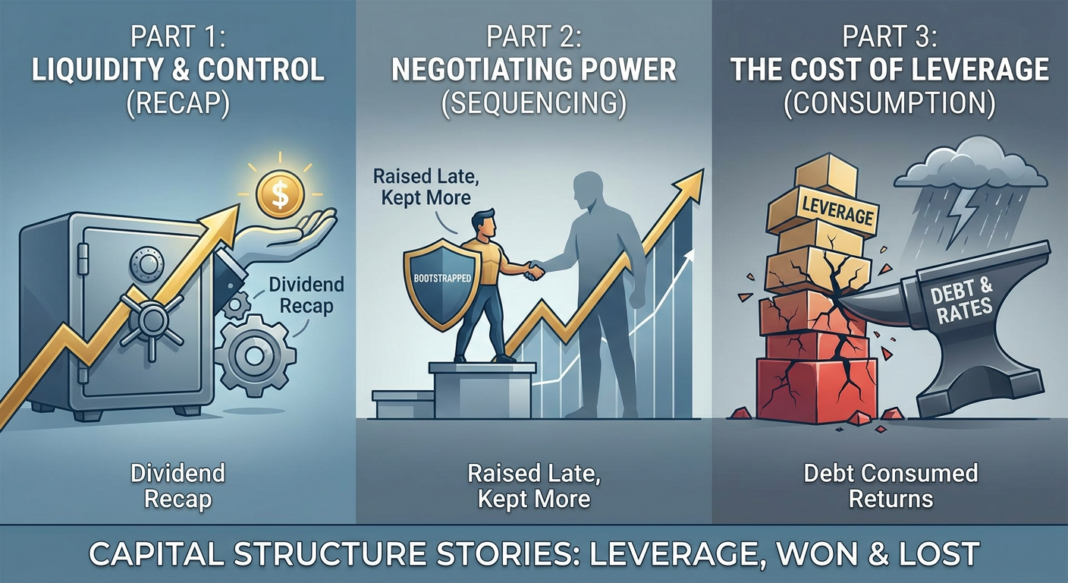
Part One: The Founder Who Got Paid Without Selling
Sandra had built exactly the kind of business that business school professors describe as the goal and most founders never actually reach. A regional B2B services company. Six million dollars in trailing EBITDA. Predictable recurring revenue. A workforce that showed up. Margins that held.
And yet, in practical terms, Sandra was broke.
Not broke in the way that means the business is failing. Broke in the way that means every dollar of value she had created over fourteen years was locked inside an illiquid asset she couldn’t touch without selling it. Her net worth lived on a spreadsheet. Her bank account did not reflect it. And the conventional paths to liquidity (selling the company outright, bringing in a private equity partner, or pursuing a minority equity raise) all carried the same quiet tax: dilution, loss of control, or an exit clock imposed by someone else’s fund cycle.
What Sandra’s CFO introduced her to instead was a leveraged dividend recapitalization: a unitranche credit facility sized at $14M, approximately 2.3x her trailing EBITDA, structured by a private credit lender against her existing, proven cash flows. The proceeds funded an $8M special dividend wired directly to Sandra’s personal account, retired $2M in existing balance sheet debt, and left $4M in operating reserves for the business. Nine weeks from first conversation to funded close. Sandra retained 100% of her equity. No board seats changed hands. No new partners appeared at the Monday morning meeting.
“She still owned 100% of her company. She still showed up on Monday morning.”, bondtv.vaultai.ca
Eighteen months later, her EBITDA had grown to $7.1M. A tuck-in acquisition of a competitor’s service routes, funded from those operating reserves, had expanded her footprint. Her leverage ratio had naturally declined from 2.3x to 1.97x EBITDA. She was already in conversation about a second facility.
The equity dilution she never took wasn’t a one-time cost avoided. It was a compounding cost avoided. Every percentage point of ownership she didn’t surrender in Year One continued to appreciate silently as the business grew. The private credit lender’s incentive was straightforward: they needed her to keep operating well, because their return depended on it. No exit clock. No misaligned timeline. Debt, sized conservatively against real cash flows, with interests fully aligned.
Note: The Sandra scenario above is a hypothetical case study constructed to illustrate real market mechanics. Numbers are based on current private credit market benchmarks. Source: bondtv.vaultai.ca.
Part Two: The Founder Who Raised $184M and Still Kept 49%
In 2026, Danone paid €1 billion for Huel, the UK-based complete nutrition brand that began life mixing powdered food in a Northamptonshire kitchen. When the proceeds distributed, Julian Hearn, Huel’s founder, received £420 million personally. That represented 49.3% of the exit. He had raised $184 million across three institutional rounds to get there.
The number defies conventional startup math. Most founders who raise that much capital across three rounds arrive at exit owning somewhere between 15% and 25%. Hearn arrived at 49.3%. The difference is not luck. It is sequencing.
Hearn bootstrapped to £18 million in revenue before approaching a single institutional investor. By the time he sat across from a term sheet, he wasn’t funding a hypothesis; he was pricing a proven operation. That shifts negotiating power dramatically. Investors were no longer buying a story; they were buying into a machine that was already working. Hearn raised what he needed, not what the market was willing to give him, and he structured each round to preserve controlling ownership through every dilution event.
Danone ultimately paid approximately 17–20x EBITDA for the business, a premium multiple even as Huel’s revenue growth had slowed to around 17% in the preceding period. That premium, according to public reporting, is directly attributable to the unit economics Hearn built over a decade of capital discipline: margins that expanded through vertical integration, marketing efficiency that improved as the brand matured, and a path to profitability that most VC-backed DTC brands never reach.
His investors made strong returns alongside his £420M personal exit, underscoring what is often obscured in founder-versus-investor narratives: equity preservation and investor returns are not zero-sum when the underlying business is built properly. The tension only emerges when founders dilute early, at low valuations, for capital they didn’t yet need, and then spend a decade watching someone else compound the equity they gave away.
Sources: creatorsblueprint.co | bondtv.vaultai.ca
Part Three: When Leverage Becomes the Master
Patrick Drahi bought SFR, France’s second-largest telecom operator, for 17 billion euros in 2014. He sold it in 2026 for 20 billion euros. He walked away with approximately 4 billion euros. The asset appreciated. His return on equity was catastrophic. The difference between those two facts is the entire story of leverage used as a permanent operating philosophy rather than a precision tool.
Drahi’s model was internally coherent. Telecom companies generate predictable cash flows. Predictable cash flows support large debt loads. Large debt loads let you acquire more telecom companies, whose cash flows support more debt. The loop works, until two things stop being true simultaneously: interest rates staying low enough that refinancing is cheap, and the underlying businesses not deteriorating faster than principal repayment.
When rates surged after 2022, both conditions broke at once. What followed was a 18-month restructuring that culminated in October 2025 with the largest debt restructuring in European history: 8.6 billion euros of debt eliminated, total obligations reduced from 24 billion to 15.5 billion euros, and maturities extended out to 2033. The price was 45% of Altice France’s equity, handed directly to creditors including BlackRock, Fidelity, and Pimco.
“The asset was fine. What nearly destroyed the empire was the capital structure sitting on top of the asset.”, thesynthesisai.substack.com
SFR still has 20 million customers. It still generates billions in revenue. The mobile market in France is not dying. Drahi’s mistake was not the business; it was the assumption that the interest rate environment of 2014 was a permanent feature of the world rather than a temporary one. He built a capital structure calibrated to a single macroeconomic scenario, and when that scenario changed, the debt he had positioned as the engine of his empire became its governor.
He bought at 17 billion. He sold at 20 billion. He kept less than a quarter of the proceeds. The business earned its keep. The leverage charged rent for twelve years and then presented the final bill.
The Lessons These Three Stories Share
Read together, Sandra’s recap, Hearn’s exit, and Drahi’s restructuring draw the same line from three different directions. Leverage is not inherently amplifying or destructive. It is a function of sizing, sequencing, and scenario discipline.
Sandra’s recap worked because the debt was sized to existing, proven cash flows, not to a projection. At 2.3x EBITDA, the structure left meaningful debt service coverage and operating headroom. The lender’s return depended on her continued operation. Incentives aligned, leverage served the owner.
Hearn’s outcome demonstrates that the leverage principle extends beyond formal debt instruments into negotiating power itself. By bootstrapping to real revenue before raising, he borrowed credibility from the market to negotiate equity terms that most founders never access. He used capital discipline as leverage in the truest sense.
Drahi demonstrates what happens when leverage is treated as a permanent feature of a business model rather than a tool with specific use cases and boundaries. The instrument that made the acquisition possible became the instrument that consumed the return. The debt was not wrong in 2014. It was never revisited seriously enough when the world it was built for changed.
For owner-operators and founders evaluating capital decisions today, these three stories converge on a framework: size debt to demonstrated cash flows, not projections. Raise equity late, at strength, and only what you need. Stress-test your capital structure against the rate environment you did not plan for. And understand that the compounding cost of equity diluted away early is not a line item on a term sheet; it is a decade of value that belongs to someone else.
Key Insights
- A dividend recap is founder liquidity without a buyer: Sized conservatively at 2x–4x EBITDA against proven cash flows, a unitranche facility can deliver meaningful personal liquidity while preserving 100% ownership and operational control, no exit required.
- Bootstrapping is a negotiating instrument: Julian Hearn’s decision to reach £18M in revenue before raising institutional capital transformed his position from supplicant to negotiator, and the compounding value of that shift was £420M at exit.
- Equity dilution is a compounding loss, not a one-time cost: Every percentage point of ownership surrendered in early rounds continues to appreciate in the hands of whoever holds it, the true cost of early dilution is not visible on a term sheet but accumulates silently over years.
- Leverage fails when sized to a single macro scenario: Drahi’s model was internally coherent under one interest rate regime and catastrophically fragile under another. Capital structures must be stress-tested against environments they were not designed for.
- Aligned incentives are the hidden variable: Private credit lenders who depend on continued operations and founder-led recaps share incentives with the owner-operator. PE funds with fixed exit timelines do not. The structure of the capital relationship shapes behavior as much as the cost of capital does.


