
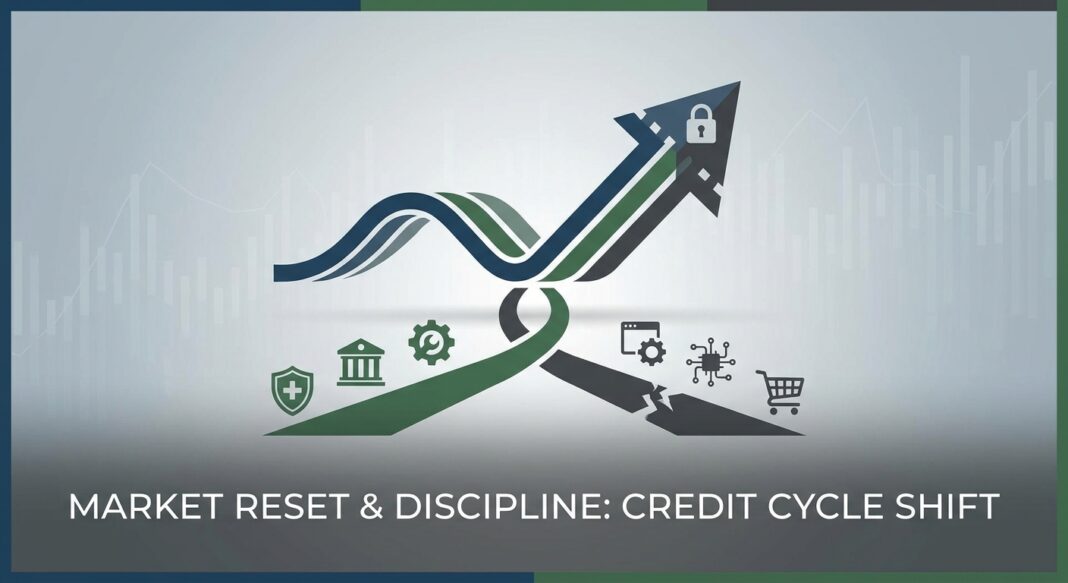
Market Headline: The Credit Cycle Has Turned, And It Is Rewarding Discipline
After two years of compressed spreads, permissive covenant packages, and abundant capital chasing limited deals, private credit markets have entered a decisively lender-friendly reset in 2026. Three converging forces (geopolitical volatility, AI-driven disruption of legacy software business models, and a wave of BDC redemption requests) combined in Q1 2026 to reprice risk across leveraged finance markets. The result is a structurally improved environment for disciplined lenders with available capital, and a materially more challenging landscape for borrowers carrying legacy leverage or sector-concentrated exposure.
According to Lord Abbett’s Midyear 2026 Outlook, spreads have widened by roughly 50 to 100 basis points since late 2025, while defensive terms have also improved, according to PitchBook. Critically, new loans are increasingly coming with better credit structures: less leverage, more covenants, fewer PIK requests, and tighter documentation.
At the macro level, the Federal Reserve’s April 2026 Senior Loan Officer Opinion Survey (SLOOS) confirmed the shift. Survey respondents reported, on balance, tighter lending standards and basically unchanged demand for commercial and industrial (C&I) loans to firms of all sizes, while banks reported basically unchanged lending standards and weaker or basically unchanged demand for commercial real estate (CRE) loans. Further, the SLOOS highlighted a new surveillance focus: banks reported, on net, tighter standards for all categories of non-depository financial institution (NDFI) loans over the past year, with significant net shares of banks reporting tighter standards for NDFI loans to business credit intermediaries and consumer credit intermediaries.
By Q3 2026, the Fed’s SLOOS data showed the net percentage of banks tightening standards for C&I loans to large and middle-market firms stabilized at 0.0%, a marginal improvement from prior quarters, suggesting the acute tightening phase may be plateauing even as standards remain elevated historically. For small firms, however, the Q3 2026 SLOOS reading held at 1.8%, indicating continued selective pressure on smaller borrowers.
The macro backdrop is equally constraining. Three-month Term SOFR sits at approximately 3.68%, while five-year U.S. Treasury yields have risen to approximately 4.23%, up from 3.92% in March, with market expectations continuing to reflect a higher-for-longer rate environment, with the forward curve broadly flat as of June 2026. This rate environment sustains all-in yields on new private credit originations at elevated levels, even as credit spreads drive additional return.
Quantitative Market Snapshot
The following data box consolidates the most current available market metrics across key credit KPIs. All figures are sourced from institutional indices and primary research published in 2026.
| Metric | Current Value | Prior Period | Change | Source |
|---|---|---|---|---|
| Middle Market Private Credit Spreads (core) | SOFR + ~500 bps | SOFR + mid-400 bps (late 2025) | +50–100 bps | Hamilton Lane, 2026 |
| Lower Middle Market Spread Premium vs. Large-Cap | +232 bps premium | Narrower in prior quarters | Widening | Avante Capital / PitchBook LCD |
| B-Minus BSL Spreads (broadly syndicated) | SOFR + 409 bps | SOFR + ~354 bps (Q1 2026) | +55 bps | Sikich Q2 2026 Credit Update |
| Software Secondary Spreads vs. Broad B-Rated Loan Index | ~+229–245 bps above index | Broadly in-line (year-end 2025) | Significantly wider | VRC Q2 2026 / PitchBook LCD |
| Private Credit Default Rate (Proskauer Index, Q2 2026) | 2.51% (Q2 2026) | 2.73% (Q1 2026); 1.84% (Q3 2025) | Slight improvement QoQ | Proskauer, July 28, 2026 |
| Fitch Broader Private Credit Default Rate | 6.0% (April 2026) | 9.2% full-year 2025 | Definitional divergence vs. Proskauer | Forbes / Fitch Ratings, May 2026 |
| Private Credit vs. HY Bond Spread Premium | ~150–200 bps over HY | ~350 bps premium (2019) | Compressed significantly | Owners.pe, April 2026 |
| 5-Year U.S. Treasury Yield | ~4.23% | 3.92% (March 2026) | +31 bps | VRC Q2 2026 |
| High Yield (HY) Option-Adjusted Spread | ~308 bps (March 2026) | Post-cycle lows late 2024 | Widening in 2026 | Universal Value Advisors, March 2026 |
| FCCR Minimum Threshold (New Originations) | >1.2x–1.5x at close | More permissive in 2023–2024 | Tightened | Bond Capital Mid-2026 Intelligence |
Data Box: Sources cited individually. All figures represent most recently published data as of September 25, 2026. Spread levels reflect institutional market observations and may vary by deal size, sector, and sponsor quality.
On the KPI frontier, the fixed charge coverage ratio (FCCR) has become the most closely watched underwriting metric of the cycle. As SOFR has declined from its 2023 peak and EBITDA recovery accelerates among PE-backed borrowers, lenders are increasingly requiring FCCR above 1.2x–1.5x at close for new credits. The leveraged loan distressed ratio is also flashing amber: Hamilton Lane flags the leveraged loan distressed ratio reaching 8.89% in February 2026, up from the 4–5% range prevailing through most of 2025, a leading indicator of future default pressure that underwriters cannot ignore.
The spread between private credit and public high yield has materially compressed. In 2019, private credit offered approximately 350 bps of spread over public high yield for comparable risk; today, that spread has compressed to approximately 150–200 bps. This compression demands that institutional investors scrutinize whether the illiquidity premium (estimated at 75–150 bps in normal markets and 200–400 bps in stress conditions) is being adequately compensated in current deal terms.
Sector Analysis: Rotation From Software to Healthcare, Infrastructure, and Asset-Backed Finance
The most consequential structural shift in credit markets in 2026 is sectoral. Software’s share of broadly syndicated loan issuance has fallen to just 8.8% year-to-date, down from 17.6% in 2025 and its lowest level since 2013. In its place, healthcare has become the largest sector for institutional loan issuance for the first time since 2015, capturing a record 12.4% of volume. This rotation is not merely cyclical; it reflects a structural reassessment of AI-driven disruption risk within legacy software business models.
Sector leadership remains fluid: Healthcare’s rise and software’s retreat may prove to be more than a temporary rotation. AI-driven disruption of legacy software business models increasingly looks like a structural credit story rather than a cyclical one, requiring lenders to underwrite technology risk with sharper scrutiny.
In private debt fundraising, the structural rotation away from core direct lending is even more pronounced. Direct lending’s share of private debt fundraising fell from 58.4% in 2024 to 31% by Q1 2026, with capital flowing into infrastructure debt, real estate credit, special situations, and other asset-backed opportunities. This rotation reflects both cyclical and structural drivers: tighter underwriting in core corporate credit, investor demand for collateral-backed structures, and strategy diversification to manage liquidity profiles.
Asset-backed finance (ABF) is emerging as the primary beneficiary. Specialty finance has been the main beneficiary of this rotation, raising $37 billion in 2025 (more than the previous two years combined, and second only to direct lending’s $79 billion) after accounting for just 5% of private credit fundraising as recently as 2023.
On the forward-looking side, priority sectors for institutional capital include energy infrastructure, digital infrastructure, defense and national security, and next-generation manufacturing, all requiring patient institutional capital. In Europe, fund managers such as Apollo Global Management and Ares Management have cited a "substantial origination opportunity" as European countries ramp up infrastructure and defense spending, with the implementation of Basel IV expected to drive a major shift away from bank lending, currently around 70% of total lending in Europe, toward private debt funds.
Healthcare deserves particular attention as a durable credit destination. In healthcare, demographic shifts and non-cyclical service models continue to attract lenders seeking stable cash flows, with the sector commanding spreads near SOFR+500 bps in recent direct lending deals, a premium reflecting both the sector’s strength and the broader repricing of risk. Software, by contrast, now demands case-by-case analysis: secondary spreads in software are approximately 245 basis points wider than year-end levels and roughly 229 basis points above the broader B-rated loan index, reflecting continued uncertainty related to AI-driven disruption.
Implications for Institutional Investors and Business Operators
For Institutional Investors and Lenders
The current reset presents a structurally improved origination environment, but only for those with capital, discipline, and sector expertise. While competition remains strong for the highest-quality borrowers, today’s market increasingly rewards lenders with broad origination capabilities and the flexibility to provide customized financing solutions. A more active market gives lenders more to choose from, but stronger deal flow is usually only helpful if a manager has the ability and discipline to say no.
The definitional gap in default rate reporting demands due diligence discipline. Fitch, applying a broader definition, reported the U.S. private credit default rate reaching a record 6.0% in April, while Moody’s estimated that distressed restructurings (debt exchanges and maturity extensions agreed under pressure) accounted for roughly 65% of all private credit defaults in 2025. Investors who rely on headline Proskauer figures alone (which show a default rate of 2.51% for Q2 2026, down from 2.73% in Q1) without accounting for amend-and-extend activity may be underestimating portfolio stress. Rising payment-in-kind income at business development companies is an additional early-warning signal.
The OCC has taken formal notice: the OCC’s Spring 2026 Semiannual Risk Perspective made private credit a discrete area of focus for the first time, citing bank exposures, concentrations, refinancing risk, and PIK structures that obscure underlying credit quality. Regulatory scrutiny will intensify, and lenders relying on PIK-heavy structures or covenant-lite terms from 2021–2022 vintages face elevated headline and reputational risk.
Many long-term allocators, including pension plans and insurers, continue to increase exposure to private credit, attracted by the asset class’s combination of income generation, diversification benefits, and historically attractive risk-adjusted returns in a higher-rate environment. The Cliffwater Direct Lending Index returned 9.3% in calendar 2025, against a twenty-year average of 9.5%, with interest income carrying the return at 10.4%. However, the index posted 3.0% for the first half of 2026 and 7.7% for the trailing year to June 30, still ahead of investment-grade corporates, but well short of the double-digit figures the asset class was marketing two years ago.
For Business Operators and Borrowers
The era of borrower-friendly terms is over in all but the largest, highest-quality deals. No direct-lender LBO over $2 billion has closed since early March, while spreads on "down-the-fairway" deals have widened 25 to 50 basis points as lenders reset terms in a more cautious environment. Operators approaching the debt markets in H2 2026 should expect more rigorous FCCR scrutiny, tighter covenant packages, and heightened sensitivity to sector exposure: particularly for any business with material software, energy-intensive, or consumer discretionary revenue concentrations.
Sponsors that have used the slower deal environment to strengthen financial reporting, improve operating performance, and present a credible long-term growth strategy continue to find capital available. Businesses with demonstrable pricing power, recurring revenue, and defensible EBITDA margins in non-cyclical sectors remain well-financed. Despite near-term uncertainty, lender demand remains strong and the market backdrop continues to favor high-quality borrowers, with higher risk premiums for AI-, tariff-, and cycle-exposed assets.
Forward-Looking View: Liquidity and Lending Dynamics, H2 2026–Q2 2027
The credit cycle is not broken; it is bifurcating. The defining question for the balance of 2026 is not whether the cycle turns, but which side of the market’s growing bifurcation each borrower, sponsor, and lender occupies when it does.
On the positive side, deal flow is normalizing. Middle market private equity activity has shown signs of improvement, with deal value increasing approximately 10.7% year-over-year and exit activity rising 14% over the same period, according to PitchBook data, suggesting a gradual normalization in transaction activity. Projections call for around 10,000 private equity deals totaling $1.4 trillion in 2026, with AI, infra-tech and professional services expected to feature prominently.
The structural shift toward asset-backed and specialty finance strategies will deepen. Strategies beyond direct lending (most notably asset-backed finance and credit secondaries) scaled rapidly, absorbing capital that is seeking diversification away from a compressed core market. The private credit market, with direct lending now matching the broadly syndicated loan market at $1.5–2 trillion in size, is forecast to reach $3 trillion by 2028, but that growth will increasingly be driven by collateral-backed and hybrid structures rather than core corporate direct lending.
Liquidity management will remain a defining operational challenge. Average loan duration has risen from approximately two to three years to four to five years as exit activity has dried up in private equity, with private credit fund managers increasingly using multi-asset continuation vehicles and strip sales to "clean up" mature, performing portfolios and provide liquidity to allocators. Investors in semi-liquid structures should anticipate continued redemption friction through at least mid-2027.
For those with dry powder and sector discipline, this environment is historically compelling. Periods of volatility often present compelling opportunities for private credit, as banks tend to retrench, making way for better pricing and structure for private credit lenders. The combination of wider spreads, stronger documentation, and more conservative leverage structures means that vintages originated in 2026 may rank among the strongest risk-adjusted opportunities the asset class has produced since 2022.
Key Market Insights
- Spreads Have Reset Materially: Middle market private credit spreads have returned to the SOFR+500 context after trading in the mid-400s through much of 2025. Lower middle market borrowers face an additional 232 bps premium over large-cap peers: a gap that is widening, not narrowing, as capital concentrates in the upper market. (Sources: Hamilton Lane; Avante Capital / PitchBook)
- Bank Standards Remain Elevated, SLOOS Signals Selective Easing: The April 2026 Fed SLOOS confirmed continued tightening across C&I and NDFI loan categories. While Q3 2026 SLOOS data shows the net tightening rate for large and middle-market C&I loans has stabilized at 0.0%, small firms still face a positive net tightening reading of 1.8%, sustaining the structural opportunity for private lenders in the lower middle market. (Source: Federal Reserve SLOOS, April & Q3 2026)
- Default Rates Are Stabilizing, But Definitional Divergence Is a Risk: The Proskauer Index shows defaults declining to 2.51% in Q2 2026 from a Q1 peak of 2.73%, but Fitch’s broader methodology registers 6.0%, a gap driven largely by amend-and-extend restructurings. Investors must understand which definition their manager uses and whether PIK-heavy positions are masking deterioration. (Sources: Proskauer Q2 2026; Forbes / Fitch, May 2026)
- Sector Bifurcation Is Structural, Not Cyclical: Healthcare has overtaken software as the largest institutional loan sector for the first time since 2015. Direct lending’s share of private debt fundraising has collapsed from 58.4% to 31% in 18 months, with specialty finance, infrastructure debt, and asset-backed strategies absorbing the reallocation. Energy infrastructure, defense, and digital infrastructure are the priority origination sectors for H2 2026. (Sources: Sikich Q2 2026; Investing.com / PitchBook)
- FCCR and Covenant Quality Are the New Underwriting Battleground: Lenders are now requiring FCCR above 1.2x–1.5x at close, with stricter net leverage definitions and fewer EBITDA add-backs. The OCC has flagged PIK structures and covenant-lite terms for the first time in its Spring 2026 Risk Perspective. Operators with leverage predicated on 2021–2022 EBITDA assumptions and interest costs should stress-test coverage ratios under a +100 bps rate shock scenario immediately. (Sources: Bond Capital Mid-2026 Intelligence; OCC Spring 2026 Risk Perspective)
Bond Capital | Market & Sector Intelligence | Published: September 25, 2026 | Data current as of publication date. This article is market intelligence reporting and does not constitute investment advice.


