
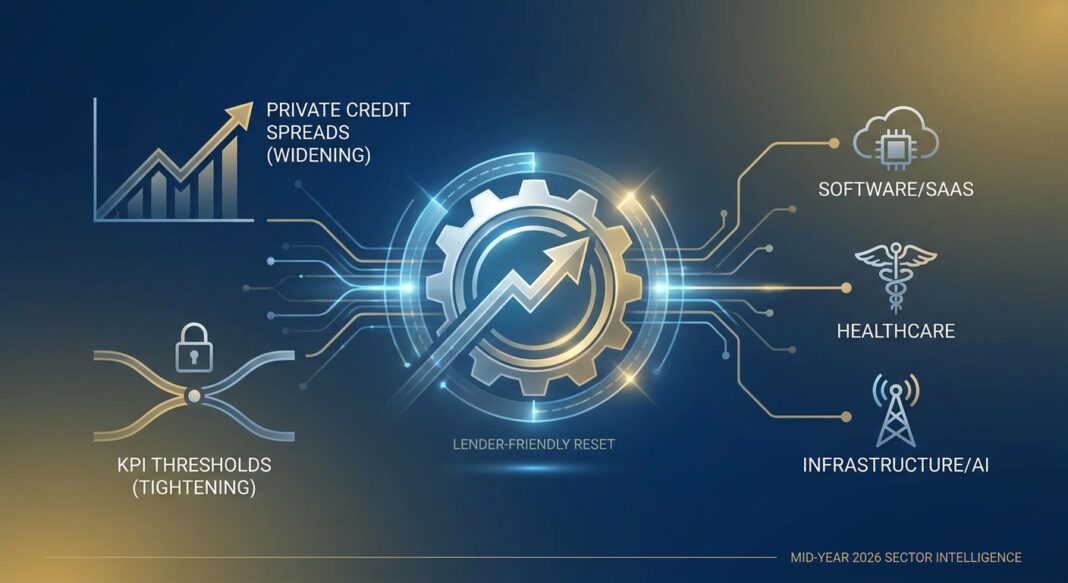
Macro to Micro: A Lender-Friendly Repricing Is Underway, but Dispersion Is the Real Story
Private credit is navigating one of its most consequential inflection points since the asset class reached mainstream scale. After years in which borrower-friendly conditions (tight spreads, loose covenants, and elevated leverage) prevailed, a meaningful regime shift is now underway. Spreads on middle-market direct lending loans have widened by roughly 50 to 100 basis points since late 2025, driven by macro volatility, geopolitical risk, and an AI-disruption-led repricing of software credit, according to PitchBook data cited by Lord Abbett.
The macro backdrop is unambiguous in its direction: the Federal Reserve held its federal funds target at 3.50%–3.75% through Q1 2026, and forward rate markets are now pricing an extended higher-for-longer trajectory, with longer SOFR rates expected to stabilize near 4.00%: versus expectations of roughly 3.00% just six months ago, per Valuation Research Corp. (VRC). Simultaneously, the Federal Reserve’s April 2026 SLOOS confirmed that domestic bank C&I lending standards tightened across firms of all sizes in Q1, deepening a private credit origination window that has been expanding since 2022.
Yet the headline spread move does not tell the full story. The more structurally significant development is a qualitative reset in how new loans are being underwritten: less leverage, more maintenance covenants, fewer PIK (payment-in-kind) provisions, and tighter documentation, all of which improve the risk-adjusted position of disciplined lenders deploying fresh capital today. The second half of 2026 will be defined not by broad asset-class performance, but by dispersion: between vintage quality, sector exposure, manager discipline, and documentation rigor.
Quantitative Market Snapshot
The table below consolidates key market metrics as of mid-year 2026, with prior-period comparisons and direct source links. Together, these data points frame the current rate, spread, and credit-quality environment.
| Metric | Current Value (Mid-2026) | Prior Period | Change | Source |
|---|---|---|---|---|
| Middle-Market Unitranche Spread | SOFR + 475–550 bps (~25 bps above year-end) | SOFR + 450–525 bps (YE 2025) | +~25 bps | VRC Q2 2026 |
| Software Sector Loan Spreads (Secondary) | ~245 bps wider than YE 2025; ~229 bps above broad B-rated index | In line with B-rated index (YE 2025) | Significant widening | VRC / PitchBook LCD, June 19, 2026 |
| 3-Month Term SOFR | 3.68% | ~3.50% (YE 2025) | +18 bps | VRC Q2 2026 |
| 5-Year U.S. Treasury Yield | ~4.23% (June 2026) | ~3.92% (March 2026) | +31 bps QoQ | VRC Q2 2026 |
| Fed SLOOS: Banks Tightening C&I Standards (Large & Mid-Market Firms) | Net +8.1% (Q2 2026) | Net tightening in Q4 2025 (January SLOOS) | Continued tightening trend | FRED / Fed SLOOS, May 4, 2026 |
| Private Credit Default Rate (Proskauer Index, Q1 2026) | 2.73% (697 loans, $189.2B tracked) | 1.84% (two quarters prior) | +89 bps | Forbes / Proskauer Index, May 2026 |
| Public High Yield OAS (ICE BofA) | ~285 bps | Historically tight through early 2026 | Modest widening in risk-off periods | InvestmentGrade.com, 2026 |
| Middle-Market Private Credit Spreads (Headline) | SOFR + ~500 bps (S+500 context) | Mid-400 bps (mid-2025) | +~50–75 bps since mid-2025 | Hamilton Lane, April 2026 |
KPI Benchmarks in Focus: Against this rate and spread backdrop, lender underwriting thresholds have tightened. The minimum Debt Service Coverage Ratio (DSCR) floor across most commercial and direct lending structures remains at 1.25x, with DSCR levels above 1.40x unlocking better pricing and higher leverage allowances. The Fixed Charge Coverage Ratio (FCCR) (which captures all fixed obligations including leases and reserves) is typically set at ≥1.30x given its broader denominator. According to S&P Global’s Q2 2026 Private Credit & Middle Market CLO Quarterly, average leverage for U.S. middle-market companies reached 7x Debt-to-EBITDA in 2024, with a material share of companies already below 1x EBITDA interest coverage, a fragility the current higher-for-longer rate environment is now exposing. New loans in Q2 2026 are coming to market with structurally tighter terms: less leverage, more maintenance covenants, and fewer PIK provisions.
Sector-Specific Lender Appetite & Structural Shifts
Lender appetite is increasingly bifurcated by sector, with capital flows reflecting a clear risk-adjustment to AI disruption, rate sensitivity, and regulatory overhang. Below is Bond Capital’s sector-by-sector read as of July 2026:
🔴 Software & SaaS: Tighter Credit, Wider Spreads
Software is the most stressed segment in the current private credit cycle. Secondary spreads on software loans are approximately 245 basis points wider than year-end levels and roughly 229 basis points above the broader B-rated loan index, per PitchBook LCD data as of June 19, 2026. The disruption risk from generative AI to incumbent SaaS business models has triggered re-underwriting across the sector, with lenders now evaluating AI-impacted borrowers on a case-by-case basis. New software-related direct lending transactions are pricing at premiums of approximately 75–100 bps above standard benchmarks, per VRC. Morgan Stanley has warned that default rates in private credit direct lending could surge to as high as 8%, with pressure concentrated in this sector. Private credit has significantly higher software exposure than public markets, approximately 20% of private market AUM versus 13% in the liquid leveraged loan market, per PitchBook and Morningstar LSTA data.
🟡 Healthcare: High Volume, Elevated Scrutiny
Healthcare led all sectors in private credit deal volume in 2025, accounting for 19% of all direct lending transactions and notably was the only major industry that did not see meaningful spread compression, with pricing holding at approximately SOFR+500 bps in Q4 2025, per Octus Data. The sector’s appeal (non-cyclical cash flows, demographic tailwinds) remains intact. However, Morgan Stanley Investment Management flagged healthcare as leading all sectors in loans placed on non-accrual status, citing highly leveraged roll-up structures that are now straining under current rate levels. Lenders are differentiating sharply between well-managed provider platforms and covenant-light healthcare roll-ups.
🟢 Infrastructure, Energy & AI-Related Buildout: Strongest Appetite
Infrastructure and AI-adjacent physical buildout represent the most actively sought credit opportunities heading into H2 2026. Morgan Stanley estimates that private credit could supply more than half of the $1.5 trillion needed for global data center buildouts through 2028. In Europe, Apollo Global Management and Ares Management have cited a substantial origination opportunity as countries ramp infrastructure and defense spending, per With Intelligence. Asset-based finance (including infrastructure debt, real estate debt, and specialty finance) is rapidly gaining share, with BlackRock flagging asset-based financing as an area of “profound increase in opportunities” in 2026.
🟡 Industrials, Aerospace & Defense: Recovering Volume
Capital goods and industrial subsectors saw direct lending volumes dip to approximately 13% of deal count in 2025, from 15% in 2024, per Octus Data. However, aerospace, defense, and government services are emerging as a bright spot, driven by a high volume of M&A activity and government-related spending momentum. Lender appetite in this sub-sector is constructive and growing.
Regulatory Development: Leveraged Lending Guidance Rescinded
A significant structural regulatory shift occurred on December 5, 2025, when the OCC and FDIC jointly rescinded the March 2013 Interagency Guidance on Leveraged Lending, including all accompanying FAQs. Per Chambers & Partners, this creates greater flexibility for private credit lenders to underwrite a broader range of transactions and to develop institution-specific definitions of leveraged loans. The move may allow some lenders to compete at deeper leverage levels previously constrained by supervisory guidance, a development that warrants monitoring in the context of the current credit cycle.
Operational & Strategic Implications
For Borrowers
The borrower-favorable conditions of 2023–2024 (tight spreads, light covenants, generous leverage) are materially over for most segments. Sponsors and corporate borrowers seeking new financing in mid-2026 face an environment where FCCR minimums of ≥1.30x and DSCR floors of ≥1.25x are being enforced rigorously. Leverage is coming down from the 6–7x Debt/EBITDA levels that characterized the 2021–2022 vintage. As the Financial Stability Board’s May 2026 report noted, approximately 10% of middle-market CLO borrowers lack sufficient cash flow to cover interest payments, meaning borrowers in rate-sensitive, highly leveraged structures must proactively address capital structure risk before debt maturities force the issue. Hybrid capital solutions (preferred equity, structured mezz, PIK toggle alternatives) are gaining traction for 2020–2021 vintage deals facing capital structure pressure, per Octus.
For Institutional Investors & Lenders
The mid-2026 environment favors disciplined, well-capitalized lenders over those managing elevated redemption queues or concentrated sector exposures. Northleaf Capital observes that elevated BDC retail redemptions have led some large lenders to moderate activity, creating more attractive supply-and-demand dynamics for institutional capital that can transact decisively. Direct lending remains the dominant sub-strategy at 52% of global private credit AUM, per PitchBook / Morgan Stanley. Non-accruals, PIK usage, sector concentration, and 2021–2022 vintage exposure are the critical portfolio monitoring flags for H2 2026. The FSB’s May 2026 report identified four systemic vulnerability clusters: bank interconnections, borrower credit quality and valuation opacity, concentration and liquidity mismatches, and data gaps, all of which demand heightened due diligence from allocators deploying new capital.
Forward-Looking View: Liquidity & Lending Dynamics Through H2 2026
The macro signals for H2 2026 point to a continued higher-for-longer rate environment, with VRC noting that the forward SOFR curve remains approximately 50 basis points above year-end 2025 levels. This backdrop sustains the yield premium available to new private credit origination, but it also sustains stress on borrowers underwritten to lower rate assumptions.
Banks have begun gradually re-entering the upper middle market in Q2 2026, contributing to increased competition in larger deals and alleviating some spread pressure at the top end, per VRC. Meanwhile, middle-market private equity activity is showing early signs of recovery, with deal value up approximately 10.7% year-over-year and exit activity rising 14% in the same period, per PitchBook, suggesting a gradual normalization in transaction flow that should support H2 origination pipelines.
Morgan Stanley Investment Management expects new deal demand and a large refinancing wave to gradually overtake private credit supply over the course of 2026, an imbalance that would allow disciplined lenders to preserve structural terms and capture the illiquidity premium over public markets. Direct lending first-lien asset yields are expected to remain in the 8.0%–9.0%+ range, elevated by historical standards and well above public high yield OAS of approximately 285 bps when adjusted for the illiquidity premium. Private credit AUM is projected to grow toward $2.9–3.0 trillion by 2030, per Moody’s, with the next 18 months separating managers who built durable, covenant-protected portfolios from those who did not.
Key Market Insights
- Spreads Have Reset, and Structure Has Reset Further. Middle-market private credit spreads have widened 50–100 bps since late 2025. More importantly, new loan documentation is structurally tighter: more covenants, less leverage, fewer PIK provisions. Disciplined lenders deploying capital now have meaningfully better downside protection than 2021–2022 vintage peers. (Lord Abbett / PitchBook, June 2026)
- Bank Tightening Creates Origination Opportunity for Private Lenders. The Fed’s Q2 2026 SLOOS confirms a net 8.1% of domestic banks tightened C&I lending standards for large and mid-market firms. For well-capitalized private credit managers, this structural retreat is a primary source of new deal flow in H2 2026. (FRED / Fed SLOOS, May 2026)
- Software Exposure Is the Most Critical Portfolio Monitoring Variable. Software secondary spreads are 245 bps wider than year-end, and private credit holds roughly 20% of its AUM in the sector, versus 13% in public markets. FCCR and DSCR stress-testing on software-exposed positions is non-optional in the current environment. (VRC / PitchBook LCD, June 2026)
- Infrastructure and AI Buildout Are the Clearest Demand Tailwinds. Morgan Stanley estimates private credit could supply more than half of the $1.5 trillion needed for global data center buildouts through 2028. Lenders with origination capability in infrastructure debt, energy transition, and asset-based finance are best positioned. (Creative Planning / Morgan Stanley, 2026)
- Default Normalization Is Real, but Not Systemic. The Proskauer Private Credit Default Index reached 2.73% in Q1 2026 (up from 1.84% two quarters prior), and Fitch’s broader methodology places the true default rate at 5.8% for the 12 months through January 2026. Moody’s baseline GDP growth of ~1.5% leaves a narrow margin of safety before defaults accelerate. This is a credit-selection environment, not a crisis, but it demands issuer-level analysis over top-down allocation. (Forbes / Proskauer, May 2026; Moody’s, April 2026)


