
Bond Capital | Market & Sector Intelligence: July 4, 2026
The Lender-Friendly Reset: Credit Cycle Intelligence for H2 2026
Spread widening, covenant recovery, a Fed on hold, and an AI-driven sector bifurcation are collectively reshaping the credit landscape. Here is what institutional investors and operators need to know entering the second half.
Market Headline: A Structural Reset, Not a Systemic Break
The dominant story in credit markets entering H2 2026 is not crisis; it is recalibration. After years of borrower-favorable conditions in which spreads compressed, leverage crept higher, and documentation loosened, the market has pivoted decisively in lenders' favor. According to Lord Abbett's 2026 Midyear Investment Outlook, spreads have widened by roughly 50 to 100 basis points since late 2025, while new loans are increasingly structured with less leverage, more covenants, fewer PIK requests, and tighter documentation, a combination that makes today's environment “potentially more attractive for disciplined lenders than the tighter conditions that prevailed six months ago.”
Three macro forces have driven this reset. First, the U.S.-Iran military conflict, which broke in February 2026, spiked energy costs, stoked inflation, and induced a risk-off pivot across leveraged finance. Second, AI-driven disruption concerns have triggered a sharp reassessment of software sector credit quality, with secondary spreads for software names running approximately 245 basis points wider than year-end levels as of mid-June, per Valuation Research Corp. (VRC) Q2 2026 Private Markets Update. Third, redemption pressure in semi-liquid BDC vehicles forced selective capital providers to the sidelines, reducing competition for new transactions. McKinsey's Global Private Markets Report notes that BDC redemptions in Q4 2025 nearly tripled quarter-over-quarter, averaging 4.5% of NAV, with the rush continuing into Q1 2026.
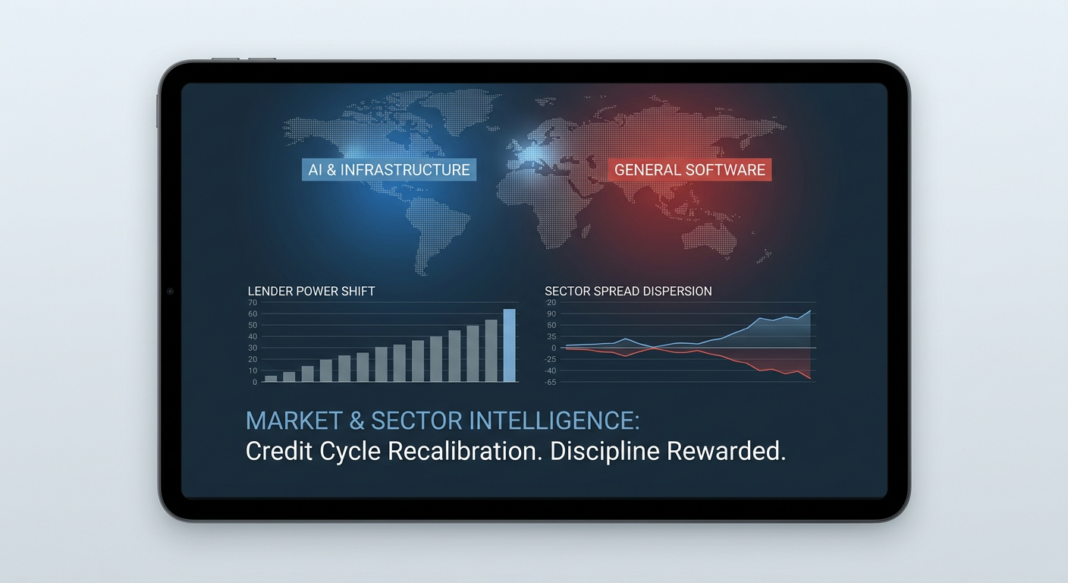
The net result is a market defined by dispersion and selectivity. Stress is real (particularly in 2021–2022 vintage loans and AI-exposed software credits) but it is company-specific, not systemic. Lenders with dry powder and underwriting discipline are operating in the best origination environment in several years. The second half of 2026 will reward those who can execute.
Quantitative Market Snapshot
| Metric | Current Value (Q2 2026) | Prior Period | Change | Source |
|---|---|---|---|---|
| Middle Market Unitranche Spread (SOFR+) | S+475 to S+550 bps (84.4% of new LBOs priced below S+550) |
~S+430 to S+475 bps (YE 2025) | +25 to +50 bps wider; further +25–50 bps expected | Capstone Partners / PitchBook Q1 2026 |
| Software Sector Secondary Spread Premium vs. B-Rated Loan Index | ~+229 bps above B-rated index (~+245 bps vs. YE 2025) |
Near parity with broad index (YE 2025) | Significant widening; case-by-case lender evaluation | VRC Q2 2026 Private Markets Update (PitchBook LCD data, June 19, 2026) |
| 3-Month Term SOFR | 3.68% (Q2 2026) Forward curve broadly flat; longer SOFR expected to stabilize ~4% |
~3.67% (Q1 2026); ~3% (late 2025 expectation) | +1 bp QoQ; materially higher than late-2025 rate-cut projections | VRC Q2 2026 Private Markets Update |
| 5-Year U.S. Treasury Yield | ~4.23% (June 2026) | ~3.92% (March 2026) | +31 bps in one quarter; higher-for-longer thesis reinforced | VRC Q2 2026 Private Markets Update |
| Fed SLOOS: Net % of Banks Tightening C&I Standards (Large & Mid-Market Firms) | +8.1% net tightening (Q2 2026) | Tighter standards reported Q4 2025 (Jan 2026 SLOOS) | Consecutive quarters of net tightening for firms of all sizes | FRED / Federal Reserve SLOOS, May 4, 2026 |
| New-Issue Direct Lending All-In Yield (Senior Secured First Lien, Mid-Market) | ~9.3% (2025 avg.); Q2 2026 expected yields up ~50 bps QoQ on rising SOFR curve | ~10.5% (2024 avg.) | Gradual compression on base rate, partially offset by spread widening in 2026 | McKinsey Global Private Markets Report, April 2026 |
| Average New-Issue Leverage Multiple (Direct Lending) | ~4.9x Debt/EBITDA (2025); lenders tightening forward FCCR underwriting | 5.0x (2024); 5.2x (2023) | Gradual deleveraging trend; FCCR constraints are binding | Kroll StepStone / McKinsey, April 2026 |
| Private Credit Estimated Default Rate Range (2025) | ~1.6% to 4.7% (incl. distressed exchanges); headline rate <2%; “true” rate approaches 5% with LMEs | Below 2% headline for several consecutive years | Stress is concentrated; not systemic | Moody's, April 2026 / With Intelligence |
KPI Watch: FCCR and Leverage Under Pressure
The higher-for-longer rate environment is structurally compressing borrower coverage ratios. Lincoln International documented that average FCCR among private credit borrowers had declined from 1.40x in Q1 2022 to a forward-projected 1.04x at sustained SOFR above 5%, effectively a “living paycheck to paycheck” scenario. While the Fed's 100 bps cut cycle in late 2024 provided modest relief, the rate pause now embedded in the forward curve means FCCR headroom remains thin. VRC notes that the average underlying corporate borrower's interest coverage ratio (EBITDA/interest) only marginally improved year-over-year, supported by lower rates and modest EBITDA growth. Lenders are responding by underwriting to a forward-looking FCCR that explicitly incorporates rate-path assumptions, a discipline that is constraining attainable leverage multiples and reshaping deal economics. Analysts at Private Equity Bro note that a 100 bps rate shock stress test across floating debt, combined with reclassifying 25% of planned capex as maintenance, will expose whether FCCR covenant definitions carry sufficient early-warning capacity, a critical diligence step in today's environment.
Sector Analysis: Where Lender Appetite Is Moving, and Where It Isn't
🔴 Under Pressure: Software & Technology Services
Software is the most consequential sector story of 2026. Lord Abbett notes that private leveraged finance markets have a ~20% allocation to software versus roughly 13% in the liquid leveraged loan market (per PitchBook and Morningstar LSTA data, as of December 31, 2025), making the asset class disproportionately exposed to AI-driven disruption risk. A large cohort of enterprise software transactions was financed between 2019 and 2022 at low rates, with borrowers that were pre-profitability and reliant on ARR-based lending structures. These vintages are now under stress as AI substitution pressure mounts and interest coverage ratios are strained.
Hamilton Lane identifies the key differentiation: lenders focused on deeply entrenched, mission-critical software with long-term contracts and lower LTVs are better positioned. General-purpose software models and seat-based subscription businesses facing potential AI-driven customer churn are the high-risk cohort. New software direct lending transactions are expected to price at premiums of approximately 75 to 100 bps above year-end levels, per VRC's Q2 2026 update. Lenders are evaluating AI-impacted borrowers on a case-by-case basis, and subordinated issuance in the sector remains severely limited.
🟡 Cautiously Active: Healthcare
Healthcare presents a two-sided picture. Demographic tailwinds and non-cyclical service models continue to attract lenders seeking stable cash flows, and large-cap sponsor activity remains robust: illustrated by Blackstone and TPG's $18.3 billion acquisition of Hologic, one of 2026's largest transactions, per PwC's 2026 Mid-Year M&A Outlook. However, Morgan Stanley Investment Management flags that healthcare has led all sectors in loans placed on non-accrual status over the past year, maintaining a meaningful underweight to the sector in its direct lending strategies. Lender selectivity within healthcare is therefore high, with a preference for revenue-cycle-resilient sub-sectors over fee-for-service models exposed to payer-mix risk.
🟢 Actively Favored: Infrastructure, Energy Transition & AI Build-Out
Infrastructure and AI-related physical assets represent the most structurally compelling lending opportunity of the cycle. McKinsey highlights that infrastructure credit has emerged as a particularly fast-growing segment of asset-backed finance (ABF), driven by the enormous capital requirements of the AI build-out, including data centers, fiber networks, and power generation. Meta's $29 billion private-market financing for Louisiana data center infrastructure illustrates the scale. ABF fundraising totaled $70 billion in 2025, and the addressable U.S. private credit market across ABF, infrastructure, residential mortgages, and commercial real estate could exceed $30 trillion as assets transition from bank balance sheets to nonbank lenders. PwC's Global Private Credit Survey 2026 confirms lender appetite for energy and infrastructure deals in both the U.S. and Europe, noting these are often highly structured with preferred equity-like characteristics. Energy-intensive industrials, however, face tighter standards as lenders factor elevated oil and transportation costs into forward leverage assumptions.
Structural Shift: Regulatory Deregulation Opens a New Lane
On December 5, 2025, the OCC and FDIC jointly rescinded the March 2013 Interagency Guidance on Leveraged Lending, per Chambers & Partners' Private Credit 2026 Guide. Institutions may now manage leveraged lending exposures based on general safe-and-sound lending principles rather than prescriptive leverage caps. This has the potential to allow private credit lenders with more competitive mandates to underwrite at deeper leverage levels previously restricted under supervisory constraints, a meaningful structural tailwind for middle-market direct lenders, though one that will require careful portfolio-level discipline to avoid accelerating credit deterioration.
Strategic & Operational Implications
For Borrowers
Operators seeking new capital in H2 2026 face a fundamentally different negotiating environment than 2023–2024. Direct lending activity has stabilized in Q2 after Q1 volatility, but lenders are exercising pronounced selectivity. Unitranche spreads are holding at S+475 to S+550, and Capstone Partners anticipates a further 25–50 bps spread widening for lower-quality or hard-to-finance sectors. Borrowers should expect (1) tighter maintenance covenants, particularly leverage ratio and FCCR tests with less EBITDA add-back tolerance; (2) more conservative attainable leverage, given lenders are underwriting to forward FCCR at a higher-for-longer rate path; and (3) greater scrutiny of AI exposure in any technology-adjacent business model. Critically, a $300–$350 billion refinancing wall of 2020–2021 vintage loans is entering its refinancing window, borrowers in this cohort must begin engaging lenders early and demonstrate credible free cash flow generation to avoid distressed outcomes.
For Institutional Investors & Lenders
The supply-demand balance has shifted materially toward lenders. Lord Abbett's midyear analysis identifies the key advantage: more transactions to finance, less capital competing aggressively for each transaction, and greater ability to negotiate price and structure. Managers with dry powder are best positioned to capitalize. The April 2026 Federal Reserve SLOOS confirms that banks tightened standards for C&I loans to firms of all sizes in Q1 2026, with a net 8.1% of banks reporting tightened standards for large and middle-market firms, and significantly, a net share of banks reported tighter standards for all categories of nondepository financial institution (NDFI) loans, including higher premiums, stricter covenants, shorter maturities, and stricter collateralization requirements. For private credit funds relying on bank credit facilities, this represents a direct increase in their own cost of capital. Portfolio-level KPIs to monitor closely include: non-accrual rates (the market-wide benchmark sits at 1.4% in Q1 2026 per Heron Finance's Q2 2026 Benchmark Report, with ~90% of loans structured as first-lien at ~40% LTV); PIK income as a percentage of total investment income (the 5% threshold is the key warning signal); and vintage exposure, particularly 2021–2022 cohorts.
Forward Look: H2 2026
VRC's Q2 2026 update reports that middle market private equity deal value rose approximately 10.7% year-over-year and exit activity increased 14%, signaling a gradual normalization. Lord Abbett identifies H2 2026 as a period defined by dispersion: the gap between better- and worse-positioned portfolios will widen as vintage stress becomes more visible, and managers with superior sector selection and documentation discipline will outperform. The higher-for-longer interest rate path, with the forward SOFR curve expected to stabilize near 4% versus the ~3% projected in late 2025, is the central constraint on new transaction economics and borrower coverage. PwC's Global Private Credit Survey notes regulators (including the FSB, Bank of England, and NAIC) are increasing scrutiny of private credit valuation, leverage, and liquidity practices, with further regulatory frameworks expected to crystallize through H2 2026 and into 2027.
Key Market Insights
- Spreads Have Reset, and May Widen Further: Middle market unitranche spreads are running S+475 to S+550, up 25–50 bps from year-end 2025, with a further 25–50 bps widening expected for lower-quality credits over the next two quarters. Lenders with dry powder should prioritize new deployment over repricing existing portfolios.
- FCCR Discipline Is Now Non-Negotiable: With the SOFR forward curve flat near 3.68% and 5-year Treasuries at 4.23%, borrowers' fixed charge coverage remains structurally thin. Lenders underwriting to forward-looking FCCR (and stress-testing a 100 bps rate shock) will identify covenant risk before it surfaces as a payment default. EBITDA add-back discipline (add-backs exceeding 30% of reported EBITDA are a documented warning signal) is equally critical.
- Software Is a Sector of Two Cities: Mission-critical, cash-generative software with long-term contracts and low LTVs remains financeable. Pre-profitability ARR borrowers, general-purpose software, and seat-based models facing AI substitution are the risk cohort. Lenders should demand explicit AI-disruption scenario analysis in any software underwriting.
- Infrastructure and AI Capex Are the Cycle's Secular Growth Engines: Data center financing, energy transition assets, and defense infrastructure represent the most structurally durable lending opportunity, supported by long-dated contracted cash flows, sovereign-adjacent demand, and regulatory tailwinds. ABF fundraising totaled $70 billion in 2025 and is accelerating.
- The $300–$350B Refinancing Wall Requires Immediate Attention: Loans originated in 2020–2021 are entering their refinancing window under materially worse rate and credit conditions than at origination. Operators holding these structures and investors in funds with high 2021–2022 vintage concentration should be stress-testing refinancing capacity now, not at maturity.


