
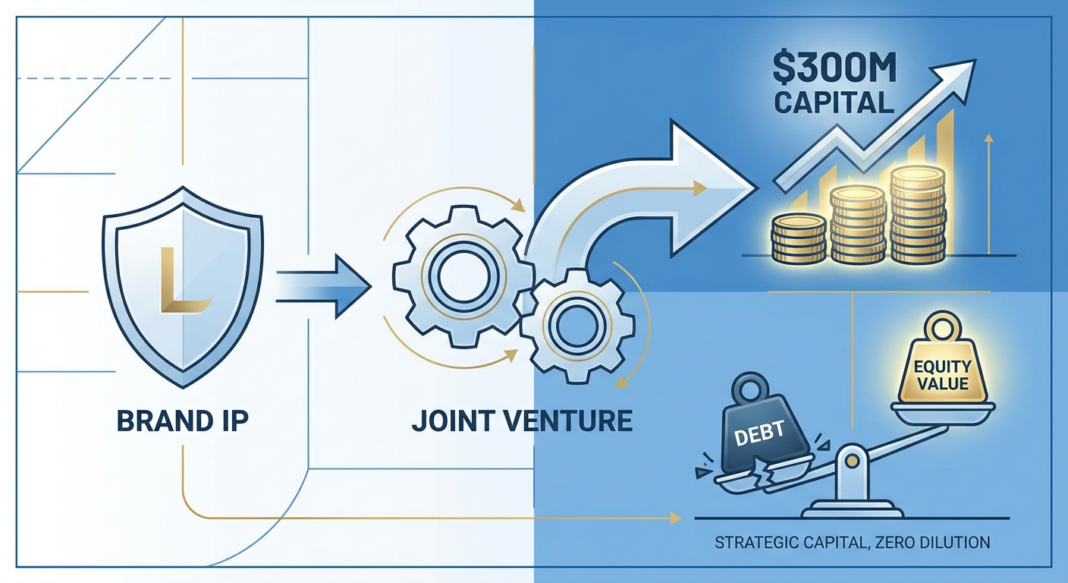
The Story: A Legacy Brand, a Balance Sheet Problem, and a Creative Fix
By mid-2025, Lands’ End found itself in a position familiar to many mature consumer brands: real equity value locked up in an iconic name, but a balance sheet weighed down by a $234 million term loan eating into flexibility and suppressing the company’s ability to invest in its next chapter. The brand (a 60-year-old American retail institution synonymous with durable outerwear and no-nonsense direct-to-consumer commerce) was operationally sound. But capital structure was the ceiling.
The conventional playbook would have been straightforward, if painful: issue new equity, dilute existing shareholders, and use the proceeds to pay down debt. Or sell the company outright. For a management team and shareholder base that believed in the brand’s long-term value, neither option was acceptable. So Lands’ End reached for a third lever: one that combined intellectual property monetization, a strategic operating partner, and non-dilutive cash generation in a single transaction.
The result was a landmark IP joint venture with WHP Global, a brand-management platform with a proven track record of scaling legacy consumer names across new categories and international markets. Lands’ End contributed its brand IP and existing licensing business into a newly formed entity (LE Topco, LLC) and sold a 50% controlling interest in that entity to WHP for $300 million in cash. Not a share of Lands’ End common stock was issued. Not a single existing shareholder was diluted.
The company used the majority of those proceeds to fully repay its $234 million term loan, eliminating a significant fixed-cost burden and resetting its balance sheet for what management described as “strategically and financially accretive opportunities” ahead, according to the company’s 8-K filing with the SEC.
The Decision: What the Options Actually Looked Like
To appreciate what Lands’ End chose, it helps to map what they didn’t choose.
Option A, Equity Issuance: A secondary offering or private placement could have raised $300M, but at the cost of shareholder dilution. With the stock already under pressure, issuing new shares would have signaled distress, likely depressing the share price further and transferring value from existing owners to new capital providers at precisely the wrong moment in the cycle.
Option B, Outright Sale or Full Brand Licensing: Selling the company or the brand outright would have generated liquidity, but surrendered all future upside, including the royalty streams that make brand IP genuinely valuable at scale.
Option C, The IP JV Recap: By carving the brand IP into a separate vehicle and selling a 50% stake to WHP Global, Lands’ End achieved several things simultaneously. It generated $300M in immediate cash (non-dilutive to equity holders). It retained 50% economic ownership of the IP and its future royalty streams. It brought in an operator, WHP, whose entire business model is accelerating brand licensing revenue across new geographies and product categories. And it maintained full operational control of its core DTC and B2B businesses, ensuring continuity for customers, partners, and employees.
The structure was elegant in its specificity: monetize the asset class (IP) where a strategic buyer would pay the highest multiple, while retaining operations where the management team had the deepest competitive advantage. This is the essence of non-dilutive capital strategy, match the financing instrument to the asset, not to the equity.
The Outcome: Balance Sheet Reset, Upside Retained
The math tells a clean story. Pre-transaction, Lands’ End carried $234M in term loan debt, with the associated interest expense acting as a drag on free cash flow and strategic optionality. Post-transaction:
- Term loan: fully repaid. Interest expense burden eliminated.
- Residual cash: Approximately $66M in net proceeds remaining after debt repayment: available for reinvestment, share repurchases, or further deleveraging.
- New royalty revenue stream: As WHP scales the Lands’ End brand into new categories and international markets, the JV generates high-margin royalty income, of which Lands’ End retains a 50% economic share.
- Operational independence preserved: The core DTC and B2B businesses, the day-to-day engine of the company, were untouched by the transaction.
Now compare the counterfactual. Had Lands’ End raised $300M through a dilutive equity offering, existing shareholders would have seen their ownership percentage compressed. Had it sold the entire brand, it would have forfeited the royalty upside entirely. The IP JV structure effectively converted an illiquid asset (brand IP sitting on the balance sheet) into liquid capital, without destroying the long-term value architecture of the company. That’s a leverage win in the truest sense, not leverage as debt-loading, but leverage as capital structure intelligence.
The Lessons: When IP Recaps Beat Equity Raises
The Lands’ End transaction is a masterclass in a principle that most operators overlook: not all assets on your balance sheet need to be financed the same way. Brand IP, real estate, receivables, and operating cash flow each have distinct capital market audiences who will pay different multiples for different risk profiles. The founder or CFO who learns to disaggregate the balance sheet (and match each asset class to its optimal financing partner) will consistently outperform the one who reaches for the equity dilution lever by default.
This approach works best when several conditions are present. First, the company must have a genuinely monetizable asset class that can be legally and operationally separated: brand IP, a real estate portfolio, a receivables book. Second, there must be a strategic partner willing to pay for that asset at a premium to book value because of what they can do with it, as WHP Global could do with the Lands’ End brand that the company itself could not. Third, the core business must be stable enough to operate independently post-transaction, so the carve-out doesn’t destabilize operations.
Where this approach fails is when founders treat it as financial engineering for its own sake, monetizing assets without a credible plan for deploying the proceeds, or selecting JV partners whose incentives diverge from long-term brand health. The structure is a tool, not a strategy. The strategy has to come first.
For context on how leverage decisions ripple through outcomes, it’s worth noting the broader landscape: the leveraged buyout mechanics documented by practitioners show clearly that leverage magnifies outcomes in both directions, the Toys ‘R’ Us and Avaya cautionary tales are reminders that debt loaded onto a business without the cash flow to service it destroys equity value fast. The Lands’ End transaction is the inverse: leverage used surgically, against an asset with a receptive buyer, to generate liquidity without compromising the equity base.
Key Insights
- Non-dilutive capital is an active discipline, not a default: Lands’ End didn’t stumble into this structure; it required identifying the right asset, the right partner, and the right legal vehicle. Founders should audit their balance sheets for IP, real estate, and other separable assets before assuming equity issuance is the only path to liquidity.
- Match the financing instrument to the asset: Brand IP commanded a strategic premium from WHP Global that the public equity markets would never have assigned to a general Lands’ End share offering. Disaggregating the balance sheet unlocks hidden value.
- Operational control is a negotiated outcome, not a given: The Lands’ End deal explicitly preserved full DTC and B2B operational control. In any IP or asset JV, founders must negotiate these terms explicitly; they don’t come automatically with the structure.
- Debt elimination is an equity event: Repaying $234M in term loans didn’t just reduce interest expense; it structurally improved the equity value of the company for every existing shareholder. Sometimes the best use of a capital raise is defensive balance sheet repair.
- The best leverage stories aren’t about loading up on debt, they’re about deploying capital structure intelligence: The most sophisticated operators in any market are the ones who understand that equity dilution is a cost, and that cost can often be avoided with the right structure, the right partner, and the right asset.


