
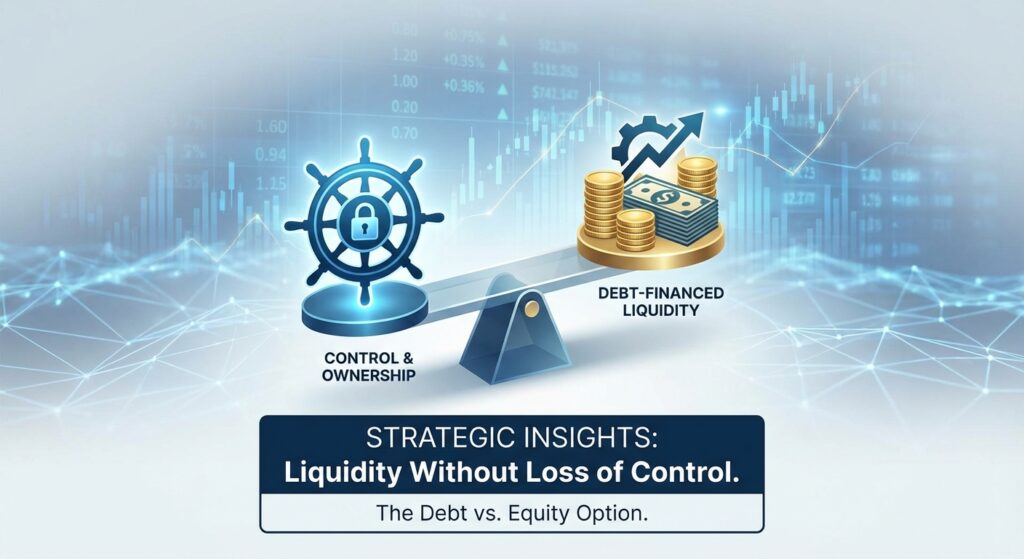
The Dilemma: Liquidity Without Loss of Control
By mid-2025, the private credit markets had shifted. As traditional banks pulled back, direct lenders began aggressively pitching higher leverage ratios to win deals, specifically targeting companies owned by private equity firms (and increasingly, astute founders) for dividend recapitalizations. As reported by Bloomberg in July 2025, lenders were offering “sweeteners” in the form of tac-on debt to fund shareholder payouts.
This environment created a unique window for founders: the ability to take significant chips off the table without selling the casino. To illustrate how this mechanic works versus a traditional equity exit, we look at a hypothetical case study based on these prevailing market conditions, contrasted with the aggressive debt strategies used by major PE players like Clearlake Capital.
Case Study: NorthStar Industrial (Hypothetical)
The Setup
Imagine NorthStar Industrial, a specialized logistics software provider generating $40 million in EBITDA. The founder, “Elena,” still owns 80% of the business. After 15 years of grinding, she wants $100 million in liquidity to secure her family’s future, but she believes the company is only halfway through its growth curve. She isn’t ready to hand the keys to a private equity firm.
The Decision: Equity vs. Debt
Elena faces two primary options in the 2025-2026 market environment:
- Option A: The Private Equity Majority Recap. A PE firm offers to buy 60% of the company at a 10x multiple ($400M valuation). Elena cashes out $240 million but becomes a minority shareholder (32%) and loses operational control. Her “second bite of the apple” depends entirely on the PE firm’s timeline.
- Option B: The Leveraged Dividend Recap. Leveraging the aggressive private credit market described by Bloomberg, Elena enters discussions with direct lenders. They offer a 4.0x leverage ratio on her $40M EBITDA.
The Execution
Elena chooses Option B. The math works as follows:
She raises $160 million in debt (4.0x leverage).
She takes a $120 million dividend for herself and minority partners.
She leaves $40 million on the balance sheet for working capital.
Crucially: She retains 80% ownership and 100% control.
The Outcome: Renting vs. Selling
In this scenario, Elena effectively “rented” capital rather than selling equity. The cost of that rent is interest, likely floating rate, but the cost of selling equity is permanent loss of upside.
Contrast this with the institutional side of the market. In April 2025, Clearlake Capital utilized a $5.75 billion bridge loan to rush a buyout of Dun & Bradstreet. While PE firms utilize debt to facilitate acquisitions (often bringing operational disruption), founders like Elena can utilize similar structures solely for liquidity, keeping the culture and operations intact.
If NorthStar grows EBITDA to $60 million over the next three years and pays down $40 million of debt:
Enterprise Value (at 10x): $600 million
Less Debt: $120 million
Equity Value: $480 million
Elena’s Share (80%): $384 million
Total Value Realized (Dividend + Second Exit): $120M + $384M = $504 million.
Under the Private Equity sale (Option A), her minority stake would have been worth significantly less, and she would have ceded governance rights years prior.
The Lessons
The “credit boom” of 2025 highlighted a critical principle for operators: Capital structure is a strategic tool, not just a finance function.
- Cost of Capital: Even at high interest rates, debt is often cheaper than equity in high-growth scenarios because it is non-dilutive. You pay it back; equity is gone forever.
- Covenants Matter: The aggressive terms pitched by private credit firms (flexibility on covenants) allow companies to weather minor storms without defaulting, a luxury not always present in traditional bank loans.
- Cash Flow is King: This strategy only works for companies like NorthStar with predictable, high margins. Without steady cash flow to service the interest, leverage turns from a tool into a trap.
Key Insights
- Liquidity Decoupled from Exit: Founders do not need to sell their company to monetize their success.
- The Control Premium: Retaining decision-making power allows founders to prioritize long-term value over the short-term IRR targets of PE backers.
- Market Timing: In periods where lenders compete for deals (as seen in mid-2025), borrowers can negotiate favorable terms that reduce the risk of leverage.
- Alignment: Debt aligns with steady growth; Equity aligns with hyper-growth or flip-events. Choose the capital that matches your operational cadence.
- Tax Efficiency: Proceeding with a debt-financed distribution can sometimes offer different tax treatments compared to a straight equity sale, though specific advice is required.


