
The Financing Problem Nobody Talks About Cleanly
A software company generating $5M in ARR with 85% gross margins and 25% annual growth sits in one of the most structurally awkward positions in private markets. It has too much revenue for early-stage venture, too little EBITDA for a traditional senior cash flow loan, and a use-of-proceeds that doesn’t fit neatly into any single product shelf. It needs capital to hire a sales team, fund a tuck-in acquisition, and carry the working capital gap, simultaneously. This is the growth-stage capital challenge in its rawest form.
Getting this wrong is expensive. The fully-loaded dilution cost of a single growth-stage priced equity round, measured at exit, typically runs 30 to 35 percent of the pre-money founder position, versus an 8 to 10 percent after-tax cost of senior secured debt. The structural decision made at this juncture (which layer of the capital stack to access, in what sequence, and on what terms) compounds at every subsequent financing event.
This article maps the full cost-of-capital spectrum for growth-stage and acquisition scenarios, provides a component-by-component breakdown of the structures available, and walks through a tactical playbook for quantifying, preparing, and negotiating gap capital.
Mapping the Cost-of-Capital Spectrum: Banks to Equity
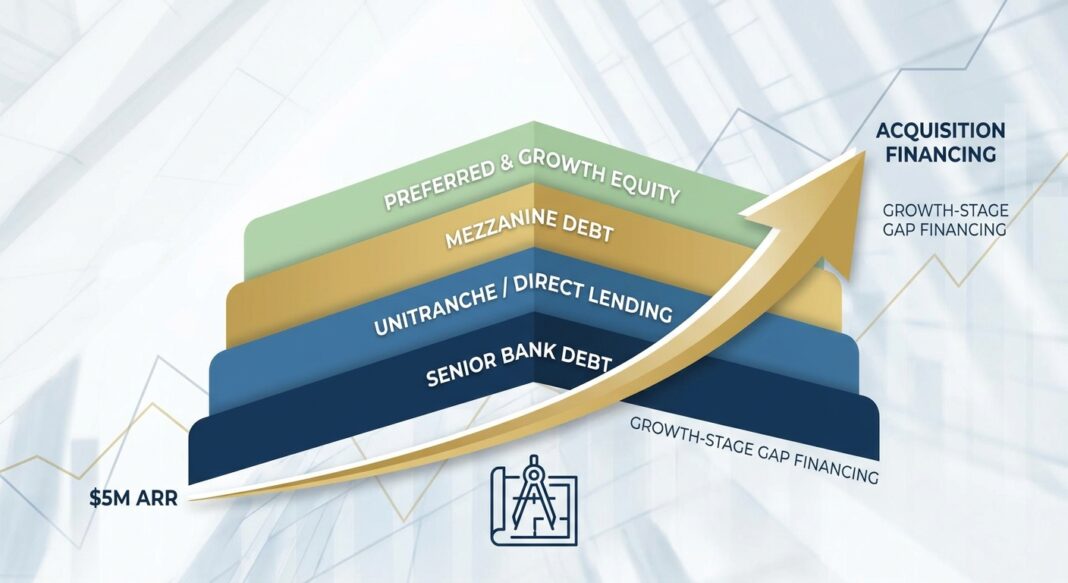
The capital stack is not a single instrument; it is a hierarchy of risk, control, and cost. The capital stack remains the foundation of how companies are financed: a hierarchy of capital ranked from lowest risk (and lowest cost) to highest risk (and highest return). For growth-stage and acquisition financings, the operative range spans five distinct layers:
Layer 1: Senior Bank Debt (Cheapest, Most Constrained)
Commercial banks remain the lowest-cost source of debt capital when a borrower can qualify. Traditional lending remains an important funding option in 2026, especially for businesses with operating history, steady revenue, and a clear repayment plan. The constraint is underwriting: banks require two-to-three years of EBITDA, hard collateral, and rigid covenant structures. For pre-profitability growth companies, bank debt is structurally inaccessible regardless of revenue quality. Bank commercial and industrial lending to non-financial corporations grew at a 3.2 percent annualized rate in Q2 2026, reversing an eighteen-month contraction, but the credit box for growth companies with negative EBITDA remains narrow.
Layer 2: Unitranche / Direct Lending (Speed & Simplicity Premium)
Unitranche dominates the lower middle-market direct lending channel in 2026. A unitranche blends first-lien senior and subordinated risk into a single facility with a single lender (or a small club) eliminating inter-creditor complexity. The borrower trades a modestly higher all-in cost for deal certainty, faster execution, and fewer counterparties to manage.
The structural sweet spot is well-defined: the deal-size sweet spot is $25M–$200M enterprise value. Below $25M EV, SBA 7(a) and traditional senior bank loans dominate because unitranche minimum check sizes ($15–25M typical) don’t pencil. Above $200M EV, broadly-syndicated loans become competitive on price and the unitranche premium isn’t justified.
Pricing as of mid-2026: lower-middle-market direct lending spreads sit at SOFR + 450 to 475 bps, a 100 to 150 bps premium over the syndicated market, per PitchBook leveraged loan data and lender disclosures summarized by Chicago Atlantic’s Q3 2025 update. The speed advantage is real and quantifiable: if unitranche financing can close 30 to 45 days faster than a syndicated alternative, sponsors often justify 50 to 100 basis points of extra spread by avoiding financing gaps, broken syndications, or delayed closings that jeopardize purchase agreements.
Layer 3: Mezzanine Debt (Subordination + Equity Features)
Mezzanine debt is the layer in the capital stack between senior debt and equity, providing 2–3x EBITDA of additional leverage above senior bank debt at 12–15% all-in cost. Its defining structural features are subordination, PIK optionality, and the equity kicker. In exchange for taking subordinated risk, mezzanine investors typically get high cash yields, payment-in-kind (PIK) interest, and sometimes an equity kicker through warrants or conversion features.
Current market pricing for corporate mezz: in 2026, all-in cost is 10–14% (cash coupon 8–11% + PIK 2–4% + warrants). PIK mechanics matter: under a PIK arrangement, the borrower pays part or all of the interest by issuing additional debt notes rather than cash. The compounding effect of PIK creates a balloon refinancing risk: when borrowers elect PIK interest, the outstanding balance compounds, increasing total debt burden. If the anticipated liquidity event is delayed, the growing PIK balance creates a larger refinancing burden at bullet maturity.
Despite the unitranche’s rise, traditional mezzanine debt has not disappeared. It remains relevant in several contexts: very large transactions where unitranche lenders cannot provide the full quantum of debt needed, situations where the borrower wants to minimize total cost by maximizing cheap senior debt separately, deals where the sponsor wants equity kickers to align lender incentives, and portfolio company add-on financings where existing credit agreements restrict additional senior debt.
Layer 4: Preferred Equity (Control Lite, Return Heavy)
Preferred equity sits above common equity but below all debt in the payment waterfall. It carries no mandatory cash coupon, preserves flexibility during cash-constrained growth phases, and is increasingly used as a bridge between mezzanine and common equity in sponsor-backed recapitalizations. The trade-off is valuation sensitivity: preferred equity holders typically negotiate liquidation preferences, participation rights, and anti-dilution protections that can meaningfully compress common equity returns at exit.
Layer 5: Growth Equity / Minority Equity (Highest Cost, Maximum Flexibility)
While venture capital targets early-stage startups with higher risk, growth capital focuses on companies with proven revenues ready for the next phase. Private equity often involves full buyouts, but growth capital partners typically take minority stakes, allowing founders to retain significant control. The dilution cost is the critical variable. According to Carta’s State of Private Markets data, median dilution in 2025 sits at approximately 19.5% for seed rounds and 18% for Series A rounds. By the time a company reaches Series B or C, cumulative dilution from stacked equity rounds can be severe.
Structure Breakdown: The Growth-to-Acquisition Financing Stack
Consider a $40M enterprise value B2B software company with $6M ARR, 80% gross margins, $500K EBITDA (on a trailing basis), and a target tuck-in acquisition at $15M. The company needs $12M total: $7M for the acquisition and $5M for go-to-market expansion. This is the prototypical growth-stage gap capital scenario.
Option A: Pure Unitranche
A single direct lender provides a $12M unitranche facility secured against all assets, at SOFR + 500 bps (approximately 10.3% all-in at current rates), with a 5-year term, 1% OID, 1% origination fee, and a single maintenance covenant, net leverage below 5.0x tested quarterly. No warrants. No PIK. Clean structure, one consent party, closes in 60 days. This is the right call if the company can service current-pay interest and wants to preserve the cap table entirely.
Option B: Senior + Mezz Split
A regional bank provides a $7M senior facility at SOFR + 275 bps with tight maintenance covenants (leverage ≤3.5x, FCCR ≥1.25x). A mezzanine fund layers $5M subordinated debt at 12% cash / 2% PIK with 2% warrant coverage on a fully diluted basis, vesting at exit. Total blended cost is approximately 9.2% cash-pay, with PIK accrual on the subordinated piece. This structure is more complex and slower (90–120 days), but the blended cost is 80–100 bps cheaper than the unitranche for a borrower comfortable managing two lender relationships and an inter-creditor agreement.
Option C: Debt-First, Equity Later
A debt-first capital stack is a financing sequence in which a growth-stage company with contracted recurring revenue draws senior secured or unitranche debt before raising a priced equity round, extending runway 12 to 18 months without dilution. Private credit AUM crossed $1.7 trillion in H1 2026, direct lending spreads compressed 175 basis points from Q1 2024 peaks, and covenant-lite structures now represent 62% of unitranche originations in the sub-$100M ticket band. Founders drawing debt against contracted revenue are extending runway, deferring priced rounds by 12 to 18 months, and entering equity conversations at higher revenue and cleaner terms, saving 5 to 7 percentage points of dilution at exit in the best cases.
For our $6M ARR software company, the debt-first path means closing the $12M unitranche now, scaling ARR to $10M+ over 18 months, then raising a Series B at a materially higher valuation, compressing dilution from a likely 22% at today’s multiple to under 15% at a scaled ARR multiple.
Covenant Design: What the Market Looks Like Now
Covenant structure is where borrower leverage is most visible, and where the market has shifted most dramatically. Maintenance covenants require borrowers to pass financial tests every quarter regardless of any action taken, while incurrence covenants only apply when the borrower takes a specific action like incurring new debt or paying a dividend.
At the large-cap level, maintenance covenants have effectively disappeared. According to Resonanz Capital’s analysis, 91.09% of outstanding U.S. leveraged loans were covenant-lite at year-end 2024, roughly $1.29 trillion in face value. In 2024, 93% of all new institutional leveraged loan issuance was covenant-lite. The private credit market is following: approximately 70% of private credit issuance is covenant-lite, while more than 90% of the broadly syndicated leveraged loan market lacks traditional maintenance tests.
However, the lower and core middle market operates differently. Maintenance covenants continue to be more prevalent in the lower and core mid-market (EBITDA <$100M), while covenant-lite structures are more common for larger borrowers (EBITDA >$100M) that operate in defensive industries. For growth-stage borrowers at the $5–15M EBITDA band, a single maintenance covenant, typically a net leverage ratio, remains standard. This is actually useful for well-run companies: the existence of maintenance covenant(s) allows the lender to engage early with a borrower in the event of weakening performance, providing a structured amendment process rather than a payment-default cliff.
The negotiation point: borrowers should push for a single springing maintenance covenant on the revolver (if any) and incurrence-only covenants on the term loan. The EBITDA definition (specifically the add-back basket for non-recurring costs and synergies) is where the real economic negotiation happens, not the headline ratio.
The Gap Capital Playbook: Quantify, Prepare, Run the Process
Step 1: Quantify the Gap
Gap capital is not the difference between what you have and what you want; it is the difference between what your existing capital structure can support and what your use-of-proceeds requires. Build a 24-month cash model with three scenarios (base, upside, stress). The gap is the maximum negative cumulative cash balance in the stress case, plus a 20% liquidity buffer. This is the number you take to market, not the number on the acquisition term sheet.
Business owners need clean financials, realistic forecasts, a clear use of funds, and a strong understanding of which funding options align with their business model, growth stage, and long-term goals. The quality of your financial model is the first underwriting filter every direct lender and mezzanine fund applies before the first call.
Step 2: Map Use-of-Proceeds to Structure
Not all uses of proceeds are structurally equivalent. Acquisition financing maps cleanly to acquisition debt; it is a defined event with a defined asset purchase, making unitranche or senior+mezz structures appropriate. Working capital and go-to-market investment map better to revolving facilities or revenue-based structures that flex with ARR. Growth capex maps to term debt with an amortization schedule matching the depreciation life of the asset. Mixing these into a single facility creates structural mismatches that surface at amendment negotiations.
Step 3: Prepare the Lender Package
A growth-stage lender package is materially different from a venture pitch deck. Direct lenders underwrite cash flows, not market narratives. Growth capital lenders bet on cashflow and unit economics. The package must include: trailing twelve-month P&L with EBITDA bridge; ARR schedule with cohort retention and net revenue retention; customer concentration analysis (top 10 customers as % of ARR); debt service coverage at the proposed leverage level; and a detailed use-of-proceeds table mapping each dollar to a specific business outcome.
Step 4: Run a Competitive Process
Bilateral processes produce worse terms than competitive ones, even in the direct lending market. Most sponsors maintain 3–6 active direct lender relationships rather than concentrating with one. Reasons include: pricing competition (lenders compete on terms when 2–3 are bidding), capacity (single lender can hit limits on individual sponsor exposure), and specialization (different lenders are better at different sectors). For a sub-$50M facility, running three to four simultaneous processes and letting lenders know they are competing produces 50–100 bps of spread compression and meaningfully better covenant packages.
Market context matters: European direct lenders continue to hold substantial dry powder, while new issuance remains limited and lender demand is high, keeping terms competitive for regular-way credits. The same dynamic holds in the U.S. lower middle market, lender supply exceeds deal flow for high-quality growth credits, giving well-prepared borrowers real negotiating leverage.
Step 5: Negotiate the Structure, Not Just the Rate
The headline spread is the least important negotiation point. The five terms that actually determine the economic outcome are: (1) the EBITDA add-back basket, how broadly the company can define run-rate EBITDA for covenant testing; (2) the equity cure right, the ability to inject equity to cure a covenant breach without triggering default; (3) the MFN provision, whether the lender has most-favored-nation pricing protection that constrains future capital raises; (4) the accordion/incremental facility, the ability to upsize the facility for future acquisitions without full renegotiation; and (5) the prepayment premium, typically a 2%/1%/0% step-down over the first three years, which determines the cost of refinancing if rates compress.
On warrant coverage in a mezzanine context: the true complexity comes from the warrants. These equity kickers can complicate the capital structure, add layers to future financing rounds, and create challenging negotiations in a potential exit scenario. Borrowers should negotiate warrant coverage on a fully diluted post-money basis (not pre-dilution), with a clear call right at a predetermined exit multiple, and anti-dilution protections that do not ratchet above the initial strike price.
Key Takeaways
- Match structure to use-of-proceeds, not to the path of least resistance. Acquisition debt, working capital facilities, and growth capex have different risk profiles and should be structured as distinct instruments within the same capital stack wherever possible.
- The unitranche is the default structure for $25M–$200M EV growth and acquisition deals in 2026, but the blended cost of a senior+mezz split can be 80–100 bps cheaper for borrowers willing to manage two lender relationships and an inter-creditor agreement.
- PIK compounds leverage silently. Every quarter of PIK accrual increases the bullet repayment at maturity. Model the PIK balance at multiple exit timelines before accepting PIK as a structural feature rather than a cash management tool.
- Covenant design is a borrower right, not a lender gift. In the lower middle market, a single net leverage maintenance covenant is standard, but the EBITDA definition, equity cure rights, and covenant headroom are all negotiable and determine the practical operating flexibility under the facility.
- Debt-first sequencing preserves equity value. For growth-stage companies with contracted recurring revenue, drawing senior secured debt before pricing an equity round can extend runway 12–18 months, allow ARR to scale, and compress dilution by 5–7 percentage points at exit, the most structurally efficient capital strategy available in the current market.


