
The Capital Gap That Stalls Growth
Every growth-stage company reaches the same inflection point: the business has outgrown its bank line, the senior lender has hit the ceiling of what it will advance against cash flow, and a full equity round would dilute ownership at exactly the wrong moment. The operator needs $8 million to fund an acquisition, a facilities buildout, or a regional expansion, but the bank says the most it can lend is $5 million at 3.5× EBITDA, and the equity investor wants a board seat and 30% of the company.
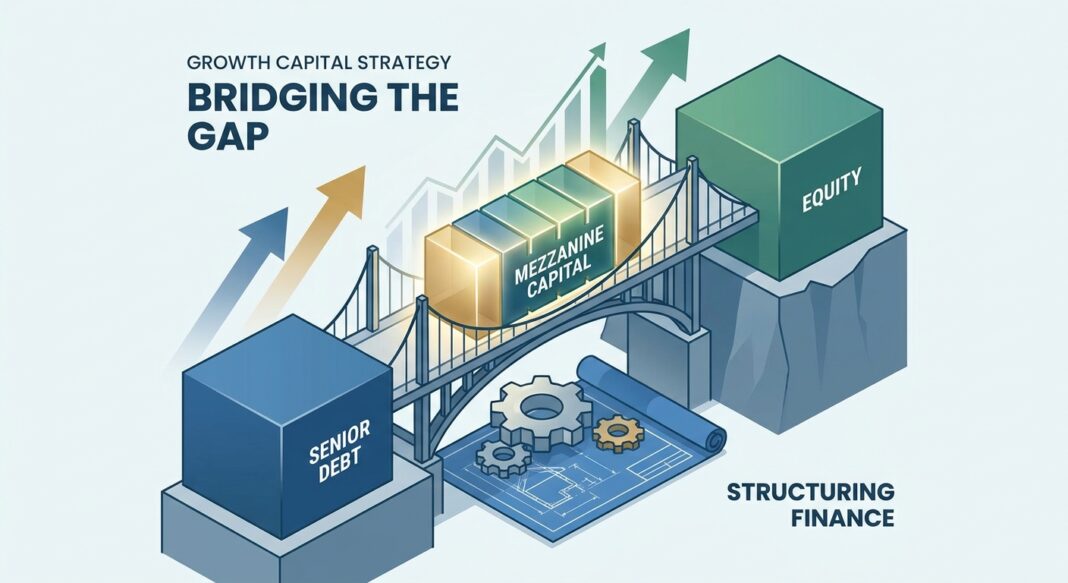
This is the gap capital problem: the financing need that sits between what senior debt will cover and what the operator is willing to give away in equity. It is not a niche situation. Mezzanine financing bridges the gap between what senior lenders provide and your total capital needs. For companies in the $5M–$50M EBITDA range, it is the most consequential structural decision in the entire capital stack.
The right instrument, sized correctly, lets an operator complete the transaction, preserve control, and service the debt from operating cash flow. The wrong instrument (over-levered, mismatched to use-of-proceeds, or loaded with PIK that compounds silently) creates a refinancing wall that arrives precisely when the business hits its next challenge. Understanding the mechanics is not optional for practitioners. It is the job.
How Mezzanine Is Actually Built: Components, Mechanics, and a Live Example
Mezzanine debt has three defining structural features that distinguish it from senior debt: its subordinated and unsecured position, its option for Payment-in-Kind (PIK) interest, and its equity kicker, almost always in the form of stock warrants. Each element serves a specific purpose in the economics of the deal.
A mezzanine facility is typically structured as a subordinated loan with a base interest rate paid monthly or quarterly, typically 8% to 14% per year depending on the company’s risk profile and market conditions. On top of that cash coupon sits PIK interest that accrues on the principal balance instead of being paid in cash, compounding over the life of the facility and increasing the effective cost of borrowing over time. Finally, warrants, conversion rights, or a direct equity stake allow the mezzanine lender to participate in the company’s upside, and this is the component that makes mezzanine dilutive even though it is structured as debt.
A Worked Example: $50M Software Business Acquisition
Consider a software company with $7M EBITDA being acquired at a $56M enterprise value (8× multiple). The capital stack is assembled as follows:
- Senior Unitranche / Bank Debt: $24.5M (3.5× EBITDA) at SOFR + 575bps (~10.5% all-in). One lender, one covenant package, first-priority lien on all assets.
- Mezzanine Tranche: $14M (2.0× EBITDA stretch) at a 13% cash coupon + 2% PIK + warrants representing 4% of the fully diluted equity. Subordinated to senior debt; governed by an intercreditor agreement. Five-year bullet maturity.
- Sponsor Equity: $17.5M (~31% of enterprise value). Target IRR of 20–25%.
Mezzanine lets an operator push effective debt capacity from the senior-debt cap of roughly 3.5× EBITDA up to a total-debt cap of 4.5× to 5.5× without giving up equity control, because mezzanine is technically debt with a small equity kicker rather than a true equity investment. In the example above, total leverage reaches 5.5×, a level no senior lender would underwrite alone, while the sponsor retains majority control.
Mezzanine providers accommodate PIK to achieve a targeted yield, often in combination with warrants or other equity-linked upside. The trade-off is explicit: the borrower preserves near-term liquidity at the cost of increased principal obligations. Warrants are not gift equity; every warrant granted to a mezzanine lender dilutes existing common equity, and in a successful exit, the mezzanine lender’s equity kicker reduces the return available to the PE sponsor and management team.
Mezzanine vs. The Alternatives: Where Each Instrument Wins
The mezzanine vs. unitranche question is the central structural debate in middle-market finance in 2026. Traditional mezzanine is under structural pressure. The cause is unitranche lending. A unitranche loan blends senior and subordinated debt into one facility at a blended all-in rate. There is one lender and one credit agreement. No intercreditor negotiation is required.
Unitranche debt is a single-tranche term loan that combines what would otherwise be a senior secured loan and a subordinated/mezzanine loan into one instrument. From the borrower’s perspective, there is one loan document, one lender (or one lender-led syndicate), one set of covenants, one interest rate, and one prepayment schedule. The execution advantage is significant: unitranche closes in 45–90 days versus 90–150 days for traditional senior + mezz syndication.
But unitranche is not always optimal. The deal size and EBITDA profile matter decisively. The unitranche sweet spot is $25M–$200M EV; below that range, SBA + senior bank wins on cost, and above $300M BSL wins on cost. When leverage needs push beyond what a single unitranche provider will underwrite, or when the acquisition is too large for the borrower’s available equity check, layered mezzanine becomes the only viable path to closing.
The cost comparison is nuanced. While the initial outlay may be more expensive for mezzanine, the cost over time is not as pricey as some think. Unitranche is structured as a single amortizing term loan, keeping the weighted average cost of capital constant over time. In a traditional senior/junior split structure, the weighted average cost increases over time, since senior debt amortizes and junior debt does not. That dynamic means the true cost differential between the two structures narrows materially over a five-to-seven-year hold.
| Structure | Typical Leverage | All-In Cost (2026) | Intercreditor | Best Fit |
|---|---|---|---|---|
| Senior Bank / SBA | 2.5–3.5× EBITDA | 7–9% | None | Sub-$25M EV, strong assets |
| Unitranche | 4.0–5.0× EBITDA | SOFR + 550–750bps | First-out / Last-out AAL | $25M–$200M EV, sponsored buyouts |
| Senior + Mezzanine | 4.5–5.5× EBITDA | Blended 11–15% | Full intercreditor required | High-leverage needs, large equity gaps |
| Preferred Equity | N/A (equity layer) | 12–18% preferred return | None (structural subordination) | No debt capacity; control-sensitive situations |
Current Market Terms: What the 2026 Data Shows
The mezzanine and direct lending markets have repriced meaningfully off 2022–2023 highs, but remain elevated relative to the pre-rate-hike era. Practitioners building models in mid-2026 should anchor to the following benchmarks:
- Mezzanine all-in cost: In 2026, all-in cost is 10–14% (cash coupon 8–11% + PIK 2–4% + warrants). For deals with more credit stress or lower EBITDA coverage, expect the cash coupon to trend toward the upper end of that band.
- Unitranche spreads: Unitranche loans typically price at SOFR plus 550 to 750 basis points and are the dominant leveraged finance product for middle-market sponsor deals below $500 million in total debt.
- Private credit AUM and dry powder: Global private credit assets under management reached about $2.1 trillion in 2025, up from $1.5 trillion a year earlier. That capital concentration is keeping spreads competitive for quality credits even as underwriting discipline tightens.
- Covenant design shift: The share of respondents that won’t do deals without financial maintenance covenants grew dramatically to 46%, climbing 11 percentage points from 2025, signaling a structural re-tightening of lender terms in the private credit market. Expect at least one financial maintenance covenant in private credit deals under $50 million EBITDA, most commonly total leverage ratio tests with cushions above closing leverage.
- PIK usage rising: Debt-for-equity swaps and PIK usage are rising, and underwriting discipline matters more than ever. Borrowers electing PIK to preserve short-term cash flow should model the compounding effect carefully: when borrowers elect PIK interest, the outstanding balance compounds, increasing total debt burden. If the anticipated liquidity event is delayed, the growing PIK balance creates a larger refinancing burden at bullet maturity.
The broader market structure is also shifting. According to Refinitiv LPC data, unitranche accounted for over 65% of middle-market sponsored LBO financings in 2024 and 2025. Meanwhile, pure-play mezzanine funds have responded by moving up-market, now targeting transactions above $500 million, stressed and distressed credits where unitranche lenders want no part of the complexity, real estate capital stacks, and markets where separate tranches remain more common. For lower middle market operators, this means the mezzanine universe has partially consolidated into unitranche, but dedicated mezz capital remains available and is often the only option for stretch-leverage situations.
The Gap Capital Playbook: Quantify, Prepare, Run the Process, Negotiate
Step 1: Quantify the Gap
The gap is always the same formula: Total Capital Need − Senior Debt Capacity − Available Equity = Mezzanine Requirement. Do this analysis before approaching any lender. Know your trailing EBITDA, your projected EBITDA with and without synergies, and your maximum equity contribution. The gap number tells you which instrument universe you are shopping in and whether the deal is structurally viable before you spend a dollar on legal or diligence fees.
Model three scenarios: base case (DSCR of 1.35×), stress case (DSCR of 1.10×), and upside case (DSCR of 1.60×). Stress test covenants: model quarterly leverage and interest coverage under downside scenarios and planned add-ons. Assume lower add-back realization and delayed synergy capture. If stress-case DSCR falls below 1.10×, the structure is too aggressive for a mezzanine lender to underwrite responsibly.
Step 2: Prepare the Materials
Mezzanine lenders are cash-flow underwriters first. They want a quality-of-earnings report, at least three years of audited or reviewed financials, a detailed 36-month projection with documented assumptions, and a sources-and-uses table showing exactly how the capital is deployed. Mezzanine debt providers evaluate your historical and projected cash flow, growth potential, and ability to service both existing senior debt and the new mezzanine layer. The intercreditor negotiation with the senior lender also needs to be scoped: who has enforcement rights, what are the cure periods, and what triggers acceleration?
Step 3: Run the Process in Parallel
Buyers who lock in an equity sponsor before pricing senior debt routinely give up 300 to 500 bps of blended cost. The winners run senior debt, unitranche, and mezz quotes in parallel, then use the tightest term sheet as leverage on the equity conversation. Apply the same logic to the mezz process: run three to five mezzanine term sheets simultaneously. Use competitive tension to compress the warrant coverage, push the cash/PIK split toward more cash (lower compounding risk), and extend the maturity from five to six years where possible.
Step 4: Negotiate the Structure
The four most important negotiation points in a mezzanine term sheet are:
- Warrant Coverage & Strike Price: Push for a strike price at or above deal close value. The difference between a 3% warrant and a 6% warrant is significant on a $50M equity base. Negotiate a buyout option (call right) at a specified multiple before expiry.
- Cash vs. PIK Split: A 13% cash / 0% PIK structure is more predictable than 10% cash / 3% PIK on a five-year horizon. If PIK is unavoidable, negotiate a PIK toggle, the right to elect PIK in lean quarters rather than a mandated PIK from day one.
- Covenant Headroom: Maintenance covenants, mostly confined to private middle market loans, require borrowers to report key financial metrics on a regular basis, providing lenders with early warning signals of potential distress. Negotiate 20–30% headroom above your closing leverage ratio as a covenant cushion, not 10%. That buffer is your operating flexibility.
- Prepayment Mechanics: Most mezzanine facilities carry a no-call period (typically 12–18 months) followed by a step-down penalty. Negotiate the no-call window as short as possible and confirm the equity kicker treatment on early prepayment, some warrants accelerate on a full call, others lapse.
Key Takeaways
- Mezzanine fills the gap, not the whole stack. It is designed to stretch total leverage from a senior cap of ~3.5× EBITDA to a blended ceiling of 4.5–5.5×, and it should be sized to exactly that incremental need, nothing more.
- The all-in cost is higher than the stated rate. The all-in cost of mezzanine capital, including fees, PIK interest, and the equity component, frequently exceeds the cost of an equity round when calculated correctly. Model the full warrant dilution, PIK compounding, and origination fees before comparing to an equity alternative.
- PIK interest compounds against you. Electing PIK preserves near-term liquidity but silently inflates the bullet repayment obligation. Always model a scenario where the anticipated liquidity event is 12–18 months late.
- Covenant design determines your operating flexibility. Maintenance covenants require borrowers to pass financial tests every quarter regardless of any action taken, while incurrence covenants only apply when the borrower takes a specific action. In a private mezzanine deal, expect maintenance covenants, and negotiate the test levels before signing.
- Run process before picking a partner. Competitive parallel process across unitranche, senior + mezz, and preferred equity options is the single most effective tool for compressing all-in cost and improving structural terms. Never accept the first term sheet as market.


