
The Challenge: You Have Traction, But the Capital Stack Is Working Against You
The growth stage is where capital strategy gets genuinely complex. A company at $3M–$15M in ARR (or $5M–$30M in EBITDA for a services or manufacturing business) has already cleared the hardest threshold: proof of concept. What it faces now is a different kind of friction. The business needs capital to accelerate, but the instruments it used to get here (founder equity, seed preferred, maybe a convertible note) were built for a different risk profile. The capital stack has to evolve, and that evolution has to be intentional.
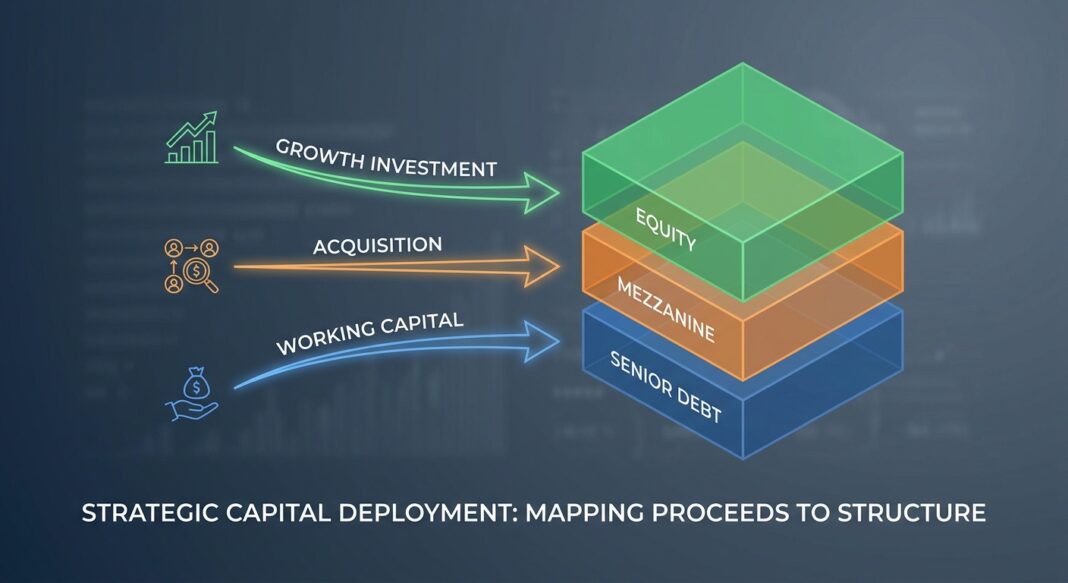
The core discipline is use-of-proceeds mapping: identifying precisely what the capital will do, then selecting the instrument whose risk/return profile matches that specific use. Working capital, growth investment, acquisition financing, and ownership recapitalization are four distinct economic activities. Each belongs at a different layer of the stack and carries a different cost. Conflating them (funding a long-duration acquisition with a short-tenor revolver, for example) is how companies end up with the wrong structure at the worst time.
The Cost of Capital Spectrum: From Senior Bank Debt to Growth Equity
Before mapping proceeds, practitioners need a clear view of the pricing and access spectrum available at the growth stage. The stack, organized from lowest cost and highest seniority to highest cost and most junior, generally runs as follows:
- Senior secured bank debt (revolvers, term loans): Lowest cost (typically benchmark + 200–350 bps in current markets), but access requires tangible assets or stable, predictable cash flow. Covenants are maintenance-based, you must stay inside financial ratios at all times, not just when you act. Suitable for working capital and asset-backed needs.
- Private credit / direct lending (unitranche or first-lien): Sits just above bank pricing, often SOFR + 450–650 bps in today’s environment for growth-stage borrowers, but offers significantly more structural flexibility. Incurrence-based covenants (triggered by actions, not ongoing financial tests) are increasingly standard. Suitable for acquisition financing and growth capex where bank appetite is limited.
- Mezzanine / subordinated debt: Priced to generate blended returns of 12–18%, often combining cash pay interest with PIK (payment-in-kind) accrual and an equity kicker via warrants or a co-investment right. Fills the gap between what senior lenders will fund and what equity investors need to own. Suitable for leveraged buyouts, recapitalizations, and sponsor-backed growth transactions.
- Preferred equity: Carries a liquidation preference and negotiated dividend (often 8–12%), providing downside protection for the investor while leaving common equity upside intact. Suitable for growth capital injections where founders want to limit dilution relative to a full common equity raise.
- Growth equity / venture capital: The most expensive capital in dilution terms, but the only instrument with no fixed repayment obligation. Suitable for high-uncertainty, high-velocity investment phases: new market entry, product bets, and acquisitions that cannot be underwritten on current cash flow.
As re-cap.com frames it, the capital stack tells you who gets paid in what order, and that priority order determines risk allocation for every party in the structure. Understanding seniority is not academic: it is the lens through which every counterparty in your deal will evaluate their exposure.
Tactical Breakdown: Matching the Use-of-Proceeds to the Layer
Here is how the mapping works in practice for a growth-stage business preparing a $20M capital raise:
Working capital ($3M): This is the most senior, most bankable use. A revolving credit facility from a commercial bank, sized against receivables or recurring revenue, is the right instrument. Cost is low; structure is clean. Do not use equity to fund working capital; that is an expensive mistake that permanently dilutes ownership for a transient need.
Growth investment: sales, headcount, product ($7M): If the company has 12–18 months of predictable cash conversion, venture debt or a direct lending term loan is appropriate. The key underwriting question is whether the growth spend has a measurable payback period. If it does, debt is efficient. If the payback is uncertain, preferred equity or growth equity is the more honest instrument, debt repayment pressure on unproven spend destroys optionality, as lendity.com illustrates with the hardware startup case study where covenant constraints blocked fulfillment of confirmed purchase orders.
Acquisition ($10M): The most structure-intensive use. The right answer depends on whether the target has hard assets (go senior secured), recurring revenue (go private credit / unitranche), or is a speculative bolt-on (layer mezzanine or bring in a co-investor). The guiding principle from flowcap.com applies: each new layer added to the stack changes the liquidation waterfall and, therefore, the incentive structure of every existing stakeholder.
The Gap Capital Playbook: Quantify, Prepare, Run the Process
Step 1, Quantify the gap precisely. Start with a rolling 24-month cash model. Identify the point at which existing resources are exhausted under a base case and a downside case. The gap is not the amount you want to raise; it is the amount required to reach the next proof point, the milestone that will either unlock organic cash flow sufficiency or justify a better-priced subsequent raise. Raise to that milestone, plus a 15–20% buffer. Over-raising on equity is expensive; under-raising on debt creates covenant breach risk.
Step 2, Build the data room around the instrument, not just the business. A bank process requires trailing twelve months of financials, borrowing base detail, and covenant compliance modeling. A direct lending or mezzanine process requires an integrated three-statement model, an EBITDA bridge, and an acquisition thesis if proceeds are M&A-related. A preferred equity process requires a cohort analysis, unit economics by segment, and a capitalization table showing the post-money liquidation waterfall. Match the materials to the audience’s underwriting framework, not to your investor deck.
Step 3, Run the process with optionality. The single most important negotiating dynamic is competitive tension. Approach at least two lenders or investors per layer of the stack simultaneously. As alvren.com recommends, sequence the process: soft-circle equity interest first, negotiate debt terms only after equity interest is confirmed, and never negotiate debt covenants in isolation from the equity structure they sit above. Covenant headroom is meaningless if the equity layer above it has blocking rights that prevent a cure.
Negotiation Guidance: Where Structure Is Won or Lost
The five terms that determine whether a growth-stage capital structure is a strategic asset or a constraint:
- Covenant type and headroom: Push for incurrence-based covenants over maintenance covenants wherever possible. If maintenance covenants are unavoidable (common in bank facilities), negotiate 25–35% headroom above your projected ratio at close, not 10%.
- PIK optionality in mezzanine: A PIK toggle, the right to elect non-cash interest accrual in defined periods, preserves cash during investment cycles without triggering technical default. Standard in quality mezzanine structures; non-negotiable if EBITDA is seasonally volatile.
- Warrant coverage and dilution math: Mezzanine and venture debt warrants are priced on a percentage of the loan amount, typically 0.5–2.0%. Model the dilution at three exit scenarios, as lendity.com prescribes, before accepting any warrant package. A 1% warrant at a $50M post-money valuation is a very different economic event than the same warrant at a $15M valuation.
- Liquidation preference structure: Standard market is 1x non-participating preferred. Participating preferred, where the investor takes their preference and participates in residual proceeds, materially subordinates common equity. Resist it; if unavoidable, cap participation at a defined return multiple.
- Pre-payment and portability: Ensure the debt can be repaid or assumed in an acquisition scenario without punitive make-whole provisions. Locking a company into a five-year fixed call structure with a 3–2–1% premium schedule can destroy deal economics in a sale process.
Key Takeaways
- Use-of-proceeds drives instrument selection: Working capital, growth spend, acquisitions, and recapitalizations each belong at a different layer of the cost of capital spectrum, conflating them is structurally expensive.
- The capital stack is a priority map, not just a balance sheet: Every instrument added changes the liquidation waterfall and the incentive alignment of every existing stakeholder in the structure.
- Quantify the gap to the next milestone, not to maximum ambition: Over-equitizing dilutes unnecessarily; under-capitalizing on debt creates covenant breach risk at the worst moment in the growth cycle.
- Competitive tension is the primary negotiating lever: Running multiple counterparties simultaneously across each layer of the stack is the only reliable mechanism for moving terms on covenants, pricing, and equity economics.
- Negotiate structure before price: Covenant type, PIK optionality, warrant coverage, liquidation preference mechanics, and pre-payment flexibility determine long-run outcomes more than the headline interest rate or valuation.


