
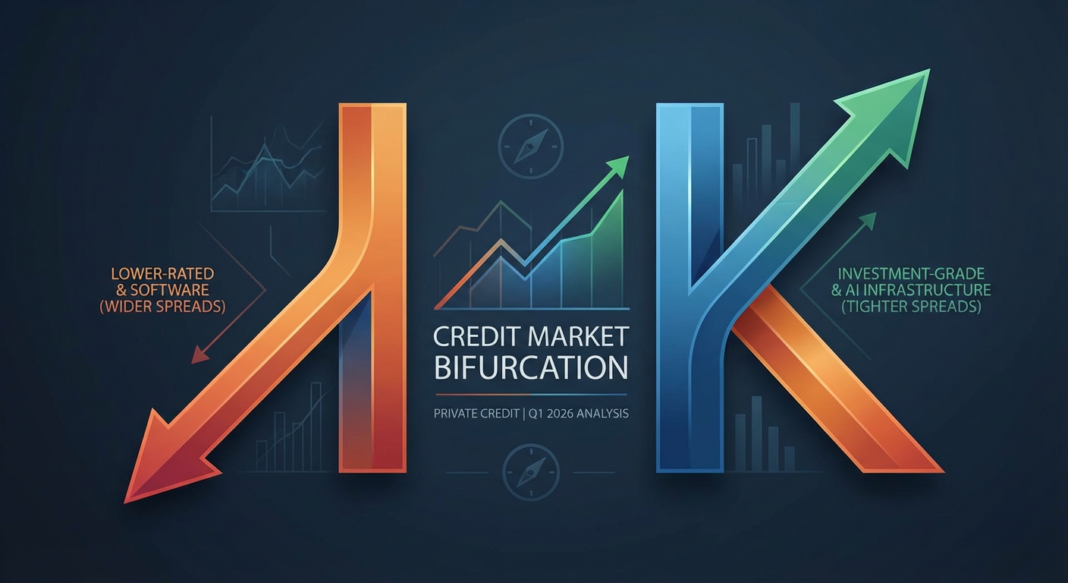
The Great Credit Bifurcation: Private Credit Spreads Widen as K-Shaped Market Redefines Lender Appetite
Market Intelligence Briefing, Bond Capital | April 28, 2026
Market Headline: A Decisive Inflection Point
The first quarter of 2026 has delivered a structural reset across U.S. credit markets that operators and institutional investors cannot afford to misread. Total U.S. leveraged loan primary activity, including repricings, fell to approximately $235–241 billion, representing a 32–34% decline versus Q1 2025’s $355 billion pace, the weakest quarterly start since the 2020 pandemic shock. This is not a technical correction. It is the crystallization of a K-shaped credit market in which a narrow tier of investment-grade and upper-BB borrowers retains near-frictionless capital access, while a growing cohort of lower-rated, software-exposed, and highly leveraged issuers faces a genuine liquidity crunch, one that could catalyze a material wave of restructurings through late 2026 and into 2027.
Three macro forces converged to produce this environment. First, the Federal Reserve’s rate-cutting cycle stalled after a Middle East conflict drove Brent crude above $120 per barrel in February, reigniting inflationary pressure. Second, Anthropic’s Claude AI agent launch triggered a sector-wide repricing of software credit risk, as markets began stress-testing the durability of SaaS cash flows against autonomous AI substitution. Third, the April 2026 anniversary of sweeping trade tariffs: including a 100% levy on branded pharmaceuticals, injected fresh supply-chain uncertainty into healthcare lending. The result: refinancing volume collapsed 42%, repricing activity fell 39%, and high-yield spreads for B-rated credits widened by more than 100 basis points over the quarter.
For lenders and operators, the operative framework is no longer cycle timing; it is selectivity at the asset level.
Quantitative Market Snapshot
The table below captures the key credit market metrics as of April 2026, with prior-period comparisons where available.
| Metric | Current Value (Q1 2026) | Prior Period | Source |
|---|---|---|---|
| Private Credit (Unitranche) Spread | S + 500 bps | S + 450 bps (Q4 2025); S + ~450–475 bps (mid-2025) | hamiltonlane.com / mondaq.com |
| BSL Single-B New Issue Spread (late 2025 peak) | S + 319 bps (late 2025 trough, now widening) | S + ~370 bps (pre-repricing cycle, early 2025) | mondaq.com |
| High-Yield Spread (B-rated credits) | +100 bps wider QoQ; spread moved from ~2.65% to ~3.17% OAS | 2.65% (Q4 2025) | investor.wedbush.com |
| U.S. Leveraged Loan Primary Volume (Q1 2026) | ~$235–241 billion | ~$355 billion (Q1 2025); down 32–34% YoY | sikich.com / investor.wedbush.com |
| Leveraged Loan Distressed Ratio (below 80 cents) | 7.23–8.89% (March–Feb 2026 range) | ~4–5% (most of 2025) | hamiltonlane.com / investor.wedbush.com |
| LTM Leveraged Loan Payment Default Rate (Feb 2026) | 1.36% by issuer count; 3.54% incl. distressed exchanges | 4.24% avg (2025 incl. distressed exchanges) | hamiltonlane.com |
| Private Credit AUM (Global) | ~$1.8 trillion (~6% of U.S. GDP) | ~1% of GDP (2008); projected to double in 5 years | cressetcapital.com |
| LBO Equity Contribution (2025) | 49% of total capitalization | ~33% (2007 pre-GFC) | hamiltonlane.com |
Note: BSL = Broadly Syndicated Loan; S = SOFR; OAS = Option-Adjusted Spread; LTM = Last Twelve Months.
A critical KPI signal for underwriters: with unitranche spreads back at S+500 and all-in yields stabilizing around the low-to-mid double digits, Fixed Charge Coverage Ratios (FCCR) are under acute pressure for borrowers carrying leverage above 5.0x EBITDA. Lenders are increasingly applying a minimum FCCR covenant floor of 1.10x–1.15x on new originations, tighter than the 1.05x floors common in 2024’s accommodative market. Debt-to-EBITDA multiples on new middle-market deals are being quoted at 4.5x–5.0x senior / 5.5x–6.0x total, a compression of roughly 0.5–0.75x versus peak 2024 leverage levels.
Sector Analysis: Who Lenders Are Backing, and Who They Are Avoiding
Software / SaaS, Tightest Conditions in Five Years. The single most consequential sector development of Q1 2026 is the rapid repricing of software credit risk. JP Morgan has already moved to tighten advance rates to non-bank lenders specifically in relation to software assets, a harbinger of broader tightening that could ripple across the CLO and BDC ecosystem. Seat-based SaaS models with agentic AI substitution exposure are facing both spread widening and covenant tightening simultaneously. Lenders are demanding lower LTVs, tighter PIK restrictions, and monthly financial reporting cadences on new software originations. Per hamiltonlane.com, mission-critical, deeply entrenched software with long-term contracted revenue remains financeable, but at meaningfully higher pricing and lower leverage.
Energy & Infrastructure, The New Beneficiaries of Sector Rotation. With oil above $120/barrel and geopolitical risk structurally elevated, capital is rotating decisively into hard-asset and energy infrastructure deals. Asset-backed structures tied to contracted cash flows (equipment leasing, pipeline royalties, midstream infrastructure) are attracting premium lender appetite. The reinstatement of full bonus depreciation under recent U.S. tax policy further enhances the after-tax attractiveness of infrastructure credit for institutional allocators, per cressetcapital.com.
Healthcare, A Bifurcated Picture. The 100% tariff on branded pharmaceuticals is creating acute supply-chain stress for companies with complex international manufacturing exposure, causing lenders to underwrite international healthcare credits more conservatively. Domestically oriented healthcare services and med-tech, exemplified by the successful $7.25 billion Hologic financing, continue to attract strong demand, per investor.wedbush.com.
Media & Telecom, Locked Out. Legacy media and traditional telecom remain in the K-shape’s lower arm. Cumulus Media’s second Chapter 11 filing in eight years, restructuring $592 million in debt, is emblematic of structural secular decline meeting a hostile refinancing environment.
AI Infrastructure & Data Centers, Upper-Arm Standouts. Oracle’s successful pricing of a $38 billion debt package to fund AI-integrated data center expansion demonstrates that AI-adjacent infrastructure with clear contracted revenue retains exceptional capital market access even in a broadly risk-off environment.
Implications for Institutional Investors and Operators
For Borrowers/Operators: The era of opportunistic refinancing and spread compression is over for all but the most creditworthy issuers. Operators approaching debt maturities in late 2026 or 2027: particularly those carrying leverage above 5.0x with FCCR below 1.20x, must act decisively now. Options include selling non-core assets to reduce gross leverage, proactively extending maturities while market windows remain open for higher-quality credits, or engaging private credit providers for rescue or bridge financing at double-digit all-in rates. Operators in software must be prepared to demonstrate AI resilience explicitly in lender presentations: customer retention data, churn metrics, contract duration, and evidence of mission-criticality are now table-stakes diligence items.
For Institutional Lenders/Investors: The widening of private credit spreads back to S+500 represents a materially improved entry point relative to the compressed S+450 environment of late 2025. However, per cressetcapital.com, the structural mismatch between illiquid assets and semi-liquid vehicle design, not credit quality deterioration, is the primary driver of current redemption pressure. Investors in interval funds and non-traded BDCs should stress-test their liquidity waterfalls. The FS KKR dividend cut from $0.64 to $0.48 per quarter is a leading indicator of potential similar actions across the BDC landscape as NAV marks absorb spread widening. Asset-backed and infrastructure-oriented private credit strategies are best positioned to capture the current opportunity set while managing downside risk through tangible collateral support.
Forward-Looking View: Next 3–6 Months
The credit market’s near-term trajectory hinges on two variables: the duration of the Middle East conflict and the Federal Reserve’s inflation response. If Brent crude remains elevated and the Fed holds rates through Q3 2026, the higher-for-longer environment will sustain private credit yields at current or wider levels, beneficial for new originations but increasingly burdensome for leveraged borrowers already in the portfolio. The distressed ratio’s climb to 7.23–8.89% is a statistically reliable 6–12 month leading indicator of default acceleration; portfolio managers should be stress-testing coverage ratios under base and bear-case EBITDA scenarios now.
The structural tailwind for private credit as a strategic alternative to bank lending remains intact. With approximately $1.3 trillion in bank loans and $1.1 trillion in undrawn commitments extended to non-bank financial institutions globally, per cressetcapital.com, and banks actively tightening advance rates in software and other high-risk sectors, the opportunity set for disciplined private lenders is expanding. The watchword for H2 2026 is selectivity: capital is available, but it is no longer price-agnostic, leverage-tolerant, or sector-indifferent.
Key Market Insights
- Spread Reset Creates New Entry Point: Private credit unitranche spreads have repriced from S+450 to S+500, restoring a yield premium over public credit that had been eroded through the 2024–2025 repricing cycle. New originations benefit; existing floating-rate borrowers face FCCR compression.
- Software Credit is the Epicenter of Risk: JP Morgan’s tightening of advance rates on software collateral signals a systemic repricing of the sector, not merely idiosyncratic stress. Lenders underwriting software assets must scrutinize AI substitution risk, seat-based revenue models, and customer churn alongside traditional EBITDA metrics.
- Asset-Backed Structures Outperform on Risk-Adjusted Basis: Infrastructure, equipment leasing, and royalty-linked credit strategies offer collateral protection, favorable tax treatment via bonus depreciation, and contracted cash flow visibility, making them the preferred structure for new institutional allocations in this environment.
- Distressed Ratio at 7–9% Warrants Portfolio-Level Stress Testing: The distressed loan ratio’s move from 4–5% in 2025 to 7.23–8.89% in early 2026 is a historically reliable 6–12 month forward indicator of default acceleration. Operators and lenders with 2026–2027 maturity exposure must act now, not at the wall.
- M&A Financing Concentration is a False Signal: More than 40% of Q1 2026 institutional loan volume derived from just five mega-transactions. The apparent resilience of M&A issuance masks weak underlying deal formation; the pipeline entering Q2 reflects 2025 carryover, not new PE activity, reducing confidence in sustained H2 2026 deal flow.


