
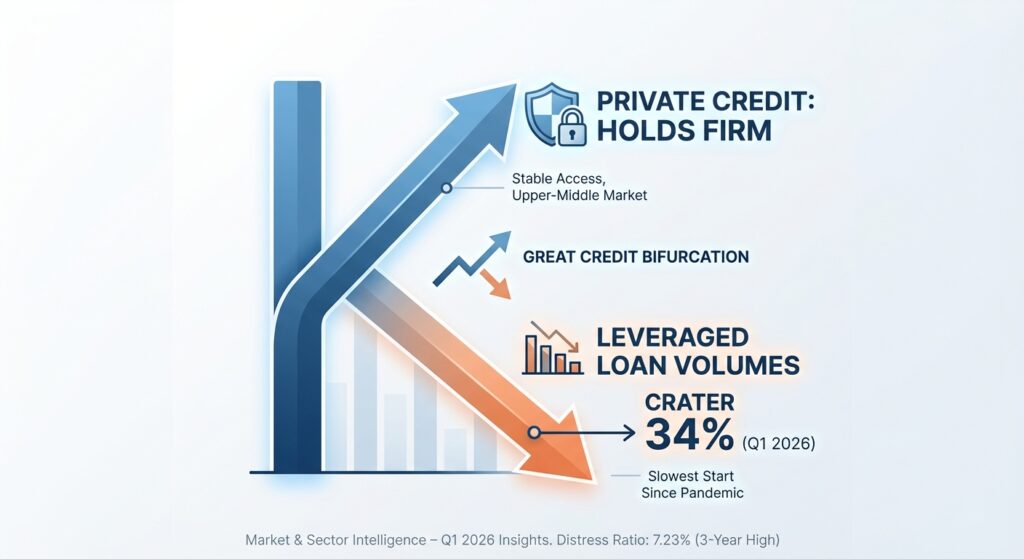
Market Headline: A K-Shaped Credit Market Takes Hold
The first quarter of 2026 has delivered a defining structural moment for credit markets. A confluence of geopolitical instability, an oil price shock that pushed Brent crude above $120 per barrel, and a Federal Reserve forced to pause its rate-cutting cycle has produced what analysts are calling a “Great Credit Bifurcation.” According to MarketMinute via FinancialContent, leveraged loan primary activity collapsed 34% year-over-year in Q1 2026, falling from $355 billion to just $235 billion, marking the slowest start to a year since the COVID-19 pandemic. Refinancings dropped 42% and repricings fell 39% over the same period.
The result is a stark K-shaped market: elite investment-grade and upper-middle-market borrowers continue to access capital at tight spreads, while a growing cohort of lower-rated, cyclical, and sector-specific issuers (particularly in software and media) find themselves effectively locked out. The distress ratio (the share of loans trading below 80 cents on the dollar) climbed to 7.23% in March 2026, its highest level in three years, per MarketMinute. For institutional investors and operators navigating debt structures, understanding which side of the K they occupy is now the central strategic question.
Quantitative Market Snapshot
The data below synthesizes the most current available metrics across public and private credit markets as of April 2026. Together, they frame the credit cycle’s current position and the divergence in conditions across borrower quality tiers.
| Metric | Current Value (Q1 2026) | Prior Period | Direction | Source |
|---|---|---|---|---|
| Leveraged Loan Primary Volume (Q1) | $235B | $355B (Q1 2025) | ▼ ‑34% | MarketMinute / FinancialContent |
| Leveraged Loan Distress Ratio | 7.23% (March 2026) | ~4–5% (Q1 2025 est.) | ▲ 3-Year High | MarketMinute / FinancialContent |
| Middle Market Credit Spreads (S+) | Near historic lows; low-to-mid band pricing dominant | Unchanged QoQ (Q4 2025) | → Flat / Compressing | Valuation Research Corp. |
| Middle Market OID (Original Issue Discount) | ~98.75–99.25 | ~98.50–99.00 (Q3 2025) | ▲ Tightening | Valuation Research Corp. |
| BCRED (Blackstone Private Credit) Redemptions | $3.7B (Q1 2026; ~8% of NAV) | Below gate threshold (prior quarters) | ▲ Record High | MarketMinute / FinancialContent |
| Fed Funds Rate (Top of Range) | 3.75% (paused; rate-cut cycle halted) | 4.00% (pre-Q4 2025 cuts) | → On Hold | McDermott Will & Schulte / Mondaq |
From a KPI standpoint, lender underwriting standards are quietly bifurcating in parallel with market volumes. Per Valuation Research Corp., pricing grids tied to leverage step-downs, such as S+475 stepping to S+450 upon reaching a deleveraging milestone, are increasingly standard for quality borrowers. By contrast, cyclical, tariff-exposed, or highly leveraged issuers are being priced at the upper band of the spread range or excluded from the market entirely, implying minimum FCCR requirements are tightening and maximum debt-to-EBITDA tolerances are narrowing for risk-off credit profiles.
Sector Analysis: Where Lender Appetite Is Expanding, and Retreating
The current credit cycle is producing sharp sector-level divergence in lender appetite. According to KKR’s Q4 2025 Credit Market Review, “greater dispersion between stronger and weaker borrowers” is the defining feature of credit markets entering 2026, with software valuations being specifically reassessed and defaults expected to rise from historically low levels.
🔴 Tighter Credit / Lender Caution
- Software & Technology (Select Subsectors): AI-driven valuation reassessments and volatile growth multiples have caused lenders to demand higher risk premiums or exit the sector. The distressed cohort is concentrated here, per MarketMinute.
- Media & Entertainment: Structural revenue deterioration and high leverage have effectively locked many issuers out of the primary leveraged loan market. This cohort represents a disproportionate share of the 7.23% distress ratio.
- Tariff-Exposed Industrials & Consumer Goods: As noted by Valuation Research Corp., tariff- and cycle-exposed credits are being pushed to the upper end of the spread band or face outright rejection, with lenders demanding conservative FCCR coverage (typically >1.25x) and lower leverage multiples.
🟢 Active Lending / Relative Opportunity
- Healthcare & Life Sciences: Non-cyclical cash flows and visible EBITDA trajectories continue to attract private credit capital. Lenders remain comfortable with leverage multiples in the 4.0x–5.0x net debt-to-EBITDA range for quality healthcare platforms.
- Infrastructure-Adjacent & Energy Transition: With Brent crude elevated and energy security a policy priority, infrastructure credit (including renewables and grid modernization) is seeing sustained institutional demand.
- Upper-Middle Market M&A Finance: Per McDermott Will & Schulte, private equity firms holding legacy portfolio companies for seven to eight years are being pressured to exit, creating a pipeline of LBO-related financing needs that private credit managers are well-positioned to serve.
Structurally, the competition between broadly syndicated loans (BSL) and private credit, fierce throughout 2024–2025, has temporarily eased as BSL volumes have cratered. This gives direct lenders a window to price deals with less competitive pressure, though PIMCO’s Credit Market Lens cautions that public corporate bond markets are actually demonstrating stronger liquidity today than at any point since the GFC, a counternarrative to private credit’s liquidity premium argument that institutional allocators should weigh carefully.
Implications for Institutional Investors & Operators
For Borrowers & Operators
The window for opportunistic refinancing has effectively closed for all but the highest-quality credits. Operators with upcoming debt maturities in 2026–2027 must assess their credit profile against tightening underwriting thresholds: lenders are increasingly requiring demonstrated FCCR of 1.20x–1.35x minimum and are stepping down leverage tolerance to 4.0x–4.5x net debt-to-EBITDA for cyclical sectors. Borrowers with tariff-exposed supply chains or declining EBITDA trajectories should proactively restructure debt profiles before conditions tighten further. The pricing-grid step-down structure now prevalent in middle market deals, rewarding deleveraging with spread reduction, creates a direct financial incentive to prioritize cash flow conversion and balance sheet discipline.
For Institutional Investors & Lenders
The record $3.7 billion in BCRED redemption requests, requiring Blackstone to deploy $400 million of balance sheet capital to honor withdrawals above its 5% quarterly gate, is a structural warning about liquidity mismatches in semi-liquid private credit vehicles, as underscored by PIMCO. Allocators should review redemption gate provisions, portfolio liquidity ladders, and the concentration of NAV in illiquid positions. Meanwhile, the BSL volume collapse creates a genuine origination opportunity for direct lenders with capital to deploy, particularly in upper-middle market and sponsor-backed transactions where private credit can offer speed and certainty of close in exchange for spread premiums that remain historically compressed but are beginning to widen at the margin for risk-off credits.
Forward-Looking View: Next 3–6 Months
The near-term outlook hinges on three macro variables: the Federal Reserve’s rate trajectory, the resolution (or escalation) of trade policy uncertainty, and whether the bottom 10% of the distressed credit cohort triggers a contagion effect or is absorbed through workouts and restructurings. KKR’s credit team notes that while headlines feel increasingly uncertain, aggregate credit spreads remain near historical tights, suggesting that market pricing has not yet fully discounted the risks embedded in the distressed tail.
Valuation Research Corp. maintains a constructive deal backdrop for higher-quality middle market assets, driven by dry powder overhang and PE exit pressure, but explicitly flags that tariff- and cycle-exposed credits may face materially higher required returns in the quarters ahead. If the Fed remains on hold and oil prices stay elevated, expect further spread widening at the lower quality tier, a continued uptick in the distress ratio toward 8–9%, and selective spread compression for defensive, cash-generative sectors where lender competition remains intense. The bifurcation is not a temporary dislocation; it is a structural re-pricing of risk that is likely to define credit market dynamics through at least Q3 2026.
Key Market Insights
- Volume Collapse Is Selective: The 34% leveraged loan volume drop is concentrated in refinancings and repricings, not new M&A activity, signaling that deal flow can rebound quickly if macro conditions stabilize, but borrowers should not count on a near-term window.
- Distress Ratio Is a Leading Indicator: At 7.23% and climbing, the distress ratio is signaling a default wave in the bottom credit tier. Operators and lenders with exposure to software, media, and tariff-exposed industrials should stress-test recovery assumptions now.
- OID Tightening Masks Spread Stability: Middle market spreads are flat QoQ, but OIDs tightening to 98.75–99.25 mean all-in economics are shifting. Lenders are capturing less upfront fee income, making covenant and structural protections more important than ever.
- Liquidity Risk Is Real in Semi-Liquid Vehicles: BCRED’s gate activation is a market-wide signal. Institutional allocators to interval funds and BDCs must rigorously model liquidity mismatch scenarios, particularly in a risk-off environment where retail redemption pressure amplifies.
- Private Credit Has a Deployment Window: With BSL volumes cratered and bank appetite constrained, direct lenders with committed capital and lean decision-making processes are best positioned to capture quality deal flow in H1 2026, but selective credit discipline is non-negotiable in this environment.


