
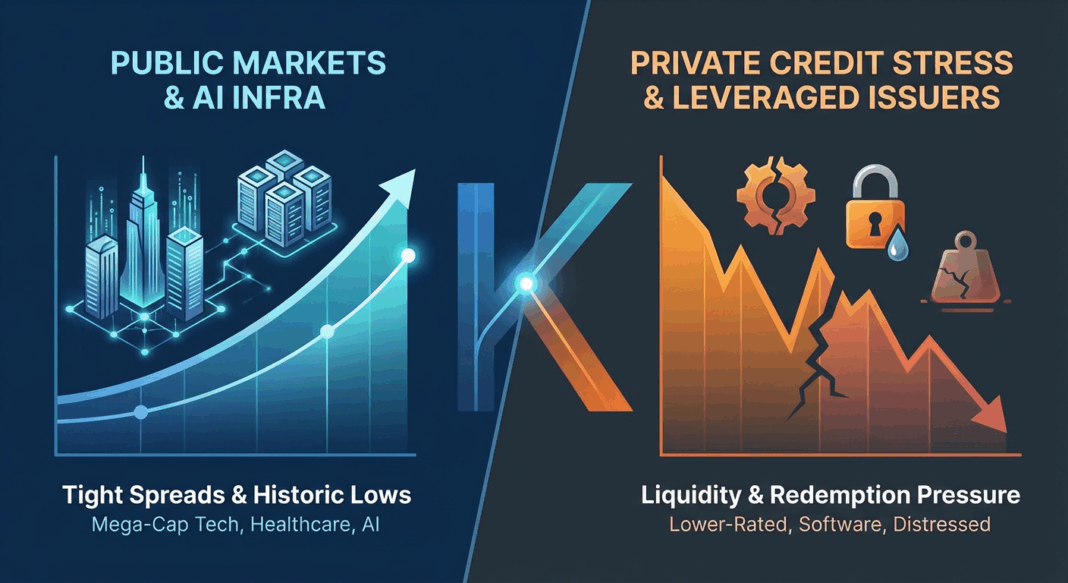
Market Headline: A K-Shaped Credit Cycle Takes Hold
The defining macro story of Q2 2026 is a structural bifurcation in credit access: a K-shaped credit cycle where elite borrowers enjoy historically tight spreads while a growing cohort of leveraged, lower-rated issuers faces illiquidity, redemption pressure, and double-digit default rates. This is not a uniform credit correction. It is a selective de-risking event, driven by the convergence of sustained elevated base rates, an oil-driven inflation resurgence, agentic AI disruption to legacy software valuations, and a stress-test of the private credit industry’s wealth-channel liquidity architecture.
Public credit markets, as of April 15, 2026, reflect an almost paradoxically risk-on posture: high yield spreads have compressed to 285 basis points: the 5th historical percentile, while investment grade spreads sit at 80 bps, the 6th percentile, per finexus.net. This compression is being driven by mega-cap issuers in tech, healthcare, and AI infrastructure, the “upper arm” of the K. The lower arm (software-heavy middle-market borrowers, distressed media operators, and over-leveraged sponsor-backed platforms) faces a very different reality: redemption gates, widening spreads, and a primary market that is effectively closed to them.
The catalyst sequence is now well established. Beginning in early January 2026, geopolitical instability and aggressive new trade policy eroded investor confidence. By February, an oil shock pushed Brent crude above $120/barrel, reigniting inflation and forcing the Federal Reserve to halt its anticipated rate-cutting cycle. The result: a 34% decline in leveraged loan primary activity in Q1 2026, falling to $235 billion from $355 billion in Q1 2025, the slowest start to a year since the 2020 pandemic, per investor.wedbush.com.
Quantitative Market Snapshot
The following data table captures the current state of credit markets across both public and private channels as of April 2026. Underwriting KPI benchmarks reflect current lender expectations for new credit facilities.
| Metric | Current Value | Prior Period | Change | Source |
|---|---|---|---|---|
| High Yield Spread (OAS) | 285 bps (5th percentile) | 328 bps (Apr 2, 2026) | −43 bps (1 month) | finexus.net |
| Investment Grade Spread (OAS) | 80 bps (6th percentile) | 92 bps (1 month prior) | −12 bps (1 month) | finexus.net |
| Direct Lending 1st Lien Spread | ~486–502 bps (S+) | ~524 bps (Dec 2024) | −~38 bps (12 months) | antares.com |
| Leveraged Loan Primary Issuance (Q1 2026) | $235B total / ~$70B new money | $355B (Q1 2025) | −34% YoY | investor.wedbush.com |
| Distress Ratio (loans trading <80¢) | 7.23% (March 2026) | ~4% (12 months prior, est.) | Highest in 3 years | investor.wedbush.com |
| U.S. Private Credit Default Rate | 9.2% (2025, Fitch monitor) | 8.1% (2024) | +110 bps YoY, record high | atlaspeakresearch.com |
| Public BDC Discount to Reported NAV | ~78 cents on the dollar (Mar 12) | ~85 cents (Jan 2026) / ~par (early 2025) | Significant deterioration | atlaspeakresearch.com |
| Software Borrower Avg. Leverage | 7.4x EBITDA | 5.9x (broader loan pool) | +1.5x vs. market average | atlaspeakresearch.com |
KPI Benchmarks for New Credit: Lenders in the current environment are requiring minimum FCCR of 1.25x–1.50x for senior secured facilities, with leverage caps tightening toward 5.0x–5.5x net debt/EBITDA for B-rated middle-market credits, a meaningful compression from the 6.0x–6.5x multiples tolerated in 2021–2022. Debt-to-equity requirements are similarly stricter, with lenders increasingly demanding meaningful equity cushions of 40%+ in leveraged buyout structures.
Sector Analysis: Where Lenders Are Leaning In, and Pulling Back
🔴 Cold: Software & Legacy SaaS
Software has become the most acute pressure point in private credit. Per atlaspeakresearch.com, software accounts for approximately 16% ($235B) of the $1.5 trillion U.S. loan market, with 50% of software loans rated B− or lower, nearly 78% sponsor-backed, and roughly 30% maturing by 2028. Software equity valuations have declined approximately 22% since January 2026, directly inflating loan-to-enterprise-value ratios on associated credits. The emergence of agentic AI, capable of automating functions previously underpinned by SaaS seat licenses, is triggering a structural re-rating of growth assumptions. Lenders are actively reducing software exposure, widening spreads for new software-sector facilities by an estimated 75–100 bps relative to Q4 2025 levels, per sikich.com.
🔴 Cold: Media & Distressed Consumer
Legacy media operators are facing an existential liquidity crunch. Cumulus Media filed for its second Chapter 11 in eight years in March 2026 to restructure $592 million in debt. New Fortress Energy entered a Restructuring Support Agreement. Lender appetite for sub-investment-grade media credits has effectively closed, per investor.wedbush.com.
🟢 Hot: AI Infrastructure, Energy & Hard Assets
The sector rotation out of software is flowing directly into hard-asset and infrastructure credits. Oracle’s successful pricing of a $38 billion debt package for AI data center expansion (and the strong demand for Electronic Arts’ $20 billion buyout financing led by Silver Lake) confirm that lenders remain highly receptive to cash-flow-positive, asset-backed, or AI-infrastructure-aligned borrowers. Energy and industrials credits have seen YTD equity outperformance of +24.7% and +10.4% respectively per finexus.net, signaling sustained lender confidence in those sectors.
🟡 Cautious: Healthcare
The April 2026 anniversary of the 2025 tariff implementations, including a 100% tariff on certain branded pharmaceuticals, has introduced meaningful supply-chain risk for healthcare borrowers with international exposure. Lenders are demanding more conservative FCCR thresholds (1.40x–1.60x) for healthcare facilities with cross-border supply dependencies, per investor.wedbush.com. Hologic’s successful $7.25 billion loan pricing demonstrates that high-quality, domestic-revenue healthcare names remain fundable, but conditions are highly selective.
Implications for Institutional Investors & Operators
For Borrowers
The market is open, but only for the strongest credits. Operators approaching refinancing windows in late 2026 or 2027, particularly those carrying leverage above 5.5x EBITDA or with FCCR below 1.30x, should treat the next 90 days as a critical execution window before credit conditions potentially deteriorate further. The 90/10 dynamic is real: 90% of the market remains functional, but the bottom 10% faces rescue financing at double-digit all-in yields. Proactive balance sheet management (asset divestitures, covenant resets, and early refinancing outreach) is not optional for the lower tier.
For Lenders & Institutional Investors
The private credit industry’s structural vulnerability is now fully visible. Semi-liquid perpetual BDC and evergreen structures have encountered their first meaningful real-world redemption stress test, with Blackstone BCRED absorbing $3.7 billion in withdrawal requests (requiring sponsor support), and BlackRock’s HLEND, Morgan Stanley’s North Haven, and Cliffwater’s Corporate Lending Fund all hitting or approaching their quarterly redemption caps, per atlaspeakresearch.com. The public BDC market’s ~78-cent discount to reported NAV signals that institutional investors are applying meaningful haircuts to mark-to-model valuations, a warning sign for reported NAV credibility across the broader private credit universe. FS KKR Capital Corp’s quarterly dividend cut from $0.64 to $0.48 may foreshadow similar actions across the BDC landscape, per investor.wedbush.com.
Direct lending in closed-end institutional structures, whose capital lockups match loan maturities, continues to offer meaningfully superior risk-adjusted positioning relative to wealth-channel vehicles. First lien direct lending spreads of ~486–502 bps over SOFR continue to offer a substantial premium over broadly syndicated loans at ~297–336 bps for comparable BB/B credits, per antares.com.
Forward-Looking View: The Next 3–6 Months
The credit market outlook for Q2–Q3 2026 hinges on two variables: the Federal Reserve’s path and the trajectory of software-sector impairments. Historical parallels from finexus.net suggest that when high yield spreads have been within 10% of current levels, median 3-month spread change is only +1 bps, but the range is wide, from −46 to +44 bps. The S&P 500 has historically been positive 85% of the time in such environments, providing a constructive backdrop for risk assets, but the 73 RSI reading signals potential near-term exhaustion.
The more pressing risk is not public market spread widening but private credit valuation credibility. If semi-liquid vehicle redemption pressure intensifies through Q2, forced asset sales could create secondary loan market dislocations, particularly in software-heavy pools, that cascade into wider marks across the industry. Conversely, any Fed pivot toward rate cuts would meaningfully relieve pressure on floating-rate borrowers currently absorbing the full burden of a higher-for-longer environment. M&A deal flow, while improving per antares.com, remains highly concentrated and dependent on the resolution of PE sponsor return-of-capital pressure. The watchword for H1 2026 remains selectivity, in sector, structure, and vintage.
Key Market Insights
- The 90/10 Rule is Now Market Reality: Public HY spreads at 285 bps (5th percentile) mask severe stress in the bottom 10% of the credit universe, where distress ratios hit a 3-year high of 7.23% in March 2026, per investor.wedbush.com.
- Private Credit Default Rates Are at Record Highs: The U.S. private credit default rate reached 9.2% in 2025 (up from 8.1% in 2024), with sub-$30M EBITDA borrowers now experiencing double-digit default rates, per atlaspeakresearch.com.
- Software Is the Sector to Watch, and Avoid at High Leverage: At 7.4x average EBITDA leverage, 50% rated B− or below, and equity valuations down 22% YTD, software-sector credits carry disproportionate refinancing and mark risk heading into a 2028 maturity wall, per atlaspeakresearch.com.
- Wealth-Channel Liquidity Architecture Has Been Stress-Tested: Major semi-liquid private credit vehicles (BCRED, HLEND, North Haven, Cliffwater CLF) have all hit or approached redemption caps in Q1 2026, revealing structural mismatch risk in retailized private credit products, per atlaspeakresearch.com.
- Direct Lending Premium Remains Compelling in Closed-End Structures: First lien direct lending spreads of ~486–502 bps S+ continue to offer ~150–200 bps of premium over comparable broadly syndicated loans, rewarding disciplined lenders in properly structured vehicles, per antares.com.


