
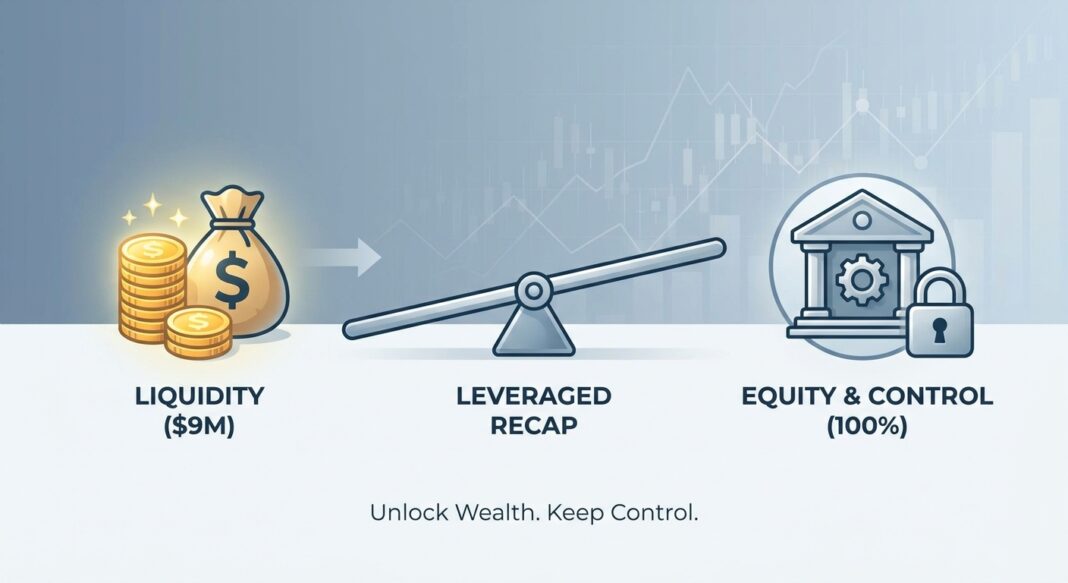
The Founder Who Cashed Out $9M Without Selling a Single Share: Inside the Leveraged Recap Playbook
A manufacturing founder with $5M in EBITDA and a net worth locked inside a single illiquid asset faced the most common dilemma in owner-operated businesses: take chips off the table or keep building. He chose a third path, the leveraged recapitalization, and walked away with $9M in personal liquidity while remaining 100% in control. Here is how it worked, what it cost, and what every founder-operator can learn from the structure.
ⓘ Case Study Note: The founder profile and company scenario below are a hypothetical case study, constructed to illustrate real structural mechanics. All market data, debt multiples, dilution figures, and deal volume statistics are drawn from cited public sources and industry reports.
The Story: All the Wealth, None of the Liquidity
Marcus had spent seventeen years building a precision components manufacturer in the Midwest. The company was good, genuinely good. Revenue had grown to $28M. EBITDA sat at $5M and climbed every year. His team was loyal. His customer base was sticky. His margins were the envy of anyone who understood the business.
On paper, Marcus was worth somewhere between $25M and $35M. In his bank account, he had the same mid-six-figure balance he had maintained for a decade. Every dollar the business generated got recycled into new equipment, working capital, and the next phase of growth. His CPA had been warning him for years: his entire financial life was a single, illiquid, undiversified bet on one privately-held company. His wife had stopped being subtle about it.
The offers came, as they always do. A strategic buyer approached at 6.5x EBITDA, roughly $32M. A private equity firm pitched a full buyout at 6.2x. Both were fair numbers. Both meant walking away from a company he had no interest in leaving. He was fifty-three years old, operationally sharp, and, critically, not done building.
What Marcus needed was not an exit. He needed a way to convert a portion of his locked-up equity into real, spendable wealth without surrendering the business he had spent the better part of two decades constructing. The instrument that solved his problem was one most of his peers had never heard of: a leveraged recapitalization.
The Decision: Structuring the Recap
Marcus had three options in front of him. The first, a full sale, would have delivered immediate, tax-advantaged liquidity but ended his operational role and transferred ownership entirely. The second, doing nothing, preserved his control but left his personal balance sheet dangerously concentrated. The third option, the one his advisor introduced, changed the framing entirely.
A leveraged recapitalization works by having the company take on new debt and distributing the proceeds to its shareholders as a special dividend or equity redemption, while the owner retains full control. As Sofer Advisors describes it: the owner extracts cash from the business without selling to a third party, while the company assumes a higher debt-to-equity ratio and accepts the ongoing interest burden.
The structure Marcus executed looked like this:
- Company EBITDA: $5.0M (trailing twelve months, normalized)
- Debt raised: $18.5M unitranche facility (3.7x EBITDA) from a private credit lender
- Special dividend paid to Marcus: $9.2M (net of fees and transaction costs)
- Ownership change: None. Marcus retained 100% of the equity
- Annual debt service: Approximately $1.55M (blended rate of ~8.5% interest-only in Year 1, transitioning to full amortization)
- Debt coverage ratio: 3.2x, comfortably above the lender’s 2.0x covenant floor
According to the Pepperdine Private Capital Markets Report (2024), lower middle market leveraged recapitalizations typically close at 3x to 5x EBITDA in total debt, with pricing tied to prevailing senior secured rates plus a margin based on risk profile, which placed Marcus’s 3.7x well within the standard range. He did not sell a single share. No VC board seats. No PE firm approvals required for strategic decisions. No dilution to manage. Just a balance sheet with new debt and a founder with nine million dollars and a business to run.
The Outcome: Two Bites, Not One
Three years after the recap closed, Marcus’s company had grown EBITDA to $7.2M, a 44% increase. The debt balance had amortized to approximately $13.1M. At a conservative 6.5x exit multiple, the business was now worth roughly $46.8M. After retiring the debt, Marcus’s equity was worth approximately $33.7M, a meaningful step up from the $25-35M range at the time of the recap.
Now compare the counterfactual: had Marcus sold at the time of the recap for the offered 6.5x multiple ($32.5M), he would have received his after-tax proceeds, closed the chapter, and missed the subsequent growth entirely. The recap, by contrast, gave him $9.2M in immediate personal liquidity and preserved the full upside of the next growth leg.
This is the mechanics of what practitioners call the “first bite and second bite” dynamic. The first bite is the recap distribution: real cash, today, tax-advantaged as a return of capital depending on structure. The second bite is the eventual full exit, taken on Marcus’s timeline, at a valuation reflecting years of additional growth. The debt was the engine. The equity stayed untouched.
The broader market context validates why this moment was right for the trade. According to Capstone Partners, leveraged loan issuance tied to sponsored dividend recaps grew 11% year-over-year to $74.3 billion in 2025, itself following a 326% surge in 2024. Stalled IPO and M&A exit markets have pushed owners and sponsors alike toward the recap structure as a primary tool for liquidity generation. Marcus was ahead of the trend, but the market followed him.
The Lessons: When the Recap Works, and When It Doesn’t
Marcus’s outcome was not accidental. The leveraged recap works when specific conditions are present, and it fails, sometimes catastrophically, when they are not. Understanding the difference is the entire job.
When the structure works:
- Stable, recurring cash flows. Debt service is non-negotiable. The recap is built for businesses with predictable EBITDA, not cyclical or lumpy revenue profiles. Lenders providing leveraged recap financing require sufficient earnings coverage as the primary collateral supporting the loan.
- Conservative leverage multiples. Marcus borrowed at 3.7x EBITDA. At 5x or 6x, the same structure becomes fragile. The coverage ratio becomes the guardrail, most lenders require 2.0x or better, and prudent operators stay well above it.
- Owner with a long runway. The recap makes the most sense for founders five to fifteen years from full exit who want liquidity now without foreclosing on future value. It is a mid-game move, not an endgame.
- Personal diversification need is genuine. When the entire net worth of a family sits inside a single illiquid operating company, the recap is not just a financial transaction; it is risk management. The tool exists precisely to solve this concentration problem without forcing a sale.
When it breaks:
- Revenue deterioration post-close. Additional debt load on a declining business creates a compounding problem. The recap is not a rescue tool; it is a reward structure for operators who have already proven the model.
- Overleveraging for maximum extraction. The temptation to pull out as much cash as possible can push debt multiples past the point of safety. As Pipeline Road’s analysis notes: if the company later underperforms, the leveraged balance sheet can constrain operations or reduce equity value at exit.
- Tight credit environments. The Federal Reserve’s Senior Loan Officer surveys confirm that bank lending standards for leveraged transactions tighten materially during periods of economic uncertainty, which directly affects both available proceeds and pricing. Timing the credit market matters.
The framework for your own decision:
- Start with your debt capacity: what does 3x-4x your normalized EBITDA look like as a cash distribution?
- Model the coverage ratio at base case and downside case, if downside still clears 2.0x DSCR, the structure is survivable.
- Separate the personal liquidity need from the business growth question. They are different problems requiring different solutions.
- Stress test the timeline: if you need to sell in two years, the recap may not be the right tool. If you are five-plus years from exit, the math typically wins decisively.
- Engage an independent valuation and debt capacity analysis before approaching lenders. As Sofer Advisors frames it; these two inputs determine whether the transaction is feasible and what proceeds are realistic before you engage a lender.
Key Insights
- 📌 Liquidity without exit is not a fantasy; it is a structure. The leveraged recapitalization lets owner-operators convert equity into cash without selling a share, triggering a change of control, or accepting an investor’s timeline.
- 📌 The recap market is at record scale. PE-owned companies borrowed roughly $94 billion in leveraged loans and high-yield bonds to fund their own payouts in 2025, according to Moody’s, a post-financial-crisis record. The infrastructure and lender appetite are there for founder-operators too.
- 📌 Concentration risk is the hidden enemy of founder wealth. When a founder’s entire net worth sits inside one illiquid private company, the recap is risk management first and a financial transaction second. Diversification does not require a sale.
- 📌 The “two bites” dynamic is real and powerful. The first bite, recap cash today, and the second bite, a full exit at a future, higher valuation, structurally outperform a single exit today when the business has genuine growth ahead of it.
- 📌 Leverage works best when it is conservative, covered, and calibrated. The sweet spot for lower middle market leveraged recaps is 3x to 5x EBITDA with a debt service coverage ratio above 2.0x. Pushing beyond that for maximum extraction trades short-term liquidity for long-term fragility, and the math rarely recovers.


