
The Story: A $600 Million Check and Eight Years of Patience
In 2018, Anastasia Soare, the Romanian immigrant who turned eyebrow architecture into a billion-dollar beauty empire, did what most founders dream of. She sold a 38% minority stake in Anastasia Beverly Hills (ABH) to private equity giant TPG for approximately $600 million, pocketing an estimated $375 million after taxes while keeping majority control and her CEO title. At a $3 billion valuation, ABH was the darling of the Instagram beauty era. The future looked limitless.
By 2025, S&P had downgraded ABH to a “D” credit rating. Revenue had declined from a peak of roughly $600 million annually to an estimated $420 million. TPG’s stake had been restructured into near-oblivion as creditors converted debt to equity, diluting the PE firm from 38% down to approximately 6%. The $600 million bet was on track to return somewhere between $40–100 million, a staggering $500 million-plus loss on a “safe” consumer brand investment.
Then Anastasia wrote a $225 million check and bought it all back.
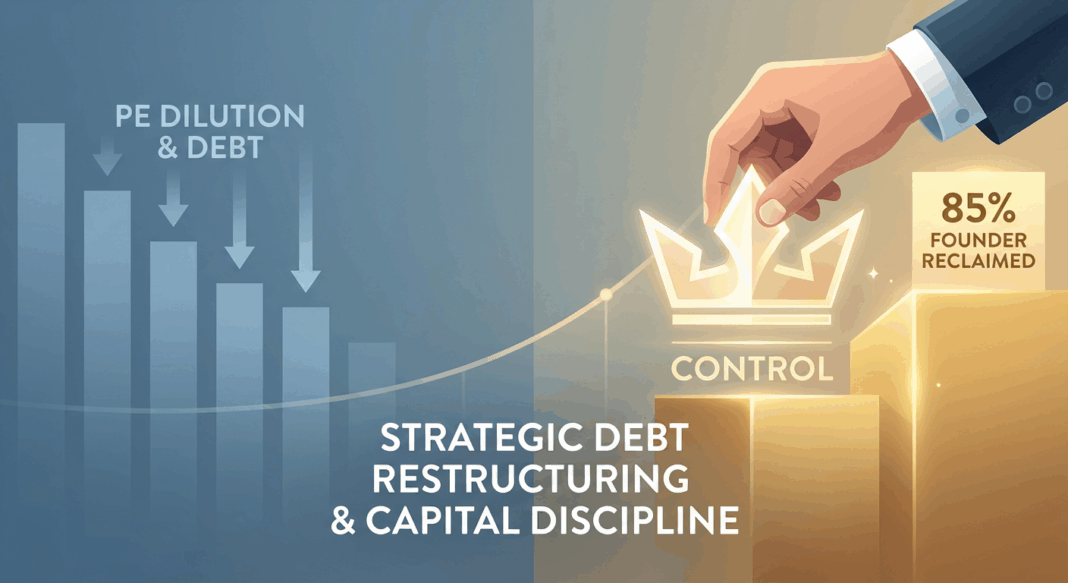
She now owns an estimated 85% of a debt-light company doing $400 million-plus in revenue, and she netted roughly $150 million in cash across the entire cycle. This is not a story of failure. It is a masterclass in patient capital, structural discipline, and knowing exactly when to strike.
The Capital Decision: Minority vs. Majority, Control vs. Liquidity
When TPG came knocking in 2018, Anastasia had options. She could have sold a majority stake (51% or more) for north of $800 million in personal liquidity. She could have pursued an IPO and handed governance to public markets. She chose neither. Instead, she sold a 38% minority stake, retained 62% ownership, and, critically, kept board control.
That single structural decision was the foundation of everything that followed. Control meant she could not be removed as CEO when growth slowed. Control meant she could slow-roll strategic decisions she disagreed with. Control meant that when TPG’s 2020–2022 playbook (expand SKUs aggressively, add leverage to juice equity returns, push into mass-market distribution) began to erode the brand, she could not be overridden entirely, but she could survive.
According to reporting by creatorsblueprint.co, TPG added an estimated $300–400 million in debt onto ABH’s balance sheet post-investment, a standard PE move to amplify equity returns through leverage. At $600 million in revenue and $110 million in EBITDA, the debt was manageable. When revenue declined toward $450 million and EBITDA compressed to an estimated $70 million, annual debt service of roughly $32 million consumed nearly half of operating profit. The margin for error had disappeared.
Anastasia’s move was not impulsive. She held $225 million in liquidity, conservatively invested across eight years, and waited for the restructuring process to do what restructuring processes do: wipe out the equity holders who overplayed their hand.
The Outcome: When the Waterfall Runs Dry on PE, the Founder Buys the River
When ABH missed debt payments and creditors forced a restructuring in 2025, the math became brutal and predictable. Creditors converted approximately $300 million in debt to equity. TPG’s stake was diluted from 38% to roughly 6%. The enterprise value, which had been marked at $3 billion in 2018, had collapsed to an estimated $600 million–$1 billion range.
Anastasia deployed $225 million across four uses: approximately $120 million to retire remaining debt, $40 million to buy out TPG’s residual 6% stake, $25 million to clear other minority investors, and $40 million in working capital to relaunch the brand on her terms. The new structure: 85% founder ownership, a clean balance sheet, and a refocused distribution strategy pulling back from mass retail toward the selective premium positioning that originally built the brand.
The numbers tell the full story of two very different outcomes from the same deal:
| Party | Invested / Deployed | Recovered | Net Position |
|---|---|---|---|
| TPG | ~$600M | ~$40–100M | –$500M+ loss |
| Anastasia Soare | $225M re-invested | $375M taken out + 85% of company ($510–680M value) | +$150M cash + full ownership |
This outcome was not luck. It was structural. The contrast with Divvy Homes, where founder Adena Hefets watched a $1 billion acquisition yield $0 for common shareholders after $735 million in debt consumed the entire exit waterfall, shows what happens when founders do not hold the structural levers. As saastr.com documented in detail, Divvy’s debt raised the founders’ breakeven exit price to a level that made a billion-dollar sale worthless to the people who built it. Anastasia structured the opposite condition: she was the creditor of last resort, not the residual claimant.
The Lessons: Five Principles for Founders Facing a PE Term Sheet
1. Minority Control Is Non-Negotiable
The entire ABH playbook collapses if Anastasia sells 51% in 2018. Board control, even a single vote of majority, is the option that keeps all other options alive. Consumer brand PE deals from 2019–2022 are breaking in waves. The founders who kept board control are positioned to execute exactly what Anastasia executed. The ones who didn’t have already been replaced.
2. Model Your Waterfall Before You Sign
Every founder should be able to answer one question before closing any capital deal: at what exit price do I personally receive zero? Debt does not dilute your ownership percentage; it dilutes your outcome. As the Divvy case illustrates, $735 million in debt means your equity is worth nothing below $735 million plus fees and preferences. The waterfall is not theoretical. It is arithmetic. Run it at every plausible exit price before you sign.
3. Liquidity from a Recap Is Only Powerful If You Keep It Liquid
Anastasia’s eight years of conservative investing (rather than lifestyle inflation or speculative angel bets) is what made the $225 million buyback possible. The recap was not just a liquidity event. It was the first move in a longer capital chess game. The founders who treat recap proceeds as personal spending money permanently forfeit the buyback option.
4. Non-Dilutive Capital Can Maximize Founder Value at Exit
The SafePointe story from timiacapital.com illustrates a complementary principle at an earlier stage. Founders Greg and Timothy Holifield used a $1 million debt facility from TIMIA Capital instead of equity to triple monthly recurring revenue before their acquisition by SoundThinking, their fourth successful exit. Their equity investors made 10x in nine months. TIMIA’s debt cost a fraction of that. “When there are no warrants associated with debt, it is truly fantastic money, and much cheaper than equity,” Greg Holifield noted. The non-dilutive path maximized the equity pool at exit, rather than shrinking it with additional preference stacks.
5. PE Leverage Works: Until the Revenue Assumption Breaks
TPG’s post-investment leverage at ABH was not irrational in isolation. Adding debt to amplify equity returns is textbook private equity. The error was applying software-style leverage assumptions, 3–4x EBITDA debt loads, to a consumer brand whose moat was cultural, not contractual. Consumer brand revenue is not recurring. It is social, trend-dependent, and fragile under brand dilution. When ABH went from “exclusive Instagram brand” to “available at Target,” the customer relationship changed in ways that a debt covenant cannot account for.
The Framework: Recapitalization Decision Tree for Founder-Operators
Before pursuing any minority stake sale or leveraged recap, founder-operators should pressure-test four variables:
- Control Threshold: Will you retain board majority? If not, every subsequent decision is contingent on investor alignment, which is never permanent.
- Debt Sensitivity: Is your revenue contractual and recurring, or cultural and trend-dependent? Higher cultural risk means lower tolerable leverage.
- Waterfall Modeling: At your most likely exit scenario (not your best case), do you receive meaningful proceeds after debt repayment and preference stacks clear?
- Liquidity Discipline: Can you hold recap proceeds in patient, liquid capital for 5–8 years without deploying them? If not, the buyback option evaporates.
The Anastasia Beverly Hills story is not a story about outsmarting private equity. It is a story about founder-operators who understand that capital structure is strategy, and that the most powerful position in any leveraged deal is the one that remains solvent when every other party does not.
Key Insights
- Minority control is the anchor: Anastasia’s retention of 62% and board control in 2018 was the structural prerequisite for the 2026 buyback. Without it, there is no story.
- Debt dilutes outcomes, not cap tables: Every dollar of debt raises the exit price at which founders see zero. Model the waterfall at every plausible exit price, not just the optimistic one.
- Patient liquidity is a strategic asset: Holding $225 million in conservative investments for eight years turned a standard minority sale into a full ownership recovery. Recap proceeds are not spending money; they are future optionality.
- Non-dilutive capital at the right stage maximizes equity pools: SafePointe’s founders used $1M in venture debt to triple MRR before acquisition, preserving equity value for all stakeholders while debt cost a fraction of what equity investors earned on the same capital.
- Consumer brand leverage is structurally different from SaaS leverage: Cultural revenue moats break under brand dilution. Applying high debt loads to trend-dependent businesses elevates bankruptcy risk precisely at the moment revenue declines, which is when PE playbooks typically cause it.


