
THE STORY
Established in 2000, WatchWire (formerly known as EnergyWatch) was built the hard way: through years of bootstrapping and steady, methodical growth. Originally founded as an energy consulting and procurement advisory firm serving the deregulated energy markets of New York, the company always had a pulse on the evolving needs of large corporate utility consumers.
Over the years, the market underwent a fundamental shift. Environmental concerns, carbon accounting, and stringent ESG (Environmental, Social, and Governance) reporting ceased being peripheral issues and became central corporate mandates. Recognizing this massive market gap, WatchWire’s leadership made a critical pivot; they evolved from a traditional consulting firm into a fully-fledged SaaS platform, designing software to help enterprise clients navigate complex, non-standardized sustainability reporting frameworks.
By 2021, the pivot was an undeniable success. WatchWire had established strong product-market fit, cultivated a deeply loyal customer base, and built highly predictable recurring revenue streams. Naturally, this traction caught the attention of the wider market. Private equity firms, venture capitalists, and larger strategics began circling, recognizing the explosive potential of cleantech and carbon accounting.
At this crucial inflection point, WatchWire needed capital to accelerate its go-to-market motions and scale its platform ahead of competitors. Founder and CEO Andy Anderson was faced with a classic entrepreneurial dilemma: raise equity to fuel the rocket ship, or find another way. [timiacapital.com](https://timiacapital.com/how-watchwire-used-debt-financing-to-achieve-a-successful-exit/)
THE DECISION
The traditional technology playbook in 2021 was simple: raise a massive Series A or Series B from a venture capital firm. For a SaaS company with WatchWire’s momentum, an equity round could have easily brought in $5 million to $10 million in fresh capital. However, such an injection comes with a heavy permanent cost. A typical venture round would have required sacrificing 20% to 30% of the company’s equity, giving up a board seat, and accepting preferred return structures that misalign founder and investor incentives during early exits.
Having bootstrapped for two decades, WatchWire’s executive team was immensely protective of their cap table. They owned their business and wanted to maintain strategic control over its future. After reviewing multiple capital providers, they decided to bypass venture capital entirely.
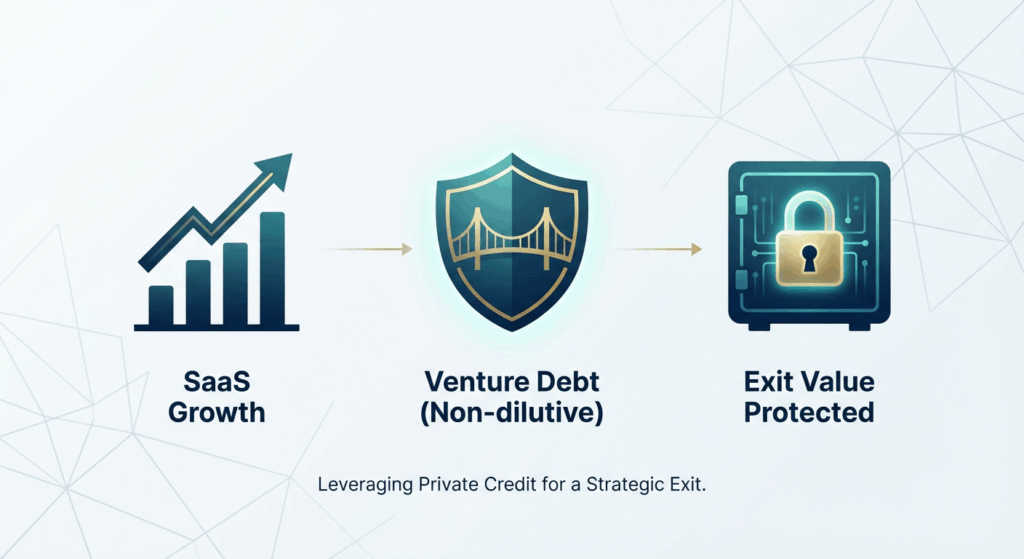
Instead, WatchWire partnered with TIMIA Capital in 2021 to secure a $2.5 million investment facility. They consciously selected venture debt because it provided the specific quantum of growth capital they needed without diluting a single share of equity. Under this structure, WatchWire agreed to a predictable cost of capital (a manageable interest rate and clearly defined repayment terms) rather than forfeiting a permanent slice of future enterprise value. As Anderson noted, for a company with a clear vision, non-dilutive capital is “simply much cheaper capital,” serving as the perfect bridge to a larger strategic event while preserving absolute governance control. [timiacapital.com](https://timiacapital.com/how-watchwire-used-debt-financing-to-achieve-a-successful-exit/)
THE OUTCOME
The decision to utilize private credit provided the exact operational fuel WatchWire required. Empowered by the $2.5 million debt facility, the company scaled its engineering, enhanced its carbon accounting features, and expanded its sales force, all without a venture capitalist looking over their shoulders or pushing for an unnatural growth timeline.
The strategy paid off brilliantly. In 2023, WatchWire was successfully acquired by Tango Analytics, a cloud-based real estate and facilities management software company backed by the private equity powerhouse Berkshire Partners. Because WatchWire was funded by debt, the founders and early employees captured the maximum possible upside of the acquisition. The debt was simply paid off at the time of the transaction.
To understand the immense impact of this decision, consider a hypothetical financial model of the counterfactual. Let’s assume WatchWire had raised $5 million in venture equity by selling 20% of the company. In a hypothetical $50 million exit, that venture capitalist would have taken $10 million off the top (plus any preferred participating hooks). By relying on a $2.5 million venture debt facility at an estimated 12% interest over two years, the total cost of capital would legally be capped at roughly $600,000 in interest. In this modeled scenario, choosing debt preserved over $9.4 million of pure enterprise value for the founders. By aligning highly predictable SaaS cash flows with a structured debt instrument, WatchWire achieved the entrepreneurial dream: a highly lucrative strategic exit with zero final-stage equity dilution. [timiacapital.com](https://timiacapital.com/how-watchwire-used-debt-financing-to-achieve-a-successful-exit/)
THE LESSONS
WatchWire’s journey highlights a defining principle in modern corporate capital structuring: capital types must be strictly matched to business risk profiles. Understanding when to deploy debt over equity is one of the most powerful levers operators possess.
When does this approach work best? It is uniquely suited for businesses with high-margin, predictable, recurring revenue (like B2B SaaS) and low customer churn. Because the enterprise generates reliable cash flow, it can easily service the interest payments, making the debt a sterile, mathematical engine for growth.
Conversely, when does this approach fail? Pre-revenue startups, companies operating in wildly volatile commodities, or hardware firms requiring massive, unpredictable research and development capital should avoid debt. In those environments, the unforgiving nature of debt obligations can rapidly trigger insolvency, whereas equity investors are uniquely designed to sit pari passu with existential operational risk.
For founders evaluating capital options, Bond Capital recommends the “Exit Proximity Framework.” If your company has a plausible runway to a definitive liquidity event (such as a strategic acquisition or private equity buyout) within the next 18 to 36 months, the true mathematical cost of equity is at its absolute peak. Selling 20% of your company immediately prior to a known value-creation milestone is the most expensive financing decision a founder can make. In these final sprits, private credit acts as a tactical bridge, capitalizing the final push to the finish line while allowing operators to retain the hard-earned wealth generated over the life of the firm.
KEY INSIGHTS
- The Control Premium: Leveraging non-dilutive capital allows founders to maintain absolute board control, enabling them to dictate the strategic timeline of their exit rather than being forced onto a venture fund’s mandated lifecycle.
- Cost of Capital Math: When a strategic exit or M&A event is 18 to 36 months away, the cumulative interest from a debt facility is almost universally cheaper than the final enterprise value surrendered in a late-stage equity round.
- Cash Flow as Collateral: High-quality, recurring revenue businesses (such as specialized SaaS) are uniquely positioned to view their predictable cash flows as an asset to borrow against instead of continually diluting shares.
- The Counterfactual Test: Operators should always dynamically model a proposed equity raise against a credit facility, specifically comparing the total cash outlay of debt interest versus the dollar-value of equity lost during a projected exit.
- The Liquidity Bridge: Venture debt acts as highly efficient, purpose-built fuel for a company’s final growth sprint, funding targeted go-to-market expansions without permanently disrupting the cap table.


