
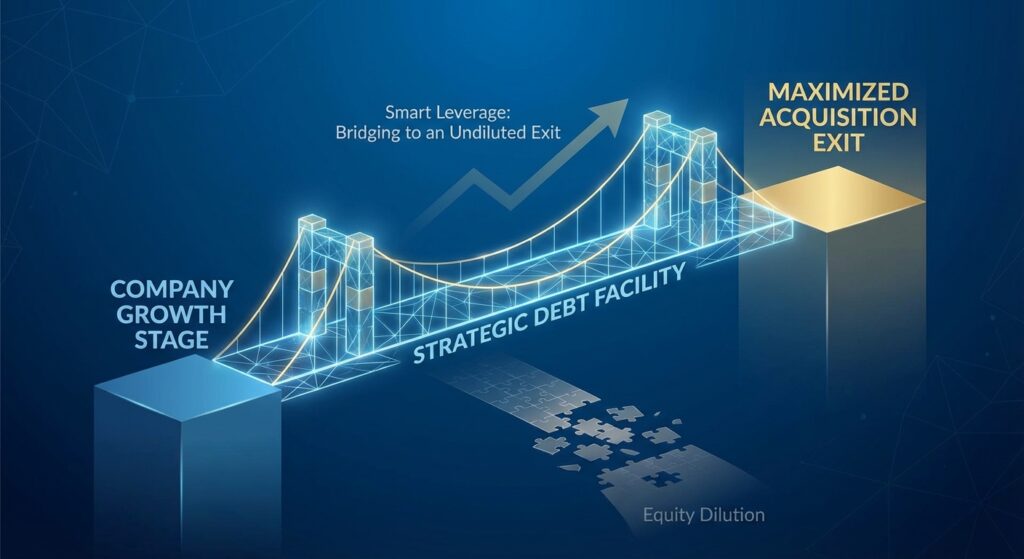
The Growth Paradox
For high-growth technology companies, the path to liquidity usually follows a predictable script: raise seed funding, prove the concept, raise a Series A to scale, and continue selling equity in subsequent rounds until an exit. While this model fuels rapid expansion, it comes with a steep price tag: massive dilution. By the time an exit arrives, founders often own a fraction of the company they built.
But there is an alternative playbook. In 2021, retail sales enablement platform Myagi faced a critical juncture. Instead of returning to the equity markets, they utilized a strategic debt facility to bridge the gap to an acquisition. The result was a successful exit to Rallyware that maximized returns for existing shareholders rather than diluting them at the finish line.
The Story: Myagi’s Pivot
Co-founded by Simon Turner, Myagi began with a mission to digitally transform the relationship between brands and retailers. The platform connected frontline salespeople with the knowledge they needed to sell effectively, replacing inefficient in-person training calls with a digital network.
By early 2020, the company was preparing for a significant equity round to fuel its next stage of growth. Then the COVID-19 pandemic hit. While the global disruption sidetracked their fundraising plans, it ironically accelerated demand for their product. With physical retail teams grounded, the need for digital sales enablement skyrocketed. Myagi experienced its best six months of growth to date.
The company had momentum, but it needed capital to capture the market opportunity. Turner and his team faced a classic dilemma: raise equity during a period of global economic uncertainty (potentially suffering a lower valuation or unfavorable terms) or find another way to finance their sprint to the finish.
The Decision: Debt as a Bridge
In early 2021, rather than selling a slice of the company to venture capitalists, Myagi secured a $2.5 million investment facility from TIMIA Capital. This was a specific type of revenue-based financing designed for SaaS companies with high gross margins and predictable recurring revenue.
The logic was mathematical. At that stage of maturity, Myagi didn’t need “venture” capital to find product-market fit; they needed execution capital to scale revenue and position for an exit. Selling equity would have permanently locked in a cost of capital equivalent to the future exit multiple. If they sold 20% of the company for $5 million, and later exited for $100 million, that capital would launch a $20 million cost.
By choosing debt, Myagi incurred a fixed cost of capital (interest and fees) that, while higher than a bank loan, was significantly cheaper than the realized cost of equity in a successful exit scenario. “Debt is a powerful tool for capital-efficient businesses when used under the right circumstances,” Turner noted reflecting on the decision.
The Outcome: Liquidity Without Dilution
Myagi deployed the capital to enhance its referral-based sales model and improve software capabilities. The injection allowed them to drive valuation-accretive metrics (specifically revenue growth and retention) without expanding the cap table.
Approximately two years after securing the debt facility, the strategy paid off. Myagi was acquired by Rallyware, a performance enablement platform for large distributed workforces. Because the founders and early investors had not suffered late-stage dilution, the exit proceeds were concentrated among those who took the initial risks.
This outcome mirrors a similar trajectory taken by WatchWire (formerly EnergyWatch). Facing a similar decision in 2021, WatchWire also utilized a $2.5 million debt facility to bridge to an acquisition by Tango Analytics in 2023. In both cases, the operators used debt to “rent” the capital needed to reach the finish line, rather than selling ownership.
The Principles: When to Choose Leverage
The Myagi case illustrates a specific “Bridge to Exit” framework that is underutilized in the tech sector. Leverage is often viewed as dangerous for pre-profit companies, but for recurring revenue businesses with a clear line of sight to M&A, it can be the ultimate equity preserver.
This approach works best when:
- Product-Market Fit is Solved: The capital is for scaling known channels, not R&D experiments.
- Churn is Low: Predictable revenue streams can service the debt without stressing cash flow.
- Exit is Visible: The debt acts as a bridge to a liquidity event within 24-36 months.
Conversely, this strategy fails when used to extend runway for a business that is burning cash without growing. In those cases, debt merely brings the bankruptcy deliberation forward. But for companies like Myagi, leverage provided the fuel to cross the finish line while keeping the trophy.
Key Insights
- Cost of Capital Relativity: In a successful exit, equity is almost always the most expensive form of capital. Debt costs interest; equity costs a percentage of the future enterprise value.
- The Bridge Strategy: Late-stage debt can effectively bridge a company from a $20M valuation to a $50M exit without the dilution of a Series B or C round.
- Strategic Optionality: Debt facilities often come with fewer governance controls than fierce VC term sheets, leaving founders in control of the exit timeline.
- Timing Matters: Myagi used debt after a demand surge (pandemic shift) to fuel execution, not to fix a broken business model.
- Preservation of Control: By avoiding a new class of preferred stock, founders simplify the M&A negotiation process, avoiding misalignment on exit thresholds.


