
The Setup: A SaaS Giant burdened by Debt
In the golden era of 2021, the playbook for enterprise software seemed infallible: acquire, leverage, optimize, and exit. Vista Equity Partners, a titan in the software buyout space, executed this strategy with Pluralsight, a workforce development platform, taking it private in a deal valued at approximately $3.5 billion. To fund the transaction, the capital structure was loaded with significant debt, predicated on the assumption that low interest rates and high recurring revenue growth would continue indefinitely.
However, the macroeconomic tides turned. By 2024, interest rates had surged, and the “growth at all costs” era of SaaS had cooled. Pluralsight remained a fundamentally sound business with a valuable product, but its capital structure was designed for a different economic reality. The debt service became a stranglehold, absorbing cash flow that was needed for operations and growth.
This situation set the stage for one of the most significant confrontations in modern private markets, a clash that would redefine the relationship between private equity sponsors and private credit lenders.
The Decision: Financial Engineering vs. Operational Reality
Facing a liquidity crunch and maturing debt obligations, the private equity sponsor faced a critical decision: infuse significant new equity to deleverage the business or attempt a “liability management exercise” (LME). In early 2024, Vista opted for the latter, aggressively utilizing a “drop-down” maneuver. This tactic involved transferring valuable intellectual property (IP) into a restricted subsidiary, effectively putting assets out of the reach of existing lenders to raise fresh financing against them.
This move was a high-stakes gamble. In the public markets, such “creditor-on-creditor” violence (reminiscent of the J.Crew or Serta Simmons cases) had been used to force lenders to the table. However, Pluralsight’s debt wasn’t held by a fragmented group of bondholders; it was held by a sophisticated consortium of private credit giants, including Blue Owl Capital, Ares Management, and Golub Capital.
The sponsor’s decision to engineer a solution rather than simply recapitalize created an immediate adversarial dynamic. As detailed in legal analysis from the time, this was arguably the “tip of the private credit iceberg,” testing whether private lenders would roll over or fight back [goodwinlaw.com](https://www.goodwinlaw.com/en/insights/publications/2024/08/alerts-privateequity-ma-pluralsight-change-of-control-transaction).
The Outcome: When the Lenders Took the Keys
The gamble failed. Instead of capitulating to the drop-down pressure, the private credit group unified. They refused to accept a haircut on their claims while the sponsor retained the upside. The lenders leveraged their own dry powder and legal protections to force a confrontation.
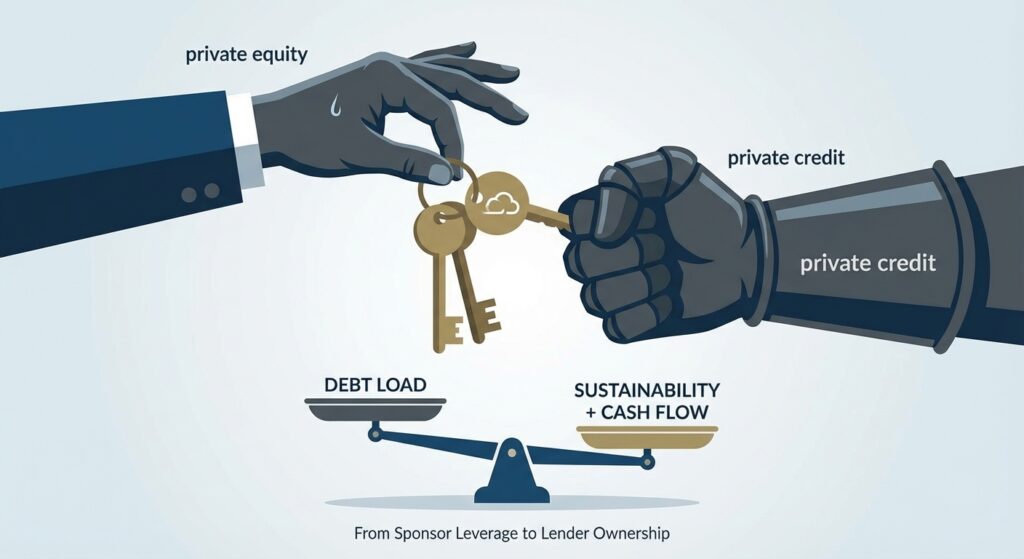
By August 2024, the standoff ended with a decisive restructuring that wiped out the existing equity. The lender group, led by Blue Owl, agreed to a debt-for-equity swap that resulted in them taking 100% ownership of Pluralsight. As part of the deal:
- Debt Reduction: The company’s funded debt was slashed by approximately $1.3 billion, instantly right-sizing the balance sheet.
- New Capital: The lenders injected roughly $250 million in new capital to fund operations and growth, transitioning from creditors to owners [goodwinlaw.com](https://www.goodwinlaw.com/en/insights/publications/2024/08/alerts-privateequity-ma-pluralsight-change-of-control-transaction).
- Sponsor Exit: The original private equity stake was effectively valued at zero, a stark reminder of the risks inherent in leveraged buyouts when the underlying thesis (or the macro environment) breaks.
The transaction was hailed as a watershed moment. It demonstrated that private credit firms were no longer silent partners but active participants capable of stepping in as operators when capital structures failed [bnnbloomberg.ca](https://www.bnnbloomberg.ca/business/company-news/2024/08/22/blue-owl-led-private-debt-group-takes-ownership-of-pluralsight/).
The Lessons: Sustainability Over Engineering
Looking back from 2026, the Pluralsight case offers critical lessons for founders and operators considering debt capital:
1. The “Option Value” of Debt Expires.
Leverage enhances returns when things go right, but it removes “option value” when things go wrong. Equity allows you to endure a down quarter or year; high leverage sets a ticking clock. When the cost of capital spiked, Pluralsight ran out of time.
2. Know Your Lender.
The dynamic between sponsor and lender has shifted. Private credit funds today possess the operational capabilities to run companies. Founders utilizing private credit must understand that their lenders are not just banks; they are shadow equity owners who will step in if covenants or payment terms are breached.
3. Complexity Has a Cost.
The aggressive financial engineering (the IP drop-down) likely accelerated the loss of control. It destroyed trust between the borrower and the lender group. In moments of distress, a transparent conversation about recapitalization often yields better outcomes than legal maneuvering. As noted in industry retrospective, this deal shaped the landscape of LME forever [restructuringnewsletter.com](https://restructuringnewsletter.com/p/pp-pluralsight-the-restructuring).
4. Valuation is Not Cash Flow.
Pluralsight was a valuable company, but its capital structure was based on a valuation multiple, while its debt service was based on cash flow. The disconnect between a “30x revenue” valuation entering the deal and the actual cash required to service billions in debt ultimately broke the equity.
For founders today, the takeaway is clear: Debt is a powerful tool for non-dilutive growth, but only when the repayment schedule aligns with conservative cash flow projections, not optimistic valuation targets.


