
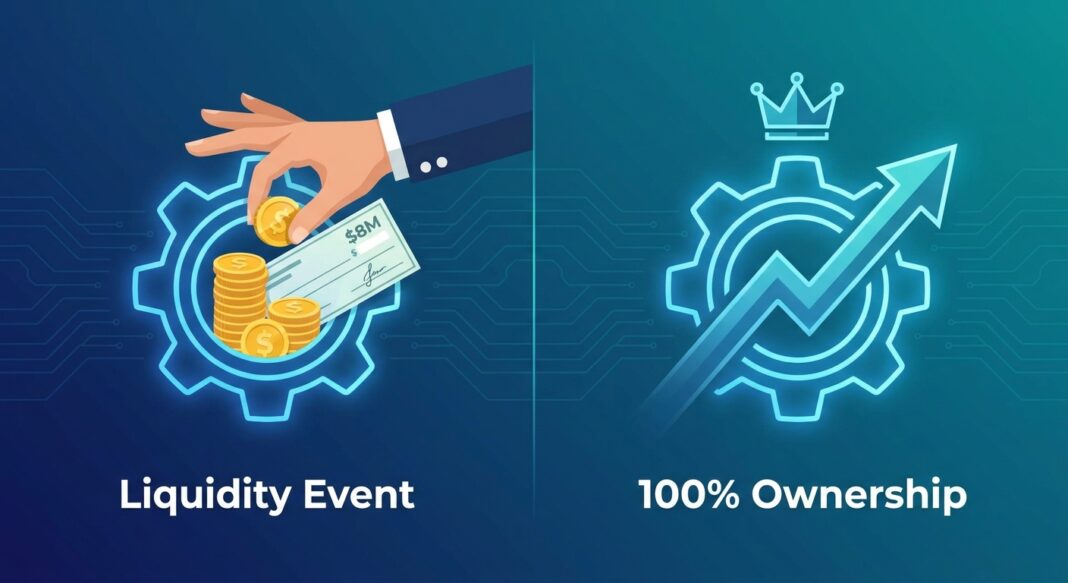
The Story: A Profitable Business, a Restless Founder, and a Question That Wouldn’t Go Away
Note: The following is a hypothetical case study constructed to illustrate real deal mechanics and market conditions. All company names, personal names, and specific financials are illustrative. Market data cited throughout is sourced from real public reports and research, linked below.
In the spring of 2023, Maria Caldwell had spent sixteen years building Caldwell Environmental Services, a regional industrial cleaning and waste-management business serving petrochemical plants across the Gulf Coast. The business generated $4.2 million in EBITDA on $22 million in revenue: consistent, contract-driven, and capital-light. No venture-backed competitor was coming for her market. No platform acquirer was breathing down her neck. She had simply built something solid, and she owned 100% of it.
But Maria had a problem that success creates: nearly all of her personal net worth was tied up in the business. Her home was paid off, but her brokerage account was thin. Her kids were approaching college age. Her aging mother needed care. And she had quietly started wondering: what if something goes wrong?
The obvious answer, sell the business, felt like amputation. Caldwell Environmental was her identity and her team’s livelihood. She didn’t want out. She wanted some of her chips off the table, not all of them. What she needed was a mechanism to monetize a portion of the value she had already created, without handing the keys to a private equity buyer who would immediately install a new CFO, load the company with acquisition debt, and start the clock on a five-year exit timeline.
She called her advisor and asked a simple question: Is there a way to take money out of this business without selling it?
The answer was yes. And the vehicle was a leveraged recapitalization.
The Decision: Two Doors, Very Different Futures
Maria’s advisor laid out two paths. Both would put significant cash in her pocket. Only one would let her keep control of the company she built.
Door One: Majority Recapitalization (PE Buyout)
A private equity firm would buy a 70–80% stake, valuing Caldwell Environmental at roughly 6.5x EBITDA, or approximately $27 million. Maria would receive $18–20 million at closing, retain a 20–30% “rollover” stake, and stay on as CEO for a three-to-five year hold period. She would have a board she didn’t control, a financial sponsor with a hard exit mandate, and a company that no longer fully belonged to her. The equity dilution was irreversible. Her ability to make strategic decisions (whether to hire, hold off on an acquisition, or simply run the business on her own terms) would be subject to sponsor approval.
Door Two: Leveraged Dividend Recapitalization
Working with a direct lender, Caldwell Environmental would take on new senior secured debt of $12.6 million, structured as a unitranche facility at 4.0x EBITDA, and use those proceeds to pay Maria a one-time cash dividend. She would walk away with approximately $8 million after transaction costs and a modest tax provision. The company would continue operating exactly as before, with Maria as 100% owner. She would carry new debt, but at a coverage ratio still well above 2.0x, with a seven-year term and no equity warrants attached.
The math on debt capacity was straightforward. According to the Pepperdine Private Capital Markets Report (2024), lower middle market leveraged recapitalizations typically close at 3x to 5x EBITDA in total debt, with pricing tied to prevailing senior secured rates. At 4.0x, Caldwell sat comfortably within the range for a business with predictable, contracted revenue streams.
Maria chose Door Two. She chose debt over dilution, liquidity over leverage of the PE variety, and control over capital. The structure: a $12.6M unitranche facility at SOFR + 525 bps, a seven-year term, with an interest coverage ratio of 2.1x at close. No warrants. No board seats surrendered. No exit timeline imposed.
The Outcome: What Happened When the Deal Closed
Three years later, Caldwell Environmental is worth materially more than it was at the time of the recap. EBITDA has grown to $5.8 million, driven in part by a strategic tuck-in acquisition Maria self-funded using the company’s free cash flow. She owns 100% of a business now worth an estimated $35–38 million at prevailing multiples, compared to the 20–30% rollover stake she would have held under the PE scenario, worth roughly $7–11 million on the same enterprise value.
Let’s look at the counterfactual clearly:
- PE Path (Door One): Maria receives ~$19M at close, retains a 25% rollover on a $27M enterprise. Three years later, same $37M valuation. Her stake is worth ~$9.25M. Total value: ~$28M, but she no longer controls the business or its future.
- Recap Path (Door Two): Maria receives ~$8M dividend at close, retains 100% of a business now worth ~$37M. Total value: ~$45M, and she still makes every decision.
The debt cost her approximately $3.8 million in cumulative interest payments over three years, a real cost, but one she absorbed through a business generating $5M+ in annual EBITDA. The debt is now partially paid down, and her debt-to-EBITDA ratio has improved to 1.6x. She has personal liquidity, her team is intact, her culture is undisturbed, and she is in an entirely stronger negotiating position if she ever does decide to sell.
This outcome isn’t unique to Maria’s hypothetical. Dividend recap activity rebounded 128.8% year-over-year in 2024 and a further 22.8% in 2025, as owners and sponsors alike recognized that selling a company is not the only way to realize its value. The market is validating this approach at scale.
The Lessons: What Every Founder Should Take From This Story
1. Liquidity and Ownership Are Not Mutually Exclusive
The most persistent myth in private business ownership is that you must sell to access meaningful capital. A leveraged recapitalization allows the owner to extract cash from the business without selling to a third party, while the company assumes a higher debt-to-equity ratio and continues operating under the same leadership. Debt is the instrument; control is the reward.
2. The Private Credit Market Has Never Been More Accessible to Mid-Market Founders
The private credit market was estimated at $1.5 trillion at the start of 2024, up from $1 trillion in 2020, and is projected to grow to $2.8 trillion by 2028, according to Morgan Stanley estimates cited by Akin. That capital needs to be deployed, and private capital’s ability to provide capital structure flexibility has seen it dominate refinancings and recapitalizations. For founders, that means more lenders, more competition for deals, and better terms.
3. The Real Cost of VC and PE Isn’t the Check: It’s the Clock
When a private equity sponsor buys into your business, they bring more than capital. They bring a mandatory exit timeline, return hurdles, and incentives that are only sometimes aligned with yours. Buyers require leverage financing to transact, and if lenders become more selective, the pool of viable acquirers shrinks, competitive tension declines, and clearing prices fall, a risk that falls on every founder who rolled equity into a sponsor deal. The recap path sidesteps this entirely.
4. Venture Debt Is Now a Strategic First Choice, Not a Fallback
For growth-stage founders not yet at the recapitalization stage, the data is equally compelling. In 2024 alone, U.S. venture debt deals hit a record $53.3 billion, reflecting a fundamental shift in how founders approach growth capital. A majority of surveyed founders now view venture debt as a flexible, founder-friendly alternative to equity that supports growth without dilution, not a last resort. Founders are prioritizing flexibility and control over headline interest rates.
5. The Framework: When Does a Recap Work?
Not every business is a recap candidate. The structure depends on three conditions: (a) stable, predictable free cash flow: lenders need confidence in debt serviceability; (b) defensible market position: a business that could deteriorate quickly is not a safe recap candidate; and (c) founder operational commitment: the transaction only works if the owner is staying and driving performance. The decision hinges on free cash flow stability, lender appetite, and the owner’s tolerance for operating under covenant-heavy debt. When all three conditions are met, the recap is often the most value-preserving path available.
Key Insights
- Ownership is a multiplier. Retaining 100% of a growing business compounds far more powerfully than a diluted rollover stake, even when the exit price rises. The founder who stays owns the upside fully.
- Debt has a known cost. Dilution doesn’t. Interest payments are calculable and finite. The cost of surrendering equity grows with every dollar of enterprise value you create after the deal closes.
- The private credit boom is a founder’s opportunity. With the private credit market surging past $1.7 trillion and lenders actively competing for quality mid-market borrowers, the terms available today for recaps and direct lending are structurally better than in any prior era.
- Dividend recaps have gone mainstream, for good reason. Recap volumes rose 128.8% in 2024 and 22.8% in 2025. The strategy is no longer esoteric financial engineering; it is a standard tool in the capital structure toolkit for any profitable business with contracted cash flows.
- The best time to do a recap is before you need it. Owners who approach the transaction from a position of strength (strong EBITDA, clean books, no covenant pressure) command the best terms. Waiting until a liquidity crisis forces your hand means negotiating from weakness. Build the structure while the business is thriving.


