
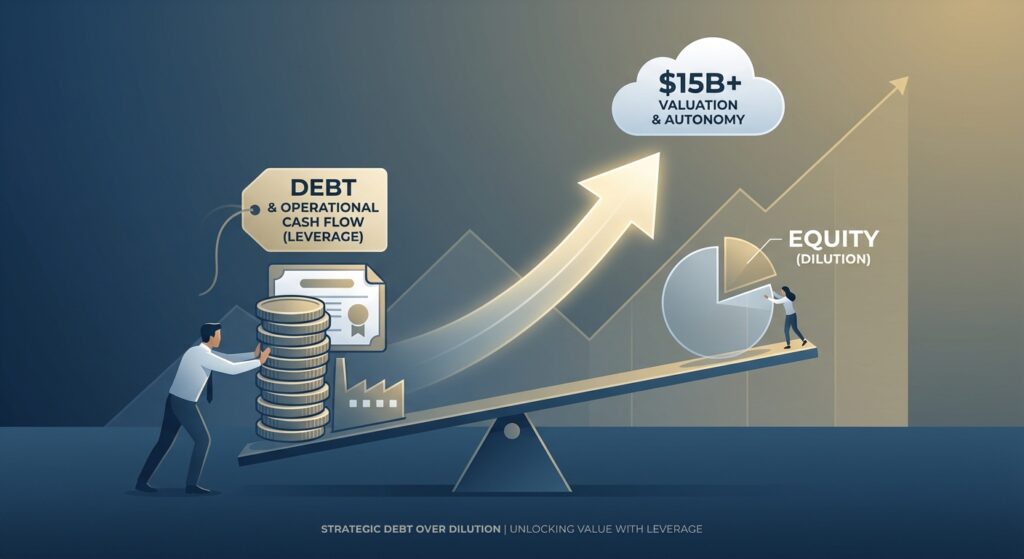
The most expensive line item on a cap table isn’t interest: it’s dilution.
In the high-velocity world of venture backing, the standard narrative often follows a predictable arc: raise a Seed round, dilute 20%; raise a Series A, dilute another 20%; and pray you hold enough points at the IPO to buy a boat. But occasionally, a founder flips the capital structure on its head, using leverage not just to survive, but to starve off outside ownership entirely.
The story of Hamdi Ulukaya and Chobani, highlighted by its stunning 2025 valuation of £15 billion (approx. $19B), is the ultimate counter-narrative. It is a masterclass in using debt to purchase time, assets, and ultimately, absolute control.
The Story: Buying a Broken Factory
The year was 2005. In upstate New York, Kraft Foods was shuttering a nearly century-old yogurt plant. It was a liquidation scenario, an asset being sold for scrap value. Hamdi Ulukaya, a Kurdish immigrant with a modest background in feta cheese, saw an opportunity where Kraft saw a liability.
In the typical Silicon Valley playbook, this is the moment the founder creates a pitch deck. They sell the vision of “disrupting dairy” to a VC firm in exchange for 30% of the company. Ulukaya took a different path. He utilized a Small Business Administration (SBA) 504 loan, government-backed leverage designed for fixed asset acquisition.
He bought the factory with borrowed money, not sold equity. According to recent analysis by David Olusegun at Creators Blueprint, this foundational decision meant that when Chobani launched in 2007 and began its meteoric rise to £750 million in revenue by 2012, Ulukaya hadn’t sacrificed a single percentage point of ownership to early-stage investors.
The Decision: The 2014 Liquidity Crunch
By 2014, Chobani was a titan, but it was cash-constrained. Rapid manufacturing expansion and supply chain demands created a severe liquidity pinch. The company needed roughly $750 million to stabilize and scale.
This was the critical juncture. Ulukaya faced three standard doors:
- The IPO: Go public immediately, inviting quarterly scrutiny and regulatory overhead.
- The Strategic Sale: Sell to a conglomerate like Danone or Nestlé (effectively becoming an employee).
- Private Equity Buyout: Sell a majority stake to a PE firm to cash out and capitalize the balance sheet.
Instead, Ulukaya chose Door Number Four: Structured Debt.
He secured a massive financing package from TPG Capital. While the deal included significant warrant coverage (giving TPG equity upside if the company succeeded), the primary instrument was debt. Unlike a buyout, this structure allowed Ulukaya to remain the Chairman and CEO, keeping his hands firmly on the wheel. He traded interest payments and future upside for present-day autonomy.
The Outcome: The $15 Billion Validation
Fast forward to late 2025. Chobani raised £487 million at a staggering £15 billion valuation.
Comparing this to a traditional VC outcome illustrates the power of leverage. In a typical unicorn scenario, a founder retains 10-15% of the company at exit. A $15 billion exit would net them $1.5 billion, a life-changing sum, certainly.
However, by utilizing debt for the initial acquisition (SBA) and growth capital (TPG restructure), Ulukaya retained a significantly higher concentration of ownership. The debt was serviced by cash flow, meaning the cost of capital was paid from profits, not ownership. The “risk” of the debt was neutralized by the company’s operational excellence.
Recent reports affirm that while the TPG warrants eventually converted, the non-dilutive nature of the early years meant the founder’s stake remained multiples higher than the industry standard. The business was built on the back of product margins, not burn rate.
The Lessons: Operational Cash Flow is the Ultimate Leverage
The Chobani case study offers a stark framework for operators facing capital shortage:
- Debt Requires Truth: You cannot service debt with “users” or “total addressable market.” You service it with EBITDA. Choosing debt over equity forces operational discipline that equity often delays.
- Control Has a Price: Ulukaya’s path wasn’t stress-free. The 2014 period was precarious. Leverage magnifies outcomes, both good and bad. Had Chobani stumbled on execution, the creditors would have owned the factory.
- The Asset-Based Advantage: This strategy works best for companies with tangible assets or predictable recurring revenue (like WatchWire’s SaaS model or Chobani’s factories). It is rarely suitable for pure R&D plays.
Key Insights
- Non-Dilutive Starts: SBA loans and asset-backed lending can bridge the “Valley of Death” without touching the cap table.
- Cost of Capital: Equity is the most expensive money you will ever take if you succeed; debt is the cheapest.
- Alignment: Debt investors care about solvency; equity investors care about 10x exits. Ulukaya’s goals aligned better with lenders who wanted steady coupons than VCs who might have pushed for a premature sale.
- The Second Bite: By delaying equity partners until the valuation was in the billions, the founder minimized the dilution impact when he finally did take outside investment.
- Execution Risk: Leverage turns execution risk into existential risk. This path is only for operators who trust their P&L implicitly.


