
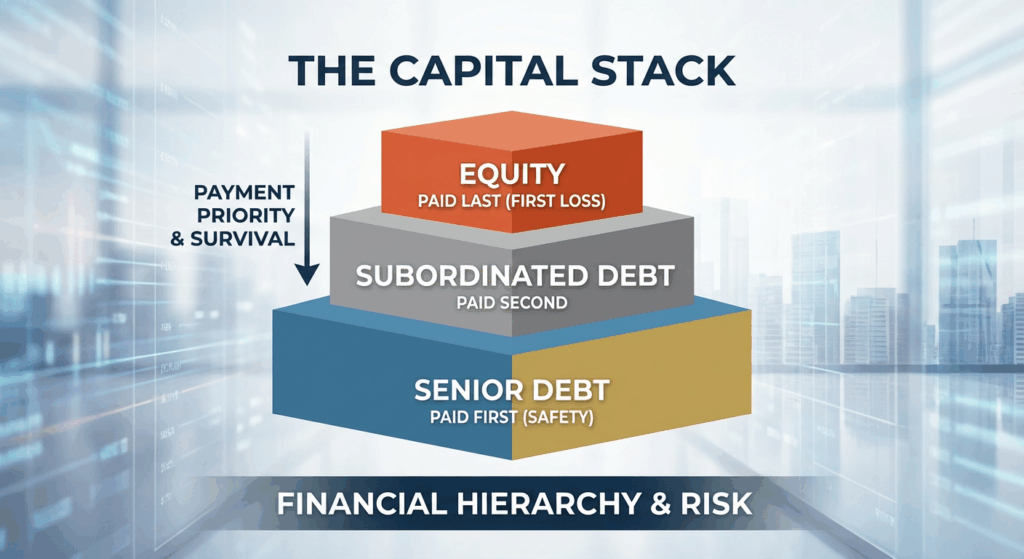
The Architecture of Risk: Understanding the Capital Stack
In the world of private credit, the most critical question isn’t always “What is the yield?” but rather “Where do we sit in the stack?” For both investors seeking preservation of capital and business owners calculating the cost of dilution, the Capital Stack is the fundamental blueprint that dictates financial outcomes.
The capital stack represents the hierarchy of rights and priorities in a company’s financial structure. It determines who gets paid first when things go right, and more importantly, who gets paid (and who doesn’t) when things go wrong. As we navigate the liquidity shifts of early 2026, understanding this hierarchy is no longer just technical knowledge; it is a defensive necessity.
The Concept: The Waterfall of Repayment
Imagine a company as a multi-story building. The capital stack is the structure of that building. The foundation is Senior Debt, followed by Subordinated (Junior) Debt, with Equity forming the penthouse at the top.
This hierarchy creates a “waterfall” of repayment:
- Senior Secured Debt: This sits at the bottom of the stack but is first in line for repayment. It is typically secured by the company’s assets (collateral) and often holds a “first lien” position. Because it is the safest, it carries the lowest cost of capital for the borrower and the lowest yield for the lender.
- Mezzanine / Subordinated Debt: This sits in the middle. It is higher risk than senior debt because it only gets paid after the senior lenders are satisfied. To compensate for this risk, it commands a higher interest rate and often includes “equity kickers” (warrants).
- Equity: This is the ownership layer. Equity holders have the highest potential upside but sit in the “first loss” position. If the company fails, they are the last to recover capital, often receiving nothing until all debt layers are fully repaid.
How It Works: A Concrete Example
To see the mechanics of subordination in action, let’s look at a hypothetical transaction for a manufacturing company, “Acme Corp,” valued at an Enterprise Value (EV) of $100 million.
The Capital Structure:
- Senior Debt (First Lien): $50 million
- Subordinated Debt: $20 million
- Equity: $30 million
Scenario A: Success
Acme Corp is sold five years later for $120 million. The Senior Lenders get their principal back plus interest (e.g., 10-12%). The Subordinated Lenders get their principal plus higher interest. The Equity holders capture the remaining value, effectively multiplying their investment.
Scenario B: Distress
Acme Corp faces a market downturn and is forced to liquidate or sell for a distressed price of $60 million.
- Senior Lenders: They are owed $50 million. Since the sale price covers this, they are repaid 100% of their principal.
- Subordinated Lenders: They are owed $20 million. However, only $10 million remains after paying the senior headers ($60M sale – $50M senior debt). They recover only 50% of their capital.
- Equity Holders: They are wiped out completely. Their recovery is $0.
This “Equity Cushion”, the $30 million in Scenario A, serves as a protective buffer for the lenders. In Scenario B, that cushion eroded, absorbing the first $30 million of losses before the debt layers were touched.
Current Market Relevance (2026)
As of March 2026, the distinction between these layers has rarely been more vital. Following a period where family offices doubled their private credit holdings to roughly 4%, we are now seeing a divergence in performance based on structure and liquidity terms.
According to Capital Founders OS (March 2026), while the underlying loans in senior direct lending are generally performing, yielding 10-12% with SOFR at roughly 4.3%, stress is appearing in semi-liquid structures where maturity mismatches exist.
Furthermore, Capital Market Insights notes that senior debt typically covers up to 50% of the funding stack, requiring coverage ratios of 2.0x to 3.0x EBITDA. With banks continuing to retreat from middle-market lending due to regulatory shifts, private credit managers are increasingly occupying this “senior” slot, offering safety that equity cannot match in a volatile rate environment.
The current market data suggests that while “reaching for yield” was necessary when rates were zero, the current base rate environment allows investors to achieve double-digit returns while remaining at the top of the capital stack, significantly reducing Principal risk.
Decision Framework
For Investors:
When evaluating a private credit fund, the primary diligence question should be: “What percentage of the portfolio is First Lien Senior Secured?” In an environment where valuation credibility is under scrutiny, being at the top of the stack provides a margin of safety against valuation mark-downs. If a fund offers higher yields by moving down the stack to mezzanine or unsecured positions, assess if the risk premium justifies the loss of asset protection.
For Operators:
Business owners must balance the lower cost of senior debt against the flexibility of equity. Senior debt is non-dilutive and cheaper (10-14% vs. the theoretical 25%+ cost of equity), but it comes with strict covenants and amortization schedules. If your cash flows are volatile, a heavy senior debt load can be dangerous. In such cases, expensive equity or flexible unitranche structures may be safer than cheap, rigid senior debt.
Key Takeaways
- Seniority is Safety: Senior debt gets paid first. In a downside scenario, your position in the stack matters more than your projected yield.
- The Cushion Matters: The “Equity Cushion” is the lender’s shield. A 40-50% equity contribution from the sponsor protects the lender from the first 40-50% of value erosion.
- Yield without Reach: With base rates (SOFR) remaining elevated in 2026, senior secured loans offer equity-like returns (10-12%) with debt-like protections.
- Beware the Structure: Liquidity gates in 2026 highlight that even senior assets can be trapped in mismatched fund structures.
- Cost of Capital: For founders, senior debt reduces dilution but increases bankruptcy risk; equity reduces bankruptcy risk but maximizes dilution.


