
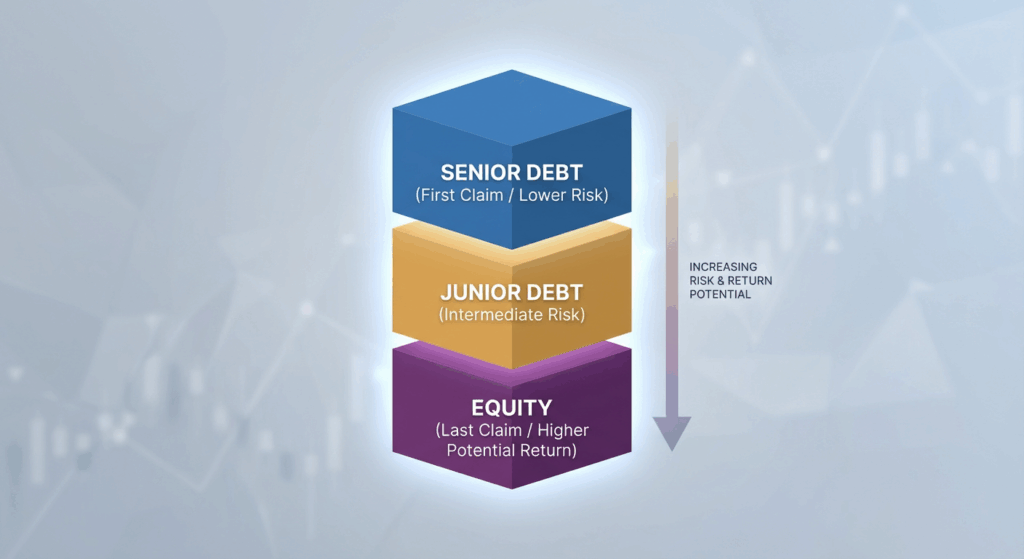
The Anatomy of Risk: Understanding the Private Credit Capital Stack
In the world of corporate finance, not all dollars are created equal. When a company raises money, every dollar entering the business is assigned a specific rank, a “place in line.” This hierarchy is known as the Capital Stack, and it serves as the gravitational center for all decision-making in private credit.
For investors, understanding where a loan sits in the stack determines the probability of repayment during a crisis. For business operators, it defines the cost of growth and the extent of ownership dilution. While interest rates and market sentiment fluctuate, the physics of the capital stack remain constant: Seniority buys safety; subordination buys potential return.
The Concept: A Layered Defense
The capital stack is structured like a layer cake of financial claims. It establishes the order in which stakeholders receive payouts from a company’s cash flows or, in a worst-case scenario, from the liquidation of its assets.
- Senior Debt: Sits at the top. It has the first claim on assets and cash flow. Because it is the safest, it commands the lowest cost of capital (interest rate). In private credit, this is often “Senior Secured Direct Lending.”
- Subordinated (Mezzanine) Debt: Sits in the middle. These lenders only get paid after senior lenders are satisfied. To compensate for this higher risk, they charge higher interest rates and often require “equity kickers” like warrants.
- Equity: Sits at the bottom. Shareholders (founders, PE firms) have the last claim. If the company fails, they are the first to be wiped out. However, they enjoy unlimited upside if the company succeeds.
As noted in the Corporate Finance Institute regarding stack structure, this hierarchy is critical for assessing risk: senior claims have priority, while junior claims carry higher risk but offer greater return potential.
How It Works: The $100 Million Deal
To see the mechanics in action, let’s look at a hypothetical acquisition of a mid-sized software company, “TechCo,” valued at $100 million.
The Structure
- Layer 1 (Senior Debt): $50 million loan from a Direct Lender (First Lien).
- Layer 2 (Junior Debt): $20 million Mezzanine loan.
- Layer 3 (Equity): $30 million cash from the Private Equity Sponsor.
Scenario A: Success (Exit at $150M)
The company grows and creates $50 million in new value. The lenders get their principal back plus interest. The Equity holders, who took the most risk, capture the entire $50 million surplus, nearly tripling their investment.
Scenario B: Distress (Liquidation at $60M)
If the company struggles and is sold for only $60 million, the hierarchy dictates the pain:
- Senior Debt: Gets paid $50 million in full (100% recovery).
- Junior Debt: Claims the remaining $10 million (50% loss of principal).
- Equity: Receives $0 (100% loss).
This illustrates the protective mechanism of the “Equity Cushion.” In this example, the Senior Lender had a 50% equity cushion ($50M debt below $100M value). The value of the business had to drop by more than 50% before the senior lender lost a single dollar.
Current Market Relevance
The capital stack is currently evolving due to the rapid growth of private credit, which has shifted how deals are structured. According to data cited by Coller Capital and Preqin, the global private credit market reached approximately $1.7 trillion by the end of 2024 and is forecast to surpass $2.6 trillion by 2029.
This influx of capital has led to distinct trends in 2026:
- Rise of Unitranche: As defined by Umbrex’s 2025 Industry Primer, unitranche facilities combine senior and junior debt into a single loan instrument. This simplifies the stack for operators but requires investors to carefully analyze the “blended” risk.
- Thicker Equity Cushions: With interest rates remaining elevated compared to the pre-2022 era, lenders are demanding larger equity contributions from sponsors to ensure cash flow can cover debt service.
- Covenant Tightening: While “covenant-lite” structures dominated the syndicated market, private credit managers are maintaining stricter document protections to actively manage portfolio risk.
Decision Framework
For Investors: The “Attachment Point”
When evaluating a private credit fund or deal, the key metric is the attachment point: the point in the capital stack where your risk begins.
Ask: “How much enterprise value must be destroyed before my principal is impaired?” A Senior Secured loan typically offers a 40-50% buffer; a Mezzanine loan might only offer 10-20%.
For Operators: Cost vs. Dilution
Business owners must weigh the Weighted Average Cost of Capital (WACC) against ownership dilution.
Ask: “Is it cheaper to pay 11% interest on debt, or to give up 20% of the company’s equity?”
Senior debt is the cheapest form of capital but requires strict adherence to covenants. Equity is the most expensive (in terms of future value given up) but requires no monthly payments. Optimizing the stack means finding the maximum amount of debt the business can safely service to minimize equity dilution.
Key Takeaways
- Seniority is Safety: Senior lenders are the first to be paid and the last to lose money.
- Equity Cushion Matters: The thickness of the equity layer below the debt acts as a shock absorber for lenders.
- Risk/Return Trade-off: Moving down the stack (from Senior to Mezzanine) increases yield but drastically increases the likelihood of principal loss in a default.
- Unitranche Efficiency: Modern private credit often blends layers into a single “Unitranche” facility for speed and simplicity.
- Structure Dictates Outcome: In a downside scenario, the legal hierarchy of the capital stack overrides all other agreements.


