
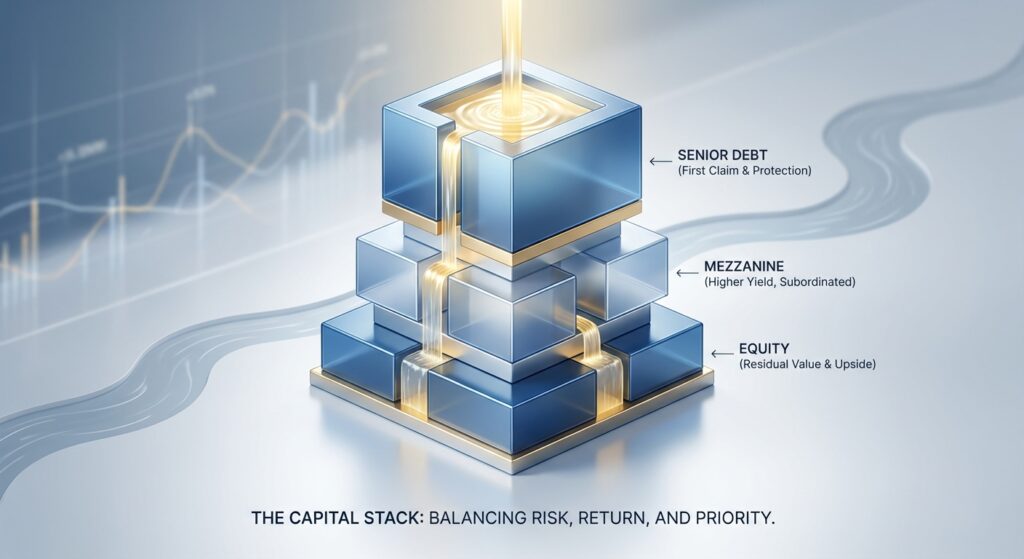
The Architecture of Risk: Understanding the Capital Stack
Every transaction in private credit (whether a direct loan to a software company or financing for a manufacturing plant) is defined by its place in the Capital Stack. This concept is the structural DNA of corporate finance. It dictates who gets paid first, who holds the most control, and who bears the most risk.
For business owners (operators), understanding the capital stack is essential for minimizing dilution while funding growth. For investors, it provides the roadmap for assessing risk-adjusted returns. In today’s market, where private credit has grown to an estimated $1.7 trillion asset class, the distinctions within the stack have never been more critical.
The Concept: The Hierarchy of Claims
The capital stack represents the layers of capital used to finance a company, organized by priority of repayment. Think of it as a waterfall: cash flows from the business pour over the top, filling the first bucket before spilling over into the next.
There are three primary layers:
- Senior Secured Debt: Sitting at the very top, this layer has the first claim on cash flows and assets. It offers the lowest yield but the highest protection. In the event of bankruptcy, senior lenders must be repaid in full before anyone else sees a dime.
- Subordinated (Mezzanine) Debt: This “middle” layer sits below senior debt but above equity. It carries higher risk (and thus demands a higher return (coupon)) because it is only repaid after senior lenders are satisfied.
- Equity: The bottom layer. Equity holders (founders, PE firms) have the last claim on assets but unlimited upside potential. If the company fails, they lose everything first; if it succeeds, they capture the residual value.
How It Works: A Concrete Example
To see the mechanics in action, consider a hypothetical company, Bond Manufacturing, with an Enterprise Value (EV) of $100 million.
The Structure:
- Senior Debt: $50 million (50% of capital)
- Equity: $50 million (50% of capital)
Scenario A: Downside Protection (The Liquidation)
Suppose the company faces severe headwinds and is forced to liquidate for $60 million (a 40% drop in value).
- Senior Lenders: Receive $50 million (100% principal recovery). Their positioning in the stack protected them despite the company’s failure.
- Equity Holders: Receive the remaining $10 million. They absorbed a $40 million loss (80% of their investment).
Scenario B: Leverage Math (The Exit)
Suppose the company grows and sells for $150 million (a 50% increase in value).
- Senior Lenders: Receive $50 million plus interest. They do not participate in the upside.
- Equity Holders: Receive $100 million. They doubled their money (100% return) on a 50% asset increase, demonstrating the power of leverage.
Current Market Relevance
The dynamics of the capital stack are shifting in 2026 as traditional banks continue to retreat from middle-market lending. According to NEPC’s late 2025 report, bank lending as a share of U.S. GDP has declined due to regulatory pressures, creating a financing gap filled by private credit managers.
Key Market Trends:
- Unitranche Structures: Modern private credit often simplifies the stack by combining senior and subordinated debt into a single “unitranche” facility. This offers speed and certainty for borrowers, blending the risk and return for lenders.
- Senior Focus: Despite the search for yield, the core of the private credit market remains defensive. As noted by T. Rowe Price, private loans are typically senior secured, sitting at the top of the capital structure with significant equity cushions beneath them.
- Deal Size Bifurcation: Data cited by NEPC shows that U.S. high-yield public market deals now average over $700 million, while private credit dominates the sub-$500 million middle market. This means the “senior” position in mid-sized companies is almost exclusively the domain of private funds, not banks.
- Floating Rate Protection: Most private credit senior debt utilizes floating rates. In a fluctuating interest rate environment, this protects the lender’s real return, a structural advantage over fixed-rate bonds.
Decision Framework
For Investors: Evaluating the Cushion
When reviewing a private credit opportunity, the primary metric is the Loan-to-Value (LTV) ratio. If a fund lends at 40% LTV, there is a 60% “equity cushion” beneath the debt. This suggests the enterprise value must fall by more than 60% before principal is at risk. Investors prioritizing capital preservation look for thick equity cushions and senior secured status.
For Operators: Cost vs. Control
Business owners must weigh the Cost of Capital against dilution.
- Senior Debt is the cheapest capital (e.g., 8-12%) but comes with strict covenants and amortization.
- Mezzanine/Junior Debt is more expensive (e.g., 12-16%) but is often interest-only and less dilutive than equity.
- Equity is the most expensive capital (expecting 20-30%+ returns) because it sells a permanent slice of the future upside.
Operators often utilize private credit to fund growth without suffering the permanent dilution of raising venture capital or private equity.
Key Takeaways
- Seniority is Safety: In the capital stack, being “senior” means getting paid first. It is the primary defense against capital loss.
- The Equity Cushion: The size of the equity layer below the debt determines the lender’s margin of safety.
- Private Credit Replaced Banks: In the middle market, private lenders have largely replaced banks as the holders of senior secured debt.
- Leverage Magnifies Returns: For owners, debt amplifies returns on equity; for lenders, it represents the risk boundary.
- Unitranche Simplification: The market is moving toward blended “unitranche” structures that simplify the stack into a single private credit facility.


