
Introduction: The Hierarchy of Repayment
In the world of corporate finance, not all dollars are created equal. When a company raises capital, it builds a structure known as the capital stack. This structure dictates the rights, risks, and returns of every investor involved. For participants in the private credit market (whether they are institutional investors seeking yield or business owners seeking growth capital) understanding where they sit in this stack is the single most important factor in assessing risk.
As we navigate the 2026 investment landscape, the distinction between “senior” and “subordinated” capital has never been more critical. The capital stack determines who gets paid first when things go right, and more importantly, who gets paid first if things go wrong.
The Concept: Senior Secured vs. Subordinated Debt
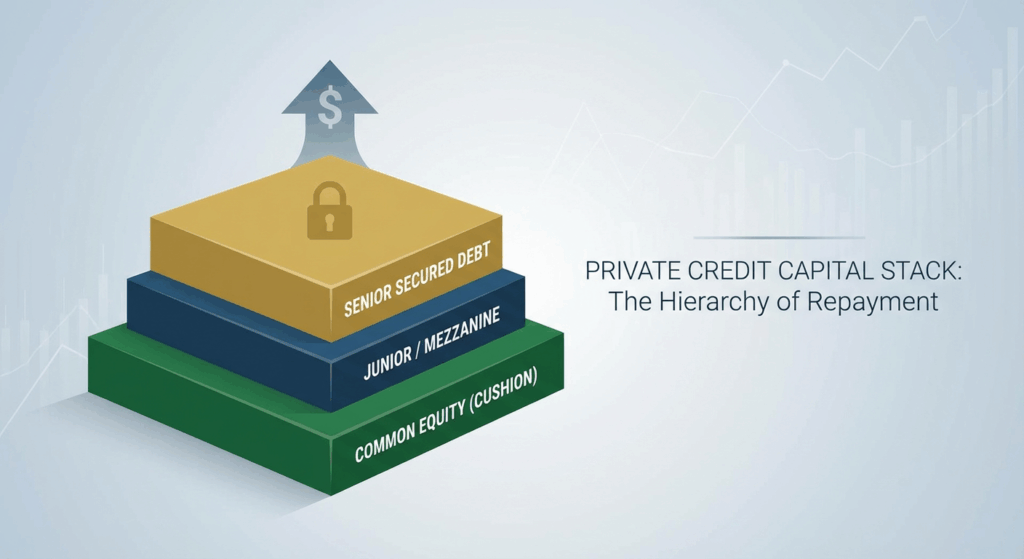
The capital stack is arranged hierarchically, resembling a layer cake. At the top sits Senior Secured Debt, and at the bottom sits Common Equity. The rules of the road are governed by “absolute priority”, a legal principle ensuring that senior creditors must be paid in full before junior creditors or equity holders receive a single cent.
Private credit strategies, particularly Direct Lending, predominantly focus on the top of this stack: Senior Secured loans. These instruments carry two distinct protections:
- Seniority: Priority in repayment over other debt and equity.
- Security: A legal claim on the company’s assets (receivables, inventory, intellectual property) as collateral.
Below the senior debt lies “Junior” or “Mezzanine” debt, which offers higher yields in exchange for taking a second-position claim. At the very bottom is Equity, which enjoys unlimited upside potential but bears the first loss if the company’s value declines.
How It Works: The “Equity Cushion” Mechanism
To understand the protective power of the capital stack, let’s look at a concrete example of a hypothetical middle-market company, “TechMfg Corp,” valued at $100 million.
The company finances its operations with the following capital structure:
- Senior Secured Loan (Private Credit): $40 million (40% of value)
- Junior/Mezzanine Debt: $20 million (20% of value)
- Private Equity Sponsor: $40 million (40% of value)
In this scenario, the Equity Cushion below the senior lender is $60 million (the combined value of the Junior Debt and Equity). This means the company’s enterprise value would have to drop by more than 60% before the senior lender suffers a principal loss.
Scenario A: Successful Exit
The company is sold for $120 million.
1. Senior Lender gets $40 million + interest.
2. Junior Lender gets $20 million + interest.
3. Equity gets the remaining ~$60 million (a 50% gain).
Scenario B: Downside Protection
The company faces headwinds and is liquidated for just $50 million (a 50% drop in value).
1. Senior Lender gets $40 million (100% recovery).
2. Junior Lender gets $10 million (50% loss).
3. Equity gets $0 (100% loss).
This “waterfall” of payments illustrates why senior secured private credit is often described as “defensive income”; it prioritizes capital preservation.
Current Market Relevance
The private debt market has expanded significantly, maturing into a core allocation for many institutions. According to PitchBook, the private debt market grew from under $600 billion in 2014 to over $2 trillion in 2023, driven by the demand for non-bank financing solutions. Even amidst fluctuating interest rates in 2024 and 2025, the appetite for this asset class remained robust.
Recent data highlights the continued resilience of the asset class:
- Fundraising Momentum: As of Q3 2024, PitchBook reported over $169 billion in committed capital raised for private debt funds year-to-date, signaling strong institutional confidence. Source: PitchBook
- Strategic Position: Major managers like Blackstone emphasize that private loans are typically senior secured with a “meaningful cushion” below them, offering floating rate coupons that adjust with the cost of money. Source: Blackstone
- Unitranche Evolution: Increasing efficiency, lenders often combine senior and junior tranches into “Unitranche” facilities, simplifying the stack for borrowers while blending the risk/return profile for lenders.
This structural seniority helps explain why private credit has historically offered lower volatility compared to public equities, as the debt is not traded daily and is insulated by the equity cushion.
Decision Framework: Investors & Operators
For Investors: Evaluating the Cushion
When assessing a private credit opportunity, the primary metric is Loan-to-Value (LTV).
The Question: “How much equity is ahead of me?”
A Senior Secured loan with an LTV of 40% (like our TechMfg example) is far safer than one with an LTV of 70%. In 2026, with economic cycles maturing, investors should prioritize deeper equity cushions and robust covenant packages that allow lenders to intervene early if performance dips.
For Operators: Cost vs. Dilution
For business owners and private equity sponsors, the capital stack represents a trade-off between Cost of Capital and Equity Dilution.
The Question: “Do I give up ownership or pay interest?”
Senior debt is the cheapest form of capital (lower risk = lower return requirement). By maximizing the senior debt portion (up to prudent leverage limits), operators can boost their Return on Equity (ROE). However, over-leveraging increases bankruptcy risk. The goal is to optimize the stack, using enough private credit to fuel growth without suffocating cash flow.
Key Takeaways
- Absolute Priority: Senior Secured lenders are legally first in line for repayment, ahead of other debt and equity.
- The Cushion Concept: The junior capital (subordinated debt + equity) acts as a shock absorber, protecting senior lenders from valuation drops.
- Growth of the Asset Class: With over $2 trillion in AUM, private credit has standardized these capital structures, making them accessible to middle-market borrowers.
- Risk Metric: Loan-to-Value (LTV) is the critical measure of safety; lower LTV implies a larger equity buffer.
- Strategic Utility: For borrowers, private credit offers a non-dilutive tool to amplify equity returns; for investors, it offers yield with structural downside protection.


