
Understanding the Hierarchy of repayment
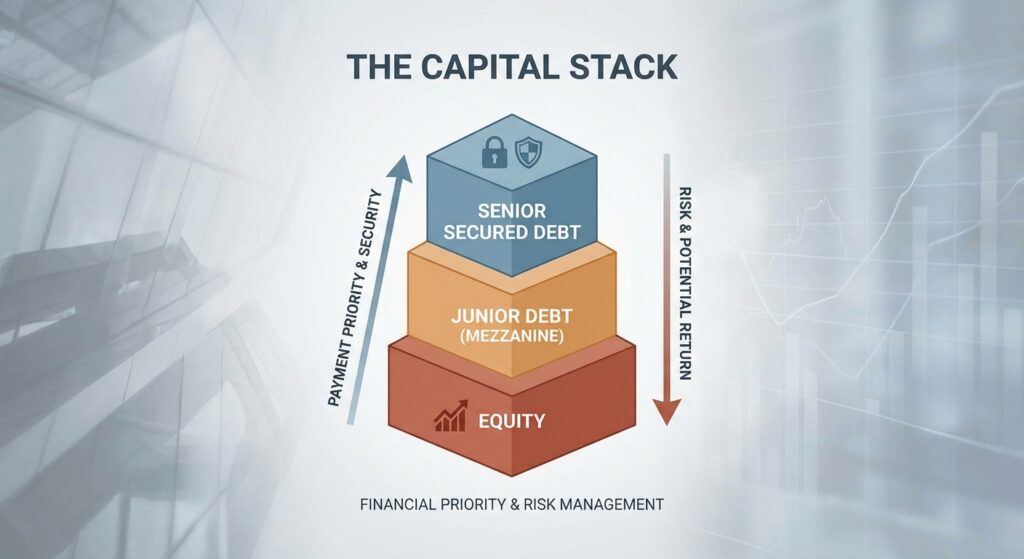
In private credit, not all dollars are created equal. Whether you are an investor seeking yield or a business owner seeking capital, the single most important concept to master is the Capital Stack. This structure serves as the blueprint for financial priority, determining who gets paid first, who holds the most control, and who bears the brunt of the risk when markets turn volatile.
Recent market data from early 2026 highlights why this matters: while family offices have doubled their private credit holdings, liquidity constraints in some semi-liquid funds have forced investors to look closely at what they actually own. Understanding where a loan sits in the capital stack is no longer just a technical detail; it is the primary safeguard against loss.
The Concept: Seniority and Subordination
The capital stack acts like a layer cake of financing that funds a company. The “higher” you are in the stack, the safer your capital is, but the lower your potential return. The “lower” you are, the higher the risk and the potential return.
At the very top sits Senior Secured Debt. This is the bedrock of private credit. Lenders in this position have the first claim on cash flows and assets. If a company fails, senior lenders are paid before anyone else.
Below that lies Subordinated (Junior) Debt or Mezzanine financing. These lenders only get paid after senior debt obligations are met. In exchange for this higher risk, they command higher interest rates.
At the bottom is Equity. Equity holders (owners/founders/PE firms) have the highest upside potential if the company grows, but they are in the “first-loss” position. They don’t get a dime in liquidation until all debt layers are fully repaid.
How It Works: The $100 Million Scenario
To see the mechanics of subordination in action, let’s look at a hypothetical acquisition of a middle-market software company with an Enterprise Value (EV) of $100 million.
The Deal Structure:
- Senior Debt (40%): $40 million loan (First priority)
- Junior Debt (20%): $20 million loan (Second priority)
- Equity (40%): $40 million cash from owners (Last priority)
Scenario A: Success
The company is sold later for $150 million. The Senior lenders get their principal plus interest. Junior lenders get principal plus higher interest. Equity holders capture the remaining massive upside ($90M+).
Scenario B: Distress (The Downside Protection Mechanism)
Due to market disruption, the company’s value crashes by 50% and it is liquidated for only $50 million.
- Senior Debt: Paid $40 million (100% recovery). Even though the company value halved, the senior loan is Money Good.
- Junior Debt: Paid remaining $10 million (50% loss of principal).
- Equity: Paid $0 (100% loss).
This “Equity Cushion” (the 60% below the senior debt) acts as a shock absorber. For the senior lender to lose even $1 of principal, the company’s value would have to drop by more than 60%.
Current Market Relevance: March 2026
The distinction between capital stack layers is critical in the current economic environment. As of March 2026, the data suggests a permanent shift in lending dynamics.
According to Capital Founders OS (March 2026), senior direct lending is currently generating yields of 10-12% while SOFR sits at roughly 4.3%. This represents a historically attractive risk-adjusted return for senior secured risk.
However, the market is also seeing stress. Atlas Peak Research (March 2026) notes that while actual defaults remain low, liquidity mismatches in semi-liquid funds have caused gate closures. This reinforces the need for “true” seniority, investors in the top of the stack are insulated from valuation fluctuations that might wipe out junior positions.
Market Metrics Snapshot:
- Senior Debt Yields: 10-12% (vs SOFR ~4.3%)
- Family Office Allocation: Increased from 2% to 4% year-over-year (UBS/Capital Founders)
- Global AUM: Approaching $2 trillion (Coller Capital)
Decision Framework
Whether you are allocating capital or seeking it, your position in the stack determines your strategy.
For Investors:
Evaluate the Attachment Point. This is the valuation level at which your capital begins to be at risk. If you are investing in a Senior Secured fund with a 40% Loan-to-Value (LTV), the portfolio companies must lose 60% of their value before your principal is touched. In today’s yield environment, obtaining double-digit returns with that level of protection is the primary thesis for private credit.
For Operators (Borrowers):
Balancing cost against flexibility is key. Senior debt is the cheapest cost of capital (significantly cheaper than equity dilution), but it comes with stricter covenants and amortization schedules. “Unitranche” facilities combine senior and junior debt into one instrument, offering speed and convenience, often at a blended rate.
Key Takeaways
- Priority is Safety: Senior lenders are paid first; in a liquidation event, they are the last to suffer losses.
- Equity Cushion Matters: The thicker the layer of equity and junior debt below you, the more protected your principal is from market volatility.
- Current Yields are Elevated: With senior lending yielding 10-12% in early 2026, the risk premium over risk-free rates remains substantial.
- Understand the Vehicle: As gated redemptions in 2026 have shown, the liquidity of the fund structure matters as much as the credit quality of the underlying loans.


