
Introduction: The Blueprint of Financial Structure
In private credit, the “capital stack” is the architectural blueprint of every transaction. It defines the hierarchy of capital sources based on risk, return, and payment priority. Whether you are an investor seeking yield or a business owner raising growth capital, understanding where you sit in this stack determines your likelihood of repayment and your potential upside.
The Concept: Priority of Payment
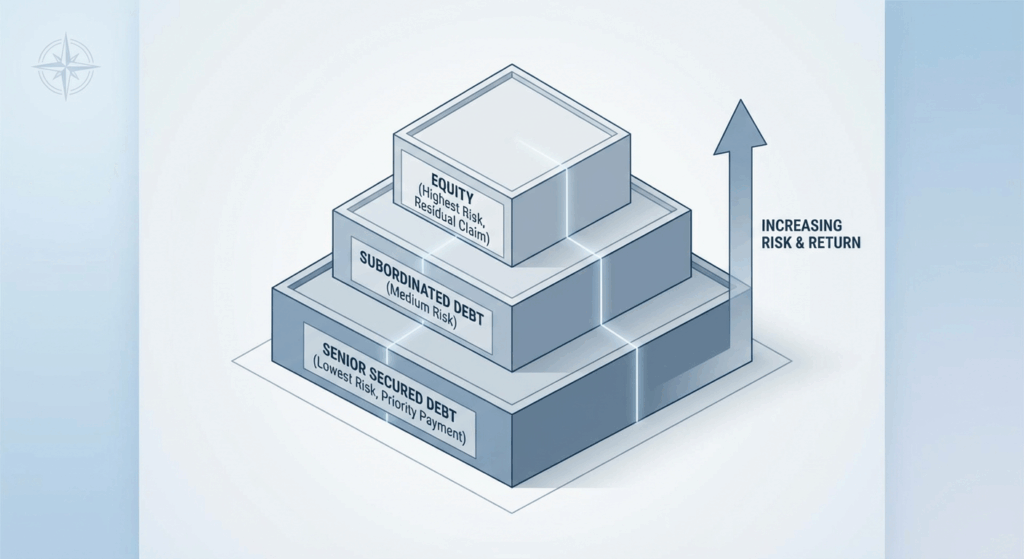
The capital stack is organized into layers. At the bottom (foundation) sits absolute priority; at the top sits the highest risk and return.
- Senior Secured Debt: The safest position. These lenders are paid first from cash flow and have the first claim on assets (collateral) in a liquidation. Because the risk is lower, the cost of capital is lowest (currently SOFR + spread).
- Subordinated (Mezzanine) Debt: Sits above senior debt but below equity. These lenders only get paid after senior lenders are satisfied. To compensate for this increased risk, they command higher interest rates and often “equity kickers” (warrants).
- Equity: The residual claim. Equity holders get paid last, only after all debt obligations are met. They take the most risk but enjoy unlimited upside if the company grows.
How It Works: The $100 Million Example
To visualize the mechanics, let’s imagine a manufacturing company with an Enterprise Value (EV) of $100 million and $15 million in EBITDA.
Scenario A: The Healthy Structure
- Senior Debt (40%): $40 million loan at ~11% interest.
- Subordinated Debt (20%): $20 million loan at ~14% interest.
- Equity (40%): $40 million invested by founders and Private Equity sponsors.
Scenario B: The Downside Protection Test
Suppose a recession hits, and the company’s enterprise value drops by 30% to $70 million.
- Equity Holders: Their stake absorbs the first loss. The $30 million drop reduces their value from $40 million to $10 million. They have lost 75% of their investment, but the company remains solvent.
- Subordinated Lenders: Fully covered. The remaining $70 million value is sufficient to cover the $40M senior debt and the $20M subordinated debt.
- Senior Lenders: Fully covered. They possess a massive “equity cushion.” The company would have to lose over 60% of its value (wiping out both equity and sub-debt) before the senior principal is at risk.
Current Market Relevance (March 2026)
The capital stack is currently subject to distinct pressures and opportunities driven by the 2026 interest rate environment.
According to Capital Founders (March 2026), the base rate environment (SOFR ~4.3%) means senior direct lending is currently generating yields of 10-12%. This has shifted the risk-reward calculus; investors no longer need to reach for the riskiest equity layers to achieve double-digit returns.
Furthermore, the UBS Global Family Office Report 2025 noted that family offices doubled their private credit holdings from 2% to 4% in just one year. This capital is primarily flowing into the senior parts of the stack, seeking shelter from equity volatility while locking in historically high regular income.
However, liquidity remains a key differentiator. While public markets offer liquidity at volatile prices, private credit offers stable principal value in exchange for illiquidity. Recent stress tests in semi-liquid structures highlight the importance of aligning the duration of capital with the underlying asset’s position in the stack (Atlas Peak Research, 2026).
Decision Framework
For Investors: The Protection First Mentality
Evaluate opportunities by looking “below” you in the stack. The thickness of the subordinated debt and equity layers represents your margin of safety. In the current market, senior secured positions offering ~11% yields provide equity-like returns with debt-like protections. Ask: “How much enterprise value must evaporate before my principal is at risk?”
For Operators: Minimizing Dilution
For founders, debt is cheaper than equity. Raising $20 million in equity requires selling 20% of your company (permanently). Raising $20 million in debt costs interest (temporarily) but allows you to retain ownership. The optimal capital stack uses enough debt to lower the weighted average cost of capital (WACC) without over-leveraging cash flows to a breaking point.
Key Takeaways
- Hierarchy is Absolute: In default scenarios, Senior pay comes first, Subordinated second, and Equity last.
- Risk Pricing: Returns should correlate directly with position; Senior yields 10-12% today, while Equity targets 20%+.
- Equity Cushion: The most critical metric for debt investors; it measures how much value can be lost before the loan is impaired.
- Non-Dilutive Capital: For operators, debt is a tool to fuel growth without giving up board seats or ownership percentages.
- Current Shift: With high base rates, the “Senior” part of the stack currently offers the most attractive risk-adjusted returns in a decade.


