
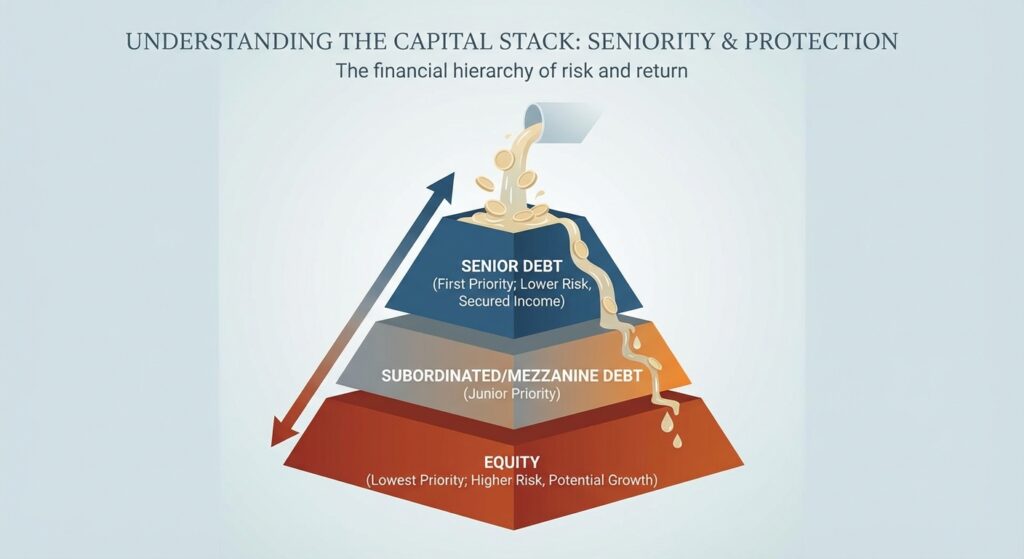
The Architecture of Risk: Understanding the Capital Stack
In the world of private finance, the most critical concept for both investors and business owners is not the interest rate; it is seniority.
Every company is financed by a mix of capital sources, arranged in a hierarchy known as the Capital Stack. This structure acts as a “payment waterfall,” dictating the strict order in which stakeholders are repaid, particularly when things go wrong.
For investors, understanding where a loan sits in this stack is the primary determinant of risk. For business operators, it defines the cost of capital and the control they retain over their company. In today’s private credit market, often characterized by senior secured lending, this structural advantage provides the “defensive” characteristics that distinguish the asset class from private equity or public stocks.
The Concept: Who Gets Paid First?
The capital stack is composed of three primary layers, ranked by priority of repayment:
- Senior Debt (Top Priority): This is the “safest” position. Senior lenders have the first claim on cash flows and assets. In a liquidation scenario, they must be paid back 100% of their principal and interest before anyone below them receives a cent. Most private credit funds focus here.
- Subordinated / Mezzanine Debt (Junior Priority): Sitting below senior debt, this layer takes on more risk. If assets are sold, they only get paid after senior lenders are satisfied. To compensate for this risk, “mezz” debt typically carries higher interest rates and sometimes equity warrants.
- Equity (Lowest Priority): Common equity (founders, PE sponsors) sits at the bottom. They have the highest upside potential if the company grows, but they are in the “first loss” position. If the company fails, equity holders are the first to be wiped out.
This hierarchy explains why private credit is fundamentally different from private equity: Credit is about capital preservation and contractual income, while equity is about capital appreciation.
How It Works: The $100 Million Waterfall
To see the mechanics of subordination in action, let’s look at a concrete example of a hypothetical middle-market company, “TechMsg Corp.”
TechMsg is valued at $100 million (Enterprise Value). To finance its growth, it constructs a capital stack:
- Senior Loan (Private Credit): $40 million
- Equity (Sponsor/Founders): $60 million
Scenario A: Success
The company is sold later for $150 million. The Senior Lender receives their $40 million principal plus accrued interest. The Equity holders keep the remaining $110 million. The lender’s upside is capped at the interest rate, while equity captures all value creation.
Scenario B: Distress (The Downside Protection)
A market downturn hits, and TechMsg is forced to liquidate for just $50 million (a 50% drop in value).
- Senior Lender: Pays out $40 million first. (100% Recovery)
- Equity Holders: Receive the remaining $10 million. (83% Loss)
Even though the company lost half its value, the private credit investor was made whole. This is the mechanism of Equity Cushion: the $60 million of equity served as a shock absorber that protected the debt.
Current Market Relevance
As we navigate 2026, the data reinforces why capital stack positioning is driving allocations.
- Market Scale: The private credit market has grown to approximately $1.7 trillion, driven by the retreat of traditional banks from middle-market lending (NEPC, Dec 2025). As banks prioritize liquidity, private lenders have stepped in to provide senior secured capital.
- Structural Safety: Institutional managers like Blackstone emphasize that private loans are typically “senior secured with meaningful cushion below,” offering defensive income that public markets struggle to match (Blackstone, July 2025).
- Interest Rate Resilience: Unlike fixed-rate bonds, private senior loans predominantly use floating rates. This structure mitigates interest rate risk, as coupons adjust with the base rate, protecting real returns (T. Rowe Price, April 2024).
- Downside Protection: The seniority of these assets provides a shorter duration and stronger collateral backing compared to private equity, offering “compelling downside protection” in uncertain economic cycles (Cambridge Associates, May 2024).
Decision Framework: Investors & Operators
The capital stack structure forces a tradeoff that dictates decision-making for both sides of the table.
For Investors: The Attachment Point
When evaluating a private credit fund, investors primarily analyze the Attachment Point and Detachment Point.
- If a loan attaches at 0% and detaches at 40% (like our TechMsg example), the “Loan-to-Value” (LTV) is 40%. The company must lose 60% of its value before the loan is impaired.
- Decision Rule: In volatile markets, investors prioritize lower LTVs (Senior Debt) to maximize the equity cushion, accepting lower yields for higher safety.
For Operators: Dilution vs. Leverage
Business owners use the capital stack to manage dilution.
- Current Logic: Raising capital via equity requires selling ownership stakes, often at a discount during flat markets. Raising capital via senior debt retains ownership but introduces interest expense and covenants.
- Decision Rule: If the Return on Invested Capital (ROIC) exceeds the cost of debt, operators should utilize the senior section of the capital stack to fund growth without diluting their equity stake.
Key Takeaways
- Seniority is Safety: Senior secured loans are first in line for repayment, making them the defensive layer of the capital stack.
- The Equity Cushion: The value of the equity beneath the debt acts as a buffer, absorbing losses before the lender is touched.
- Return Correlations: Debt returns are contractually capped; Equity returns are theoretically uncapped. The position you choose depends on your appetite for risk vs. reliable income.
- Floating Rate Advantage: Senior private credit loans generally float with rates, removing the duration risk common in public fixed income.
- Strategic Utility: For operators, debt is non-dilutive capital; for investors, it is income-generating collateral.


