
Where You Sit Determines What You Get
In private credit, one principle shapes nearly every lending decision, return expectation, and risk assessment: position in the capital stack. Whether you are an institutional investor evaluating a direct lending fund or a business owner structuring a leveraged buyout, understanding where each dollar sits in the hierarchy of a company’s balance sheet is not optional; it is foundational.
The capital stack is the ordered arrangement of all the capital financing a business or transaction. It dictates who gets paid first when things go right, and who absorbs losses first when things go wrong. Mastering this concept unlocks the logic behind yield premiums, covenant requirements, and the entire spectrum of private credit strategies.
How the Capital Stack Is Structured
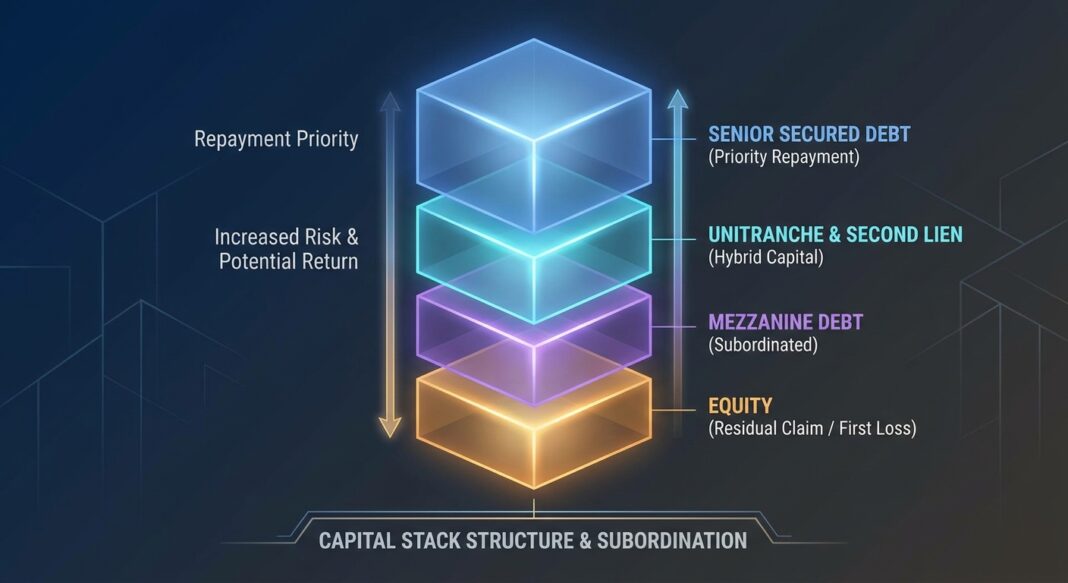
Think of the capital stack as a building with multiple floors. The higher the floor, the safer the position, but the lower the potential reward. The lower the floor, the greater the upside, but also the greater the exposure to loss. From top to bottom, a typical leveraged buyout (LBO) capital stack looks like this:
- Senior Secured Debt (First Lien): The highest-priority claim on a company’s assets and cash flows. In a liquidation, first lien lenders are repaid before anyone else. Because of this protection, they accept the lowest interest rate in the stack, typically SOFR plus 400–600 basis points in today’s middle market.
- Unitranche Debt: A hybrid instrument that blends senior and subordinated debt into a single facility provided by one lender or lending group. The interest rate reflects a blended cost between the two layers. Unitranche has become the dominant structure in private credit direct lending due to its simplicity and speed of execution.
- Second Lien / Subordinated Debt: Junior to first lien holders, this layer is only repaid after senior creditors are made whole. The higher subordination risk commands a meaningfully higher spread, often 700–1,000+ basis points over SOFR.
- Mezzanine Debt: Sits between senior debt and equity. Often unsecured or lightly secured, mezzanine financing frequently carries equity “kickers” such as warrants, rights to purchase equity at a set price, to compensate lenders for the elevated risk of their subordinated position.
- Preferred Equity: Paid after all debt obligations are satisfied but before common equity holders. Preferred equity holders typically receive a fixed dividend and have priority over common stockholders in liquidation.
- Common Equity: The residual claim on assets after every other layer has been repaid. Equity holders bear the first dollar of loss but also capture unlimited upside if the company performs well.
A Concrete Example: The $100M Acquisition
Consider a private equity firm acquiring a manufacturing company for $100 million in enterprise value. The deal is financed as follows:
- $50M, First Lien Senior Secured Loan (50% of capital stack) at SOFR + 500 bps
- $20M, Mezzanine Debt (20% of stack) at a fixed 13% with equity warrants
- $30M, Equity (30% of stack) contributed by the private equity sponsor
Now suppose the business deteriorates and is ultimately sold for only $60 million: a $40 million shortfall from the original purchase price. Here is how losses cascade through the stack:
- The first lien lender receives the full $50M. They are protected entirely by the equity and mezzanine cushion beneath them.
- The mezzanine lender receives $10M of their $20M back, a 50% loss on their position.
- The equity sponsor receives nothing. Their entire $30M is wiped out.
This example illustrates the core principle of subordination: junior capital absorbs losses so senior capital does not have to. The $50 million of equity and mezzanine beneath the first lien loan acts as a protective cushion. This is why private credit investors who lend at the senior secured level command lower yields than mezzanine lenders, and why mezzanine lenders demand significantly higher compensation than senior lenders.
Current Market Relevance
The capital stack concept is not merely theoretical; it directly explains the growth and structure of private credit markets today. According to Long Angle’s Private Credit Investment Guide 2026, private credit assets under management exceeded $2 trillion in 2025 and are projected to reach $4.5 trillion by 2030, driven in part by banks retreating from corporate lending, with bank lending as a share of U.S. GDP declining from 59% in Q4 2008 to 44% as of Q1 2025.
As banks have pulled back, non-bank lenders have stepped into the senior secured layer of the stack, a position traditionally dominated by commercial banks. According to Meketa Investment Group’s Private Credit Primer (April 2024), private credit financed approximately 85% of leveraged buyouts in 2023, up from 65% in 2021, citing LCD data sourced through Blackstone. Direct lending (predominantly first lien, senior secured) remains the largest private credit strategy by capital raised.
According to Long Angle (2026), direct lending accounted for 38% of private credit capital raised in H1 2025, reflecting investor preference for the capital stack’s most protected position. Meanwhile, Coller Capital’s Secondaries Institute (2025) reports that global private credit AUM reached approximately $1.7 trillion at end of 2024, up from just $300 billion in 2010, a nearly sixfold expansion in fifteen years.
The dominance of unitranche structures reflects how the market has adapted the capital stack for efficiency. By collapsing senior and subordinated layers into a single instrument, unitranche financing reduces transaction complexity and accelerates closing timelines, a meaningful advantage in competitive buyout processes.
Decision Framework: Investors and Operators
For Investors Evaluating Private Credit Opportunities:
- Identify stack position first. Before analyzing yield, determine where the loan sits. A 12% return in second lien is not comparable to a 12% return in first lien, the risk profile is fundamentally different.
- Quantify the cushion beneath you. Evaluate how much junior capital absorbs losses before yours is impaired. A first lien loan with 50% loan-to-value (LTV) has a far larger buffer than one at 80% LTV.
- Assess covenants relative to position. Senior secured loans typically carry financial maintenance covenants (minimum EBITDA, fixed charge coverage ratios) that trigger early intervention. Junior positions without covenants offer less protection.
- Match stack position to your risk mandate. Income-focused, capital-preservation mandates typically favor senior secured direct lending. Investors seeking equity-like returns consider mezzanine or opportunistic credit strategies, understanding that subordination risk rises commensurately.
For Business Owners and Operators Accessing Capital:
- Senior debt is cheaper, use it first. Because lenders in the senior secured position face lower risk, they accept lower rates. Maximizing senior debt capacity before layering in junior capital reduces your overall cost of financing.
- Unitranche simplifies execution. If speed and certainty matter, as in competitive acquisitions, unitranche financing consolidates the debt stack into one lender relationship, one set of documents, and one closing process.
- Mezzanine fills the gap equity cannot. When senior debt capacity is exhausted but the business does not want to dilute equity further, mezzanine financing bridges the gap, at a cost, but without surrendering ownership.
- Understand what you are pledging. Senior secured lenders hold a first lien on your assets. Defaulting does not simply mean missed payments; it can trigger lender control over the collateral underlying the loan.
Key Takeaways
- Position determines protection. Senior secured creditors sit at the top of the capital stack and are repaid first in any liquidation scenario. Junior capital layers (mezzanine, subordinated debt, equity) absorb losses in descending order.
- Higher yield signals deeper subordination. Yield premiums across the stack are not arbitrary; they compensate lenders for the specific probability and severity of loss at each position. A wider spread always signals a more junior position or weaker collateral.
- Equity cushion is the senior lender’s core protection. The percentage of the capital stack funded by equity and junior debt beneath a senior loan directly determines how much enterprise value can erode before the senior lender faces impairment.
- Private credit now dominates the senior secured layer. With banks retreating from corporate lending, non-bank direct lenders have become the primary providers of first lien capital for middle-market companies, financing 85% of leveraged buyouts in 2023.
- Unitranche is the market’s structural innovation. By combining senior and subordinated debt into one instrument, unitranche financing has made private credit faster and more operationally efficient for both borrowers and lenders, accelerating its adoption across the market.


