
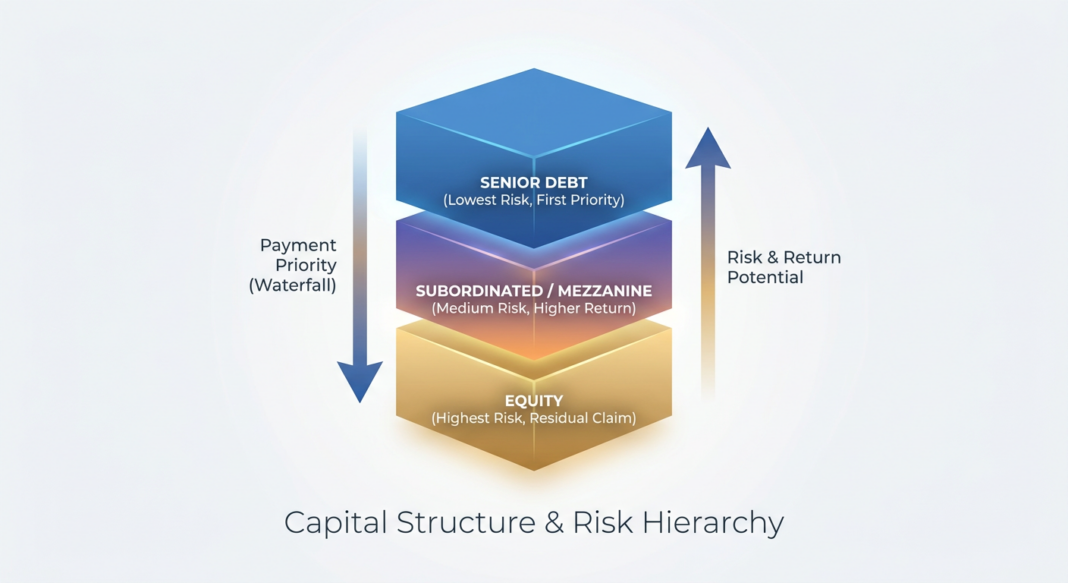
Why Where You Sit in the Stack Determines Everything
In private credit, not all lenders are created equal. Two investors can fund the same company, earn interest on the same underlying business, and still face dramatically different outcomes when things go wrong. The difference comes down to one foundational concept: capital stack position. Understanding where a loan sits in the hierarchy of claims is the single most important variable in evaluating private credit risk, and it shapes every term from interest rate to covenant strength to expected recovery in default.
This is the first framework every investor evaluating private credit (and every business owner raising debt) needs to internalize before a single dollar changes hands.
What the Capital Stack Actually Is
The capital stack is the ordered hierarchy of all financial claims on a company’s assets and cash flows. Think of it as a waterfall: when a company generates cash, payments flow from the top of the stack downward. When a company fails, recoveries flow in the same direction. Those at the top get paid first; those at the bottom get whatever, if anything, remains.
From top to bottom, the stack typically looks like this:
- Senior Secured Debt (First Lien): The highest-priority claim, secured by specific collateral assets. Paid first in both normal operations and liquidation. Carries the lowest interest rate because the risk is lowest.
- Unitranche Debt: A hybrid structure combining senior and subordinated elements into a single facility at a blended rate. Increasingly common in middle-market buyouts due to structural simplicity.
- Second Lien / Subordinated Debt: Paid only after first lien holders are made whole. Higher interest rate reflects the elevated risk of sitting behind senior lenders.
- Mezzanine Debt: Sits between senior debt and equity, often unsecured or lightly secured. Frequently structured with warrants or equity participation features to compensate for junior positioning.
- Preferred Equity: Not debt, but ranked above common equity. Receives dividends before common shareholders but after all debt obligations.
- Common Equity: The residual claim. Paid last. Absorbs all losses before any debt holder is impaired. Highest risk, highest potential return.
Subordination is the legal mechanism that enforces this hierarchy. A subordinated creditor formally agrees, via an intercreditor agreement, to stand behind senior creditors in any recovery scenario. This is not a gentleman’s agreement; it is a contractually binding priority of payment.
A Concrete Example: The Same Company, Two Very Different Outcomes
Consider a hypothetical manufacturing company with an enterprise value of $10 million and the following capital structure:
- First Lien Senior Loan: $5 million at SOFR + 300 bps
- Mezzanine Debt: $2 million at 14% fixed
- Equity: $3 million
In a default scenario where the business is liquidated and assets recover just $6 million, a 40% haircut from enterprise value, here is how each class fares:
- First Lien Lender: Recovers full $5 million. Full principal returned, zero loss.
- Mezzanine Lender: Recovers the remaining $1 million of the $2 million owed. Takes a 50% loss on principal.
- Equity Holders: Recover nothing. Complete wipeout.
The same business failure produces three entirely different investor experiences based solely on stack position. The first lien lender’s higher structural priority, not superior credit analysis, is what preserved capital. This is why seniority is often described as built-in downside protection that operates independently of business performance.
The mezzanine lender accepted the higher rate of 14% precisely because they knew their recovery would depend on how much value survived above them. The equity holder accepted zero contractual return because they retained upside if the business grew, a bet that did not pay off here.
Current Market Relevance: Where Capital Is Flowing in 2026
The structure of the capital stack has taken on renewed importance as private credit has scaled into a defining force in corporate finance. According to Long Angle’s Private Credit Investment Guide (March 2026), private credit assets under management exceeded $2 trillion in 2025 and are projected to reach $4.5 trillion by 2030, growth driven in significant part by banks retreating from leveraged lending after post-GFC regulation.
That same report notes that bank lending as a share of U.S. GDP declined from 59% in Q4 2008 to 44% as of Q1 2025, a structural withdrawal that private credit has stepped in to fill, particularly at the senior secured level. As PitchBook’s Private Debt Guide (2025) documents, direct lending, which is predominantly first lien senior secured, remains the largest private debt strategy by assets under management, reflecting investor preference for stack seniority during periods of economic uncertainty.
According to Meketa Investment Group’s Private Credit Primer (April 2024), approximately 80% of the direct lending market is sponsor-backed, meaning the controlling owner is a private equity firm, a dynamic that makes understanding capital stack seniority critical, since PE sponsors occupy the equity layer and their interests can diverge sharply from those of lenders in a restructuring.
Meanwhile, unitranche structures, which compress the stack into a single blended facility, have gained significant traction. Gridline’s Capital Structure Analysis (January 2024) highlights that unitranche has become a preferred instrument for middle-market buyouts precisely because it eliminates intercreditor complexity while delivering a blended yield that sits between senior and subordinated rates.
Decision Framework: What Stack Position Means for You
For Investors Evaluating Private Credit
- Define your risk tolerance first, then match it to stack position. Senior secured positions offer lower yield but contractual priority. Mezzanine and subordinated positions offer higher yield but meaningful loss exposure if enterprise value erodes.
- Assess the equity cushion beneath you. The more equity sitting below a senior loan, the greater the enterprise value decline the company can absorb before lenders are impaired. A senior loan with 50% loan-to-value has significantly more cushion than one at 75% LTV.
- Read the intercreditor agreement. In multi-tranche structures, the legal mechanics of subordination (payment blockages, standstill provisions, enforcement rights) determine how seniority actually functions in a default, not just how it is described in a pitch deck.
- Understand what “senior secured” actually secures. A first lien on inventory or receivables is different from a first lien on intellectual property. Collateral quality materially affects first lien recovery rates.
For Business Operators Raising Capital
- Senior debt is the cheapest capital you will access outside of subsidized programs. Operators evaluate senior secured facilities first because the interest rate reflects the lender’s structural protection, not a concession to the borrower.
- Mezzanine and subordinated debt costs more but preserves equity. A business owner choosing between mezzanine debt at 14% and selling additional equity considers that the mezzanine obligation ends at maturity, while equity dilution is permanent.
- Unitranche simplifies execution at a cost. A single lender, a single set of covenants, and faster closing, but the blended rate typically exceeds what a pure first lien facility would cost. Operators weigh speed and simplicity against the marginal rate difference.
Key Takeaways
- Position determines outcome. In any credit scenario (performing or distressed) capital stack position is the primary driver of both income and recovery. It precedes all other analysis.
- Seniority is contractual protection, not a promise. First lien lenders have legal priority enforced through security agreements and intercreditor contracts, not merely preferential treatment.
- Higher yield always signals lower stack position. In private credit, rate differentials across the stack are not arbitrary. They are compensation for the incremental subordination risk each layer accepts.
- The equity cushion is the first line of defense. For any private credit investor, understanding how much equity sits below their position (and how stress-tested that cushion is) is as important as the borrower’s income statement.
- Market structure validates the framework. The dominance of senior secured direct lending in private credit AUM reflects broad investor consensus: in an uncertain macroeconomic environment, structural seniority is worth accepting a lower spread.


