
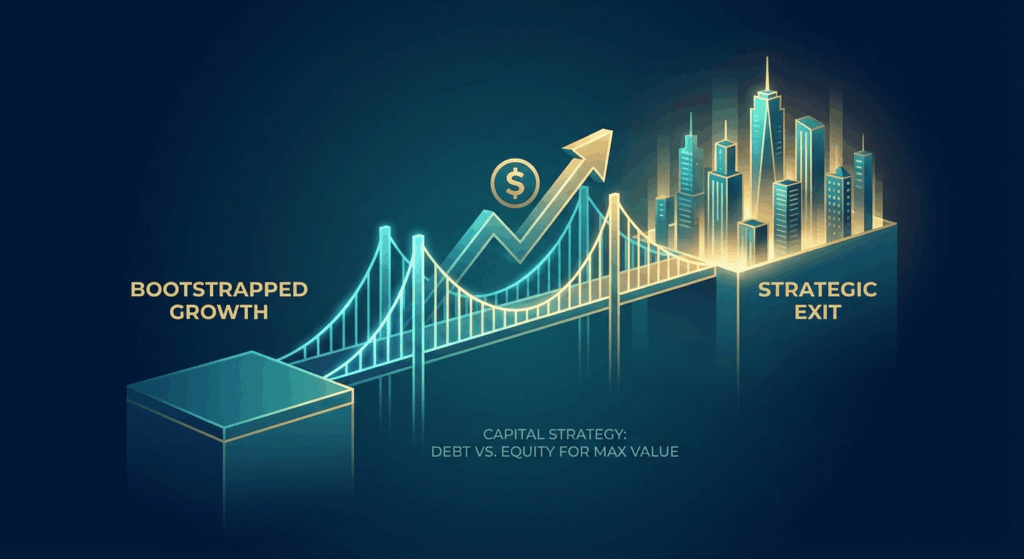
The Founder’s Dilemma: Fueling the Final Mile
For many bootstrapped founders, the hardest capital decision isn’t the first one, it’s the one made right before the finish line. You have built a viable product, established product-market fit, and can see a strategic exit on the horizon. But to maximize that valuation, you need one final burst of growth.
This is the “Bridge to Exit” scenario. The conventional playbook suggests raising a growth equity round to muscle through to the acquisition. But for founders who have spent years preserving their cap table, selling 15% to 20% of the company just years before a sale can be a mathematically painful decision.
The story of WatchWire (formerly EnergyWatch) offers a compelling counter-narrative. By choosing debt over equity at a critical inflection point, the management team preserved their ownership and optionality, ultimately securing a strategic exit that maximized returns for the people who built the business.
The Story: From Services to Software
WatchWire began in 2000 as a straightforward energy consulting firm in New York. However, as the energy market deregulated and corporate sustainability mandates grew, the team led by Andy Anderson saw a bigger opportunity. They identified a gap for a SaaS platform that could standardize messy energy data and streamline sustainability reporting.
Transitioning from a service-based revenue model to a recurring software revenue model is capital intensive. It requires engineering talent, product development, and a different sales motion. Unlike many potential competitors who might raise early Venture Capital to fund this “J-curve” of development, WatchWire largely bootstrapped. They built a robust culture and tested product-market fit on their own dime, retaining control over their destiny.
By 2021, the pivot had worked. WatchWire was a leader in energy management and carbon accounting. The market for Cleantech was heating up, and private equity firms were beginning to circle the sector. The company was poised for a larger event, but they needed capital to accelerate into that window.
The Decision: equity vs. Debt
In 2021, WatchWire had options. The Cleantech sector was attracting record levels of venture investment. The executive team could easily have courted Growth Equity investors to put millions onto the balance sheet.
However, equity capital comes with two distinct costs: dilution and governance. Raising equity would mean permanently parting with a slice of the upside. Furthermore, institutional equity often comes with liquidation preferences and board control provisions that can complicate future exit negotiations.
As reported in a case study by TIMIA Capital, the WatchWire team was “certain about one thing; it wanted to avoid more dilution of the business.”
Instead of selling shares, they sought a debt facility. They partnered with TIMIA Capital for a $2.5 million investment facility. Because WatchWire had established recurring revenue (the “SaaS” model), they could access capital based on the predictability of their cash flows rather than personal guarantees or hard asset collateral.
The Outcome: A Clean Exit
The debt capital acted as rocket fuel without the weight of a new partner on the cap table. WatchWire used the $2.5 million to invest in growth initiatives that increased their recurring revenue and market position.
Crucially, debt is “rental capital”: you pay for it while you use it, and once you repay it, the relationship ends. Equity is “marriage capital”; it is permanent.
Just two years later, in 2023, the strategy paid off. WatchWire was acquired by Tango Analytics, a leader in real estate and facilities management software backed by Berkshire Partners.
The Impact of the Structure:
Consider a hypothetical comparison. If WatchWire had raised $2.5 million in equity at a $15 million pre-money valuation in 2021, they would have sold roughly 14% of the company. At the time of the exit in 2023, that 14% of the exit proceeds would have gone to the investors. By using debt, that 14% (minus the cost of interest) stayed in the pockets of the founders and early employees.
The Lessons: Principles of the ‘Bridge to Exit’
The WatchWire case illustrates a specific moment where debt is often superior to equity: The Value Inflection Bridge.
Founders should consider this approach when:
- The Timeline is Clear: You have a line of sight to a liquidity event (IPO, acquisition, or recapitalization) within 24-36 months.
- Revenue is Recurring: Lenders can underwrite the predictability of SaaS churn and retention, offering better terms than they would to cyclical businesses.
- Control is Premium: You want to negotiate an exit based on your terms, without pressure from a VC firm that might need to return their fund within a specific window.
Conversely, this strategy is risky if the “bridge” leads nowhere. If the acquisition market had dried up or growth significantly slowed, the debt service could have strained cash flows. Debt creates a burden of repayment that equity does not.
Framework for Founders
When facing a capital decision within 3 years of a potential exit, run the “Cost of Capital at Exit” calculation:
- Equity Cost: (Capital Raised / Valuation) * Expected Exit Value
- Debt Cost: Interest Rate * Capital Raised * Years Outstanding
In successful exits, the “Equity Cost” is almost always significantly higher than the “Debt Cost.” If you are confident in the exit, debt is the cheaper fuel.


