
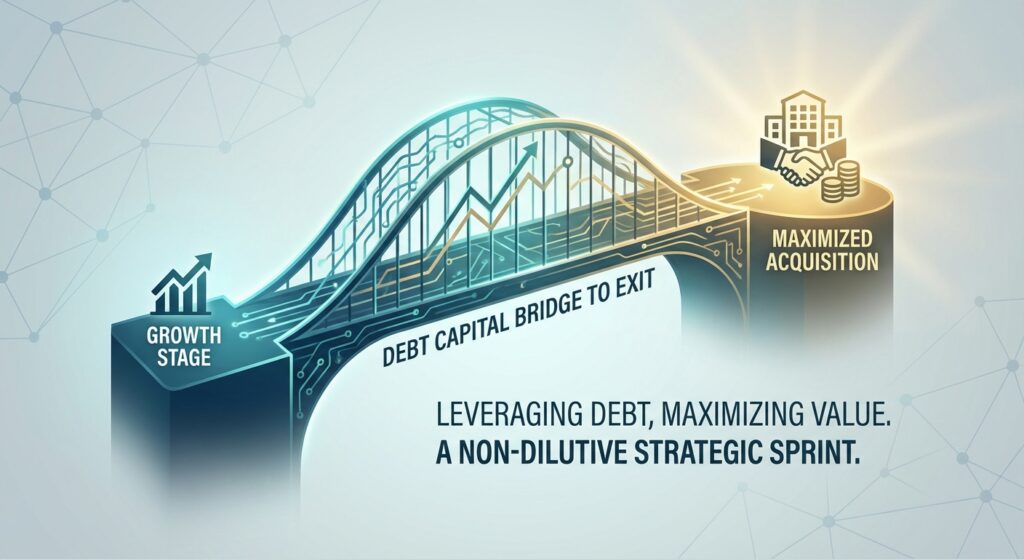
The Multi-Million Dollar Difference: A “Bridge to Exit” Case Study
In the high-stakes world of venture-backed technology, the celebration usually centers on the size of the capital raise. But for founders focused on personal wealth creation and control, the most critical metric isn’t how much you raise, it’s how much you keep.
The story of WatchWire (formerly EnergyWatch) offers a textbook example of how founders can use private credit as a strategic “bridge to exit,” financing their final sprint to acquisition without suffering the heavy dilution of a late-stage equity round. By choosing debt over equity at a critical inflection point, the leadership team likely preserved millions of dollars in enterprise value for themselves and their long-term employees.
The Story: From Bootstrap to Breakout
Established in 2000, WatchWire began as an energy consulting and procurement advisory firm in New York. As the market evolved, the team recognized a deeper opportunity in the data. They pivoted from pure consulting to building a SaaS platform that helped clients manage sustainability reporting, carbon accounting, and energy data, a sector now booming under “ESG” and “Cleantech” banners.
For years, the company bootstrapped. They built a robust culture, honed their product-market fit, and navigated the difficult transition from service provider to software company without outside institutional capital. By 2021, they had solidified their position as a leader in the space. The market was heating up, and larger players were looking to acquire.
However, to maximize their valuation in a potential sale, WatchWire needed to show aggressive pipeline growth. They needed cash to invest in sales, marketing, and technology. This led them to a classic “Founder’s Dilemma.”
The Decision: Dilution vs. Leverage
In 2021, Cleantech was attracting massive venture capital interest. WatchWire’s executive team had options. They could have easily engaged growth equity firms or VCs to inject $5 million to $10 million onto the balance sheet.
But the cost of that capital would have been steep. A typical Series B or late-stage growth round might demand 15% to 25% of the company’s equity. If the company was already eyeing an exit in the near future (12–36 months), giving up a quarter of the capitalization table would mean giving up a quarter of the exit proceeds.
Instead, the team, led by then-CEO Andy Anderson, looked at private credit. They ultimately secured a non-dilutive investment facility from TIMIA Capital.
“Non-dilutive capital was key for us. It’s simply much cheaper capital,” Anderson noted in a retrospective on the deal. “Even if it’s just a bridge to something bigger… [the] investment will help us get to the next stage without giving up more of our company.”
The Capital Structure Logic
Consider the math of this decision (using hypothetical numbers for illustration based on market standards):
- Scenario A (Equity): Raise $5M for 20% equity. If the company sells for $50M two years later, that $5M investment costs the founders $10M in exit value.
- Scenario B (Debt): Borrow $5M. Pay an interest rate (even a high one, say 15-18%) plus a small warrant coverage (e.g., 1-2%). Over two years, the cost of capital might be $1.5M – $2M in interest.
In this simplified model, choosing debt saves the founders roughly $8 million in the final exit. The “expensive” interest payments are significantly cheaper than the “permanent” cost of equity.
The Outcome: Acquisition Without Abdication
WatchWire put the debt capital to work immediately. They invested in:
1. Pipeline Growth: Expanding sales and marketing to prove future revenue velocity.
2. Product Maturity: Enhancing the software to meet the complex needs of enterprise clients.
The strategy worked. The capital injection allowed them to accelerate growth metrics, making them an attractive target for strategic buyers. In 2023, less than two years after taking on the debt, WatchWire was successfully acquired by Tango Analytics, a cloud-based real estate and facilities management software company backed by Berkshire Partners.
Because they had funded their final growth phase with debt, the founders and early shareholders didn’t have to split the acquisition premium with a late-stage VC who had only been on the cap table for 24 months. The debt was repaid from the proceeds, and the remaining equity value, undiluted, flowed to the people who built the business over two decades.
The Lessons: When to Bridge
The WatchWire story illustrates a specific application of leverage known as the “Bridge to Exit.” This strategy is highly effective, but it requires specific conditions to work safely.
1. Revenue Predictability is Prerequisite
WatchWire had a mature product and a historically clear sales cycle. Leverage is dangerous when product-market fit is unproven. It is a powerful accelerator when the machine is already enticing customers.
2. The “Last Mile” is the Most Expensive
Founders often succumb to valuation fatigue right before the finish line. They raise a “pre-IPO” or “pre-exit” round to dress up the balance sheet, not realizing this is the most mathematically expensive equity they will ever sell. If an exit is visible within 12–24 months, debt is almost universally the superior instrument for ROI.
3. Optionality has Value
Had the acquisition market frozen, debt would have required WatchWire to service payments, whereas equity would not. This is the risk premium. Founders must be confident in their ability to either service the debt through cash flow or achieve the liquidity event. WatchWire’s pivot to SaaS likely provided the recurring revenue stability needed to mitigate this risk.
For founders sitting on stable, growing businesses, the question shouldn’t just be “Who will give us money?” but “Who will let us keep the value we create next?” As WatchWire demonstrated, sometimes the best partner is a lender, not a shareholder.
Key Insights
- Equity is permanent; debt is temporary. In a short-term sprint to exit, equity is often the most expensive form of capital.
- Bridge financing creates leverage in negotiations. Having cash on hand allows founders to negotiate exit terms from a position of strength, rather than desperation.
- Recurring revenue enables safe leverage. The shift to SaaS provided the predictable cash flows that made debt a viable option for WatchWire.
- Alignment of incentives. Lenders want their principal back with interest; they don’t fight for board seats or block storage exits that don’t return 10x.
- The “20% Rule.” If a capital injection requires giving up 20% of your company within 3–5 years of an exit, run the math on debt. The savings could be generational.


