
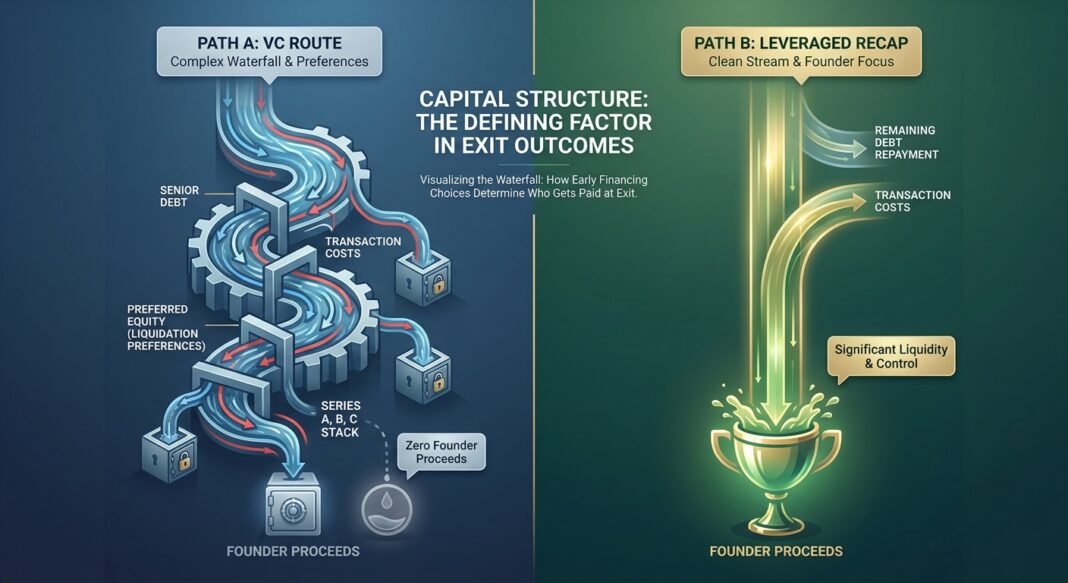
The Story: Same Era, Opposite Outcomes
January 2025. Two exits close within weeks of each other. Both are success stories by headline standards. Both involve real companies with real customers and real revenue. But when the wire transfers settle, only one set of founders actually gets paid.
The first company is Divvy Homes, a San Francisco-based rent-to-own proptech darling that raised more than $400 million in venture capital from Andreessen Horowitz, Tiger Global, and GGV Capital, hit a $2.3 billion peak valuation in 2021, and was acquired by Brookfield Properties for approximately $1 billion in January 2025. By any external measure, a major exit. By internal measure, a quiet devastation. CEO and co-founder Adena Hefets wrote directly to shareholders that after repaying outstanding debt, covering transaction costs, and fulfilling liquidation preferences for preferred shareholders, neither common shareholders nor founders would receive any proceeds. A billion dollars in the door. Zero to the people who built it.
The second scenario, a hypothetical composite drawn from the structural patterns of lower-middle-market deals documented across publicly available private credit and M&A data, describes a different kind of founder entirely. One who never pitched Sand Hill Road. One who, when the business hit $4 million in annual EBITDA, called a private credit lender instead of a venture partner. And who walked away from an exit three years later with nearly everything they had built.
Same era. Opposite outcomes. The difference wasn’t talent, market timing, or product quality. It was capital structure.
The Decision: Two Paths at the Same Crossroads
Path A: The VC Route (Divvy Homes, Real Deal)
Divvy’s model was capital-intensive by design: the company purchased homes on behalf of customers who rented them back while building toward ownership. Scaling that model required enormous balance sheet capacity. Over four years, the company raised over $400 million in equity, at escalating valuations, and then, in October 2021, layered on approximately $735 million in debt financing on top of that preferred equity stack.
The equity capital came with liquidation preferences, contractual rights that ensure preferred investors get paid before common shareholders in any exit. Each successive round amplified the preference stack. When the exit finally came at $1 billion, already less than half the peak valuation, the waterfall was unforgiving. Debt got repaid first. Transaction costs came next. Liquidation preferences for the preferred stack consumed the remainder. Common equity, held by founders, employees, and later-round participants, received nothing.
As TechCrunch reported at the time, this outcome was confirmed directly in writing by Divvy’s own CEO. The company had helped over 2,000 families on their path to homeownership. Its founders walked away with none of the $1 billion that changed hands.
Path B: The Leveraged Recap Route (Hypothetical Scenario)
Now consider a structurally different choice, one grounded in the documented transaction patterns of the lower-middle market, but presented as a composite illustration rather than a named deal.
A founder-owned B2B services business generates $4 million in EBITDA, growing at 18% annually, with recurring contract revenue and clean books. Rather than raising VC to fund an acquisition and accelerate growth, the founder contacts a direct lender. The structure: a leveraged recapitalization at 3.5x EBITDA, producing a $14 million term loan. Of that, $8 million is distributed as a personal dividend to the founder, de-risking their personal balance sheet, and $6 million is deployed to acquire a bolt-on competitor. The founder retains 100% of the equity. No new shareholders. No board seats surrendered. No liquidation preferences created.
This structure is not exotic. According to the Pepperdine Private Capital Markets Report (2024), lower-middle-market leveraged recapitalizations typically close at 3x to 5x EBITDA in total debt, exactly the range used here. Private credit now dominates this space: direct lending captured approximately 90% of middle-market LBO lending in 2024, up from just 36% in 2014, according to Bain & Company data cited by CapitalPad’s 2026 research. The product is widely available. The decision to use it is entirely the founder’s.
The Outcome: What the Numbers Actually Show
Divvy Homes: The Cost of the Preference Stack
When Divvy sold for $1 billion in January 2025, the math was brutal and linear. The company had raised over $700 million in combined debt and equity. Preferred equity investors held liquidation preferences that senior-ranked their claims ahead of common equity. Debt holders senior-ranked everyone. The $1 billion exit, at less than half of the 2021 valuation, was consumed entirely by senior obligations before a dollar could reach founders or employees. A company that once sat on a $2.3 billion cap table generated zero founder proceeds at exit.
The lesson isn’t that Divvy was a bad business. At its peak, it managed roughly 7,000 homes and was on track for more than $100 million in annual revenue. The lesson is structural: the capital choices made during the growth phase created a claims waterfall that no reasonable exit could clear. Every venture round was another preference layer. Every dollar of debt was another senior claim. By the time the exit came, the economics had been pre-allocated, to everyone except the founders.
The Hypothetical Founder: Clean Waterfall, Full Proceeds
In our hypothetical scenario, three years after the leveraged recap, the bolt-on acquisition has driven EBITDA from $4 million to $7 million. A strategic acquirer, benchmarking against lower-middle-market multiples, which GF Data shows averaged 7.2x EBITDA in 2025 for sponsored transactions, values the business at approximately $49 million. The outstanding loan balance has amortized to roughly $10 million. After repayment of the remaining debt and transaction costs, the founder nets approximately $36 million at close, in addition to the $8 million personal dividend taken three years prior. Total personal liquidity: ~$44 million: from a business that was worth $20 million on paper when the recap was executed.
The cap table had one name on it the entire time. The waterfall had one step. The founder got paid.
The Market Is Confirming the Shift
This isn’t an isolated preference, it’s a documented trend. Venture debt deal value hit a record $53 billion in 2024, up 94% from 2023, as founders used loans to extend runway and preserve equity, according to PitchBook data. Separately, PitchBook LCD tracked roughly $76 billion in dividend recap loans in 2024: the third-highest annual total on record and a 240% jump versus 2023. The market is speaking clearly: founders and operators are choosing structured debt over dilutive equity at a historic pace.
The Lessons: A Framework for Capital Decisions
1. Equity Isn’t Expensive at the Round: It’s Expensive at the Exit
The true cost of venture equity is almost never visible at the term sheet. A 25% ownership stake given up in a Series A feels abstract. At a $500 million exit, that same stake costs the founder $125 million in forgone proceeds. The opportunity cost scales with success. Debt cost stops when the loan is repaid, interest and fees represent the total expense, with no perpetual claim on future value creation.
2. Liquidation Preferences Are a Silent Senior Claim
Every venture round that includes a liquidation preference creates a contractual obligation that senior-ranks investor capital in an exit. In a clean outcome, an IPO at a 5x valuation step-up, these preferences rarely matter. In any outcome that approximates a flat or down valuation from peak, they consume the exit entirely. Divvy’s outcome wasn’t unusual; it was mathematically predictable given the structure in place.
3. The Leveraged Recap Is the Founder’s Liquidity Tool
A leveraged recapitalization allows founders with stable EBITDA and cash-generative businesses to extract personal liquidity, fund acquisitions, or buy out partners, without triggering a change of control, creating a new preference layer, or accepting a VC clock. The owner extracts cash from the business while the company assumes the debt obligation and services it from operating cash flows. The cap table stays clean. The clock stays with the founder.
4. Know When This Works, and When It Doesn’t
Leverage rewards businesses with predictable, recurring cash flows and manageable existing debt levels. It punishes businesses with cyclical revenue, rate-sensitive cost structures, or models that require continued equity to survive. Divvy’s business was rate-sensitive by design, its rent-to-own model depended on stable or declining mortgage rates. Adding $735 million in debt to that structure was not a capital optimization; it was an amplification of the company’s single greatest operating risk. Non-dilutive capital works best when tied to specific operational milestones and matched to the business’s underlying cash flow profile, not used as a substitute for a flawed unit economics model.
5. The Private Credit Market Has Democratized Access
Access to institutional private credit is no longer limited to PE-sponsored transactions. The private credit market reached roughly $1.8 trillion in 2025, with non-sponsor direct lending growing as founder-owned businesses increasingly access institutional capital on their own terms. Closed-end direct lending dry powder stood at approximately $500 billion as of H1 2025, near all-time highs, meaning lenders are actively competing for quality middle-market borrowers. For a founder-owned business with $3–$10 million in EBITDA, multiple sources of private credit capital are available today that simply didn’t exist a decade ago.
Key Insights
- Capital structure is an exit outcome, not just a financing decision. The terms you accept today determine who gets paid (and in what order) the day you sell. Liquidation preferences and senior debt claims consumed a $1 billion acquisition entirely, leaving Divvy’s founders with nothing.
- Debt has a fixed cost. Equity has a compounding one. Interest is a finite obligation. An equity stake is a permanent, compounding claim on every dollar of future value the business creates. In high-growth businesses, the equity cost always exceeds the debt cost, often by multiples.
- A clean cap table is a strategic asset. A company with one owner and no liquidation preferences has a simple, one-step exit waterfall. Every additional preferred investor adds a senior claim that must be cleared before the founder participates. Simplicity compounds in your favor at exit.
- The leveraged recap is liquidity without a sale. Founders with stable EBITDA can distribute personal cash, fund acquisitions, and reset their capital structure, without selling, without diluting, and without accepting a VC hold period. The private credit market in 2025 and 2026 is deep, competitive, and actively seeking quality founder-owned businesses.
- Match the financing instrument to the business’s cash flow profile. Rate-sensitive businesses with cyclical revenue should approach high leverage with extreme caution. Stable, recurring-revenue businesses with pricing power are the natural home for leveraged capital structures. The instrument is only as good as the underlying cash flow that services it.
The most dangerous moment in any founder’s capital journey is not the down round or the missed milestone. It is the moment they accept a term sheet without modeling what the waterfall looks like if the exit comes in at half of expectations. Divvy Homes was a $1 billion outcome that produced zero founder value. That is not a story about a bad business. It is a story about a capital structure that was never designed to pay the people who built it.
The founders who will look back on this era with clarity are not the ones who raised the biggest rounds. They are the ones who thought carefully about what every dollar of capital cost, not at the close, but at the exit.


