
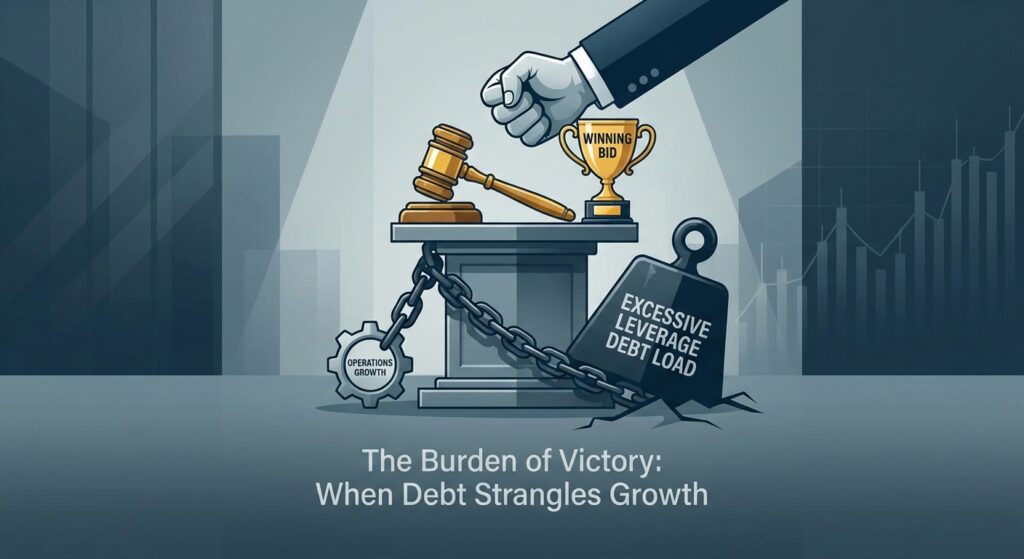
The Story: The High-Stakes Auction
By mid-2025, the private markets had entered a peculiar phase of aggression. While broadly syndicated markets were oscillating, private credit firms, sitting on massive piles of dry powder, began aggressively pitching higher leverage ratios to win deals from private equity sponsors. The directive was clear: deploy capital.
Consider a hypothetical scenario that mirrors several transactions seen in Q3 2025. Let’s call the target company “LogiTech Solutions,” a B2B logistics software provider generating $50 million in EBITDA. The business was healthy, growing at 12% year-over-year, and commanded a strong moat.
When LogiTech went up for auction, a mid-market Private Equity firm, “Apex Partners” (Hypothetical), identified it as a platform acquisition. However, the auction was crowded. To win, Apex realized they wouldn’t just need to pay a premium; they would need to structure the deal with aggressive leverage to make their internal rate of return (IRR) models work.
The Decision: Debt as the Winning Bid
Apex faced a binary choice: discipline or victory. A strategic acquirer led the bidding with an offer implying a 13x EBITDA multiple ($650M). To top the bid and secure the asset, Apex needed to hit 14x ($700M).
In previous cycles, potential lenders might have capped leverage at 5.5x or 6x EBITDA. However, market reporting from July 2025 highlighted a shift: direct lenders were pitching significantly higher leverage ratios to sweeten deals for sponsors. Bloomberg reported that direct lenders were “tacking on more debt” to give companies flexibility for acquisitions and dividend recaps.
Apex’s Investment Committee reviewed the terms available from a hungry private credit fund:
- Purchase Price: $700 million (14x EBITDA)
- Equity Check: $300 million (43%)
- Debt Financing: $400 million (8x Leverage)
- Interest Rate: SOFR + 600 bps (approx. 10-11% all-in cost)
The decision was made. Apex chose the aggressive debt package to minimize their equity check and boost projected ROE. They justified the 8x leverage by pointing to LogiTech’s high free cash flow conversion. They won the deal.
The Outcome: Operating in a Straitjacket
While Apex won the auction, the victory quickly soured post-close. This scenario echoes the urgency seen in real-world deals, such as Clearlake Capital’s rush to secure financing for Dun & Bradstreet in April 2025, where the firm had to utilize a risky $5.75 billion bridge loan due to tight timelines.
For our hypothetical LogiTech, the math of 8x leverage clashed with operational reality immediately. With $400 million in debt at ~10% interest, the annual interest expense ballooned to $40 million.
The Post-Close Reality:
- EBITDA: $50 million
- Interest Expense: $40 million
- Remaining Cash Flow: $10 million
- Taxes & Capex: $8 million
- Net Free Cash Flow: $2 million
The company was left with virtually zero margin for error. When a major customer delayed a contract renewal in Q4 2025, LogiTech faced a liquidity crunch. instead of investing in R&D to maintain their growth rate, management was forced to cut costs solely to service the debt. The leverage that helped Apex “win” the deal effectively strangled the company’s ability to compete.
The Lessons: Price is Vanity, Structure is Sanity
The LogiTech case illustrates a critical principle for founders and operators: Leverage is an amplifier, not a fundamental value driver.
In a market where asset managers like Ares are pushing to dominate private credit with massive scale, the availability of debt does not always correlate with the prudence of taking it.
Principles for Capital Structure:
- The Coverage Ratio Rule: Never structure a deal where interest payments consume more than 50-60% of free cash flow, regardless of what a lender offers. In the LogiTech example, interest ate 80% of EBITDA.
- Auction Fever: In competitive auctions, the “winner” is often the party willing to accept the most fragile capital structure. There is value in losing.
- Flexibility has Value: “Cheap” equity is expensive if it dilutes ownership, but “cheap” debt is fatal if it eliminates operational flexibility.
Key Insights
- Availability ≠ Viability: Just because private credit funds pitch 8x leverage to deploy capital doesn’t mean the business can support it.
- The Winner’s Curse: Overpaying via leverage often converts an equity growth story into a credit monitoring exercise.
- Speed Kills: Rushed financing, like 364-day bridge loans, imposes refinancing risks that can force unfavorable exits.
- Cash Flow is King: EBITDA means nothing to a lender; Free Cash Flow (FCF) pays the bills. High leverage requires high FCF conversion.
- Incentive Misalignment: Lenders are incentivized to deploy dry powder; operators are incentivized to survive. These goals diverge at high leverage multiples.


