
The Myth of the Pitch Deck
In the modern startup playbook, the “hero’s journey” almost always follows a specific script: build a pitch deck, court venture capitalists, dilute ownership for cash, and race toward a liquidity event before the clock runs out. It is a model predicated on the idea that capital is the primary constraint and equity is the cheapest currency.
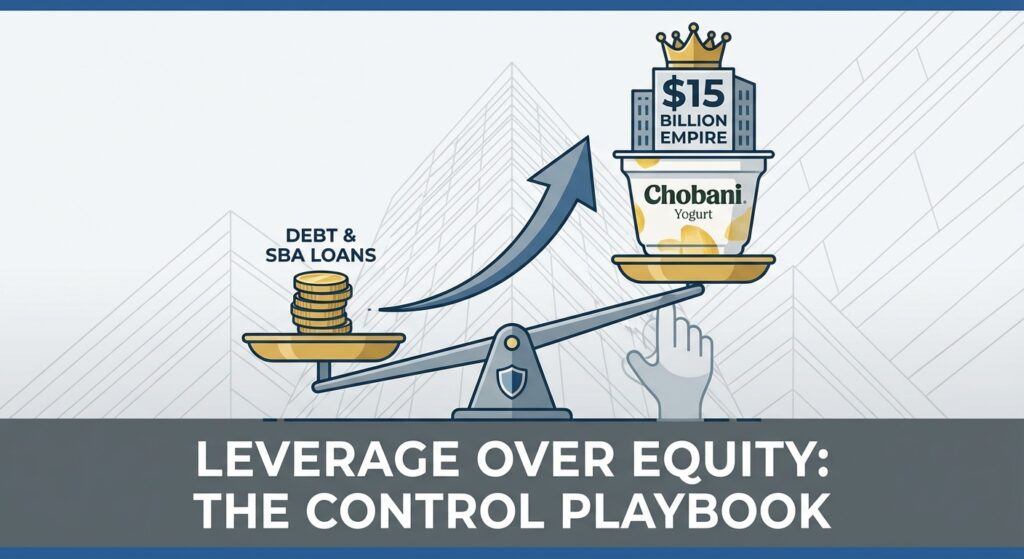
Hamdi Ulukaya, the founder of Chobani, proved precisely the opposite. His journey from a shuttered factory in upstate New York to a multi-billion dollar empire is not just a success story; it is a masterclass in utilizing leverage to preserve control.
While recent headlines highlight Chobani’s massive valuation, reportedly reaching near £15 billion as of late 2025, the true architectural marvel of the company isn’t its yogurt. It is its capital structure. Ulukaya’s refusal to sell his soul to early-stage equity investors offers a blueprint for founders who value sovereignty over speed.
The Decision: Debt as a Sword and Shield
The saga began in 2005 with a piece of junk mail. Kraft was unloading a defunct yogurt plant in New Berlin, New York. The asking price was low, but for Ulukaya, a Kurdish immigrant with limited resources, it might as well have been a fortune.
faced with this acquisition opportunity, the standard advisor would have suggested finding a partner or an angel investor to put up the cash in exchange for a 40% stake. Ulukaya chose a different path: the Small Business Administration (SBA) loan.
This was the first layer of his “Anti-VC” strategy. By utilizing government-backed debt, he secured the asset without surrendering a single share of equity. “No pitch deck. No cap table. No board meetings. Just debt and a vision,” notes a recent analysis by David Olusegun at Creators Blueprint. The loan was a risk, but it was a calculated one. Debt required monthly payments, which forced immediate operational discipline. Equity requires an exit, which forces short-term growth unnatural to the product.
The Growth Crunch: Structured Capital vs. Selling Out
By 2012, Chobani had hit £750 million in revenue, but hyper-growth creates hyper-consumption of cash. In 2014, the company faced a critical bottleneck: it needed massive capital to scale infrastructure and distribution to defend its market share against waking giants like General Mills and Danone.
This is the “Valley of Death” where most bootstrapped founders capitulate. The offers were likely on the table: sell to a strategic conglomerate or raise a massive private equity round that would dilute Ulukaya below majority control.
Instead, Ulukaya executed a sophisticated leverage play. He raised roughly £560 million (approx. $750 million) from TPG Capital. But he didn’t sell common stock. He structured the deal as a loan with significant warrant coverage.
The distinction is critical. TPG received warrants, options to buy equity later, rumored to be around 20-35% of the company if certain conditions were met or upon exit. This structure allowed Ulukaya to:
- Keep Voting Control: He remained the captain of the ship.
- Align Incentives: TPG got downside protection via debt and upside participation via warrants.
- Avoid selling at the bottom: He didn’t have to value the equity at a fixed price during a cash-crunch moment.
The Outcome: The £15 Billion Validation
The results of this leverage-first strategy are staggering. Because Ulukaya retained control, he was able to make unconventional decisions, like granting equity stakes to factory workers, that a traditional PE-controlled board might have blocked.
As of late 2025, reports indicate Chobani raising capital at a £15 billion valuation. Had Ulukaya taken the standard VC route, raising Series A through D, his stake would likely be diluted to the industry standard of 10-15% at IPO. By using debt and structured capital, he retained the lion’s share of the upside.
The math is simple but brutal: owning 10% of a $20 billion company is $2 billion. Owning 70% of a $20 billion company is $14 billion. Leverage didn’t just fund the factories; it funded the wealth retention.
The Lessons: When to Borrow
The Chobani model isn’t for everyone. It requires a business with tangible assets and cash flow, software startups with zero revenue cannot service an SBA loan. However, for operators in manufacturing, logistics, or recurring-revenue models, the lessons are clear:
- SBA Loans are “Non-Dilutive Seed Rounds”: For asset-heavy businesses, government-backed debt is the cheapest capital available.
- Profitability is a Defense Mechanism: You can only leverage debt if you have cash flow. Profitability isn’t just a metric; it’s the attribute that allows you to tell VCs “no.”
- Structured Capital Bridges Gaps: When you need growth equity, look for partners willing to structure deals (debt + warrants) rather than straight equity sells. It preserves optionality.
In a market where money is expensive and equity is precious, the most dangerous thing a founder can do is sell ownership to solve a cash flow problem. As Hamdi Ulukaya proved, sometimes the best partner you can have is a bank statement that says you owe money, rather than a cap table that says you work for someone else.


