
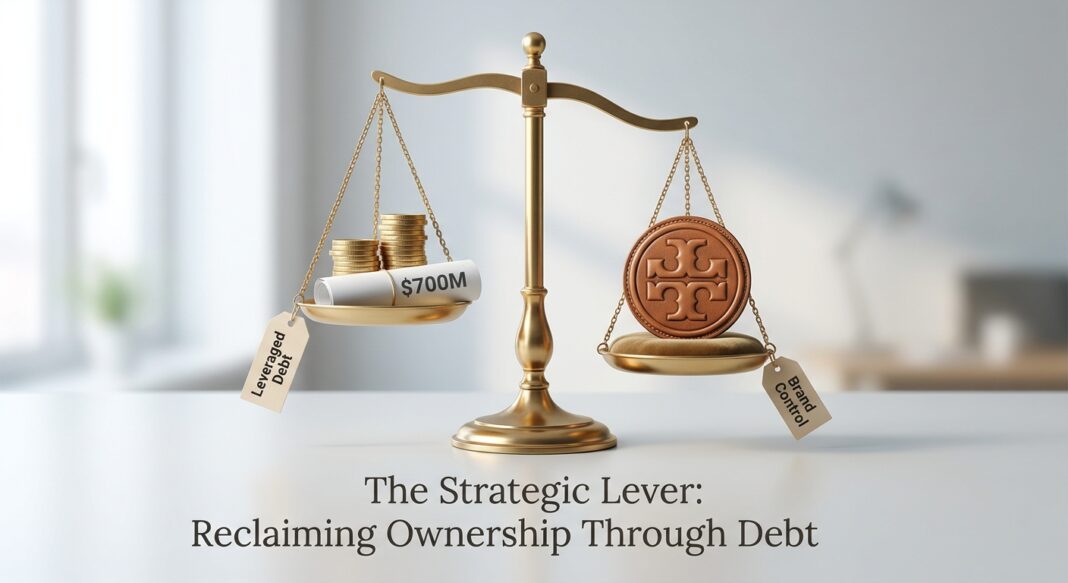
The Story: A Designer, a Decade-Long Partner, and a Decision About Who Owns the Brand
In the spring of 2026, Tory Burch made a move that crystallized something many founders feel but few execute: she chose debt over dilution to take back what was hers.
General Atlantic had been on the cap table since 2012, not by design, but by circumstance. The firm acquired its stake as part of a settlement tied to a legal dispute involving the designer’s former husband, Christopher Burch. For more than a decade, the relationship endured. But PE firms don’t hold forever. Eventually, the clock runs out, and founders face a fork: find a new equity buyer, sell the whole company, or get creative.
Tory Burch chose creative, and she’d done it before. In 2018, she used debt to buy out early investor Tresalia Capital, concentrating ownership around herself, her family, and strategic partner BDT & MSD Partners. That playbook worked. So in April 2026, she ran it again, only bigger.
The vehicle: a $700 million leveraged loan led by Bank of America. The target: General Atlantic’s minority stake, priced at $346 million. The message: the brand belongs to its founder, and she intends to keep it that way.
It wasn’t frictionless. Moody’s flagged the deal with a negative outlook. But the underlying logic was sound, and the numbers told a story worth studying for any operator who has ever looked at their cap table and wondered if there was a better way out than a full sale.
The Decision: Debt or Another Equity Event?
When a PE firm’s holding period approaches its end, the options for a founder are rarely all good. A strategic sale hands the keys to someone else. An IPO introduces a different kind of accountability. Bringing in a new financial sponsor resets the clock without eliminating the problem. And doing nothing means the PE firm pursues its own exit on its own terms.
Tory Burch chose a fifth path: lever up, buy them out, own more of your own company.
The structure was straightforward in concept, complex in execution. According to Bloomberg and WWD reporting, the company raised a $700 million term loan (originally structured at a seven-year tenor, later shortened to five years at final pricing) at a spread of 400 basis points over the benchmark rate, offered at 98 cents on the dollar. Of that $700 million, $346 million was earmarked specifically to repurchase General Atlantic’s interest.
Alongside the term loan, Tory Burch entered into a new $300 million revolving credit facility due 2031, replacing a prior $200 million revolver due 2030, a $100 million increase in available liquidity. The total package represented a comprehensive balance sheet restructuring, not merely a single transaction.
The tradeoff was explicit: pro forma leverage rose to approximately 3.4x. But the company and its advisors projected that operational cash flow (estimated at $150 million or more annually) would drive leverage below 3.0x by fiscal 2027. The bet was that the brand’s earnings power would service the debt faster than the alternative, welcoming a new equity partner, would cost in dilution and control.
Post-transaction, ownership would concentrate around Tory Burch herself, her family, and BDT & MSD Partners. No new PE sponsor. No new governance clock ticking. The brand’s equity story (and its future exit upside) stays with the people who built it.
The Outcome: What the Numbers Say, and What They Don’t
The deal was not without headwinds. Fiscal 2025 had been difficult; S&P noted a roughly 3.5% year-over-year revenue decline linked to broader softness in discretionary luxury spending. Moody’s moved to a negative outlook in response to the incremental leverage taken on. These are real risks, not cosmetic ones.
But look at the capital structure after close, and the strategic logic is hard to argue with. S&P projected free operating cash flow of approximately $94 million in fiscal 2026: after $80 million in capital expenditures, directed toward international store expansion, retail refreshes, and technology upgrades. The company entered the transaction with roughly $121 million in cash on hand and a fully undrawn $300 million revolver. That is not a distressed balance sheet; it is a business with room to operate.
Now consider the alternative scenario: Tory Burch invites a new private equity sponsor to replace General Atlantic. That sponsor acquires a meaningful stake, likely at a price that reflects the brand’s current revenue softness, not its long-term potential. They install board representation. They impose a 5-to-7-year hold timeline. They may push toward an IPO or strategic sale on a schedule that serves their fund, not the brand. The founder ends up further from control, not closer.
By choosing debt, Burch paid a financing cost, roughly $28 to $32 million annually in interest at current rate assumptions, rather than an equity cost measured in permanent ownership dilution and governance concessions. At a brand valued in the multi-billion dollar range, the math favors leverage. And crucially, the brand’s future upside (a potential IPO, an eventual sale, or a generational transfer) now flows almost entirely to the founder’s family and their chosen long-term partners.
This is also the second time this playbook has worked. In 2018, debt retired Tresalia Capital. In 2026, debt retires General Atlantic. The pattern is not coincidental; it is a deliberate capital philosophy.
The Lessons: What Every Founder Should Take From This Deal
1. PE clocks are real, and debt can be the exit strategy
When a private equity firm enters your cap table, their incentive is eventual liquidity, typically within 5 to 7 years. When that window arrives, founders often feel they have no choice but to participate in a process designed for the fund’s benefit. The Tory Burch approach flips this: if the business generates sufficient cash flow to service term debt, the founder can define the exit on their own terms, buying the PE firm out rather than being swept along in their sale process.
2. Debt is dilution-free, but cash flow is the prerequisite
This structure only works because the underlying business generates real, recurring cash flow. S&P’s projection of $150 million-plus in operating cash flow is what makes a $700 million debt load serviceable. Founders with lumpy, project-based, or early-stage revenue profiles cannot replicate this playbook. Non-dilutive capital demands cash flow discipline in a way that equity does not, and that discipline is ultimately its own form of business quality filter.
3. Incremental leverage beats permanent dilution: when you believe in the asset
Moody’s negative outlook sounds alarming. But consider the counterfactual: a new PE sponsor acquiring a meaningful stake at depressed fiscal-2025 valuations would permanently reduce the founder’s share of a brand that S&P expects to return to revenue growth in fiscal 2026. Temporary leverage at 3.4x declining to below 3.0x is recoverable. Dilution is not.
4. The “second bite” has a tax on it: borrowing avoids it entirely
The PE-sponsored recapitalization model often pitches founders on a “second bite of the apple”: take partial liquidity now, roll equity, and participate in future upside. That structure can work. But it also means a new governance layer, new reporting obligations, new board dynamics, and a new clock. The leveraged buyout of a minority stake skips all of that. The founder takes no new equity partner, makes no governance concession, and retains full strategic authority. The only new counterparty is a lender, whose only interest is timely debt service, not a seat at the strategy table.
5. Pattern recognition matters: the 2018 playbook was the proof of concept
Tory Burch used debt to exit Tresalia Capital in 2018. That transaction validated the model. When General Atlantic’s timeline arrived in 2026, the company had already demonstrated that this capital structure approach was repeatable and manageable. For founders and their advisors, building an ownership consolidation thesis early (and testing it at smaller scale before it is existentially necessary) is sound strategic planning.
A Framework: When Does the Leveraged Recap Work?
The Tory Burch transaction is instructive, but it is not universal. Here is how to assess whether a leveraged recapitalization to buy out a financial sponsor is appropriate for your situation:
| Factor | Favors Leveraged Recap | Caution Zone |
|---|---|---|
| Cash Flow Visibility | Strong, recurring, predictable EBITDA | Project-based or early-stage revenue |
| Leverage Tolerance | 2.5x–4.5x EBITDA with clear deleveraging path | Above 5x without earnings growth line of sight |
| Founder Conviction | High, founder believes long-term equity value exceeds debt cost | Low, founder prefers full exit or risk reduction |
| Sponsor Relationship | Financial sponsor with minority or non-controlling stake | Sponsor holds majority and controls board |
| Market Timing | Healthy leveraged loan market; manageable spreads | Distressed credit conditions; covenant risk elevated |
The private credit market in 2026 is well-positioned to support this kind of transaction. Evergreen and open-end private credit vehicles grew approximately 27% year over year in 2025, and non-sponsored growth lending is emerging as a distinct and increasingly competitive market category. Founders who approach lenders with clean financials, strong cash flow documentation, and a clear deleveraging narrative have real options, options that did not exist with the same depth even five years ago.
Key Insights
- Debt is not the enemy of ownership, equity dilution is. When cash flow is sufficient to service debt, leverage is a tool for founders to consolidate control rather than a threat to it.
- PE firm timelines create optionality windows. As a financial sponsor approaches the end of their typical 5-to-7-year hold, well-capitalized founders can choose to buy them out rather than participate in the sponsor’s own exit process.
- The leveraged buyout of a minority stake is one of the most underutilized founder tools in private markets. It requires cash flow discipline, credit market access, and conviction, but it preserves everything a dilutive round gives away.
- Temporary leverage at 3–4x with a clear deleveraging path is preferable to permanent equity dilution when the founder has long-term conviction in the business’s value trajectory.
- Repetition builds the playbook. Tory Burch’s 2018 Tresalia buyout made the 2026 General Atlantic buyout credible, executable, and accepted by lenders. Founders who build a track record of responsible leverage can access this tool repeatedly over a company’s lifecycle.


