
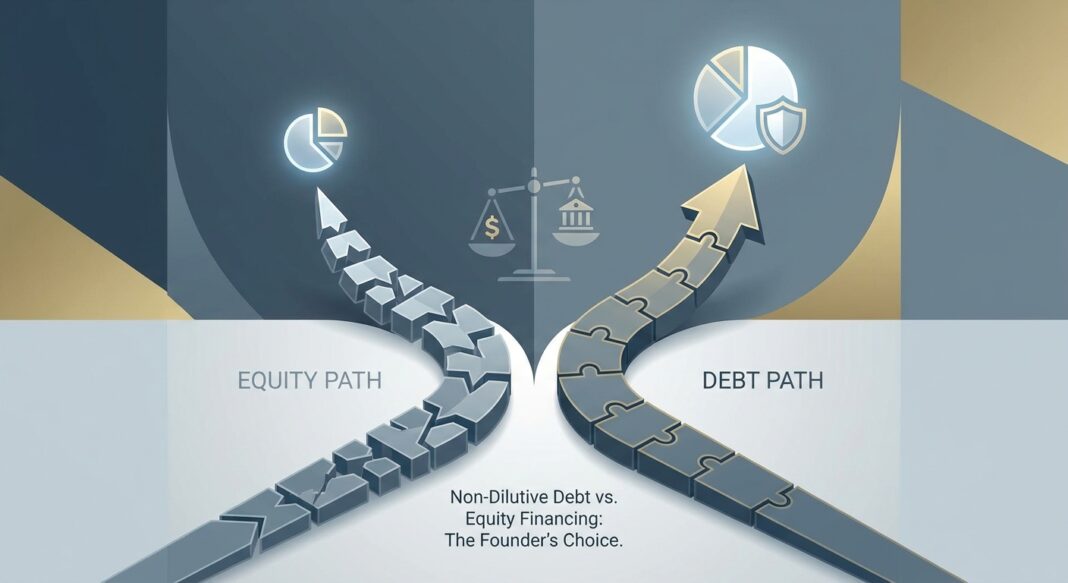
The $68.8 Billion Shift: How Founders Are Using Non-Dilutive Debt to Fund Growth and Keep Every Point of Equity
A record $68.8 billion in venture debt was raised in 2025, not by desperate startups, but by disciplined founders who refused to sell equity at a discount. Inside the capital decision that separates the builders from the sellers.
The Story: Two Founders, One Fork in the Road
Note: The following scenario is a Hypothetical Case Study constructed using real market benchmarks, publicly reported deal structures, and data sourced from PitchBook, Runway Growth Capital, Carta, and Capstone Partners. It is designed to illustrate real capital decisions that founders face today. All names are fictional.
In early 2024, two founders sat across from their respective advisors with almost identical businesses. Both ran B2B SaaS companies. Both had crossed $8 million in annual recurring revenue with healthy 75% gross margins. Both had EBITDA of roughly $2.4 million. Both needed approximately $6 million to hire a national sales team, expand infrastructure, and pursue a bolt-on acquisition that had just come to market.
They were, on paper, the same company at the same moment. But the capital decisions they made in that room would produce dramatically different outcomes three years later.
Founder A: call her Maya, walked into a Series B equity raise. She had raised a seed and Series A previously, cumulatively giving up 38% of her company. Her advisors told her the market would support a $40 million post-money valuation. A $6 million raise meant selling another 15% of the business. By closing, Maya and her team held 47% of a company valued at $40 million. Their paper stake: $18.8 million.
Founder B: call him Rafael, took a different call. His CFO had been tracking the surge in non-dilutive growth lending and pointed him toward a direct lender offering a $6 million term loan structured at 13.5% all-in with a 4-year amortization and a modest 1% warrant coverage. Rafael borrowed the capital, retained 100% of his equity, and went to work.
Same business. Same moment. Radically different futures.
The Decision: What the Numbers Actually Said
Maya's Series B felt like validation. A $40 million valuation headline is hard to argue with when you are sitting across from a credible growth equity fund. But the math beneath the headline told a more complicated story.
At a 15% dilution on a $40M post-money, Maya was selling $6 million of future upside for every dollar raised. If that company eventually sold for $120 million, a 3x exit, Maya's 47% stake would net her roughly $56 million. That sounds compelling until you run Rafael's numbers.
Rafael's $6 million term loan carried annual interest of approximately $810,000 at 13.5%. Over four years, the all-in interest cost was roughly $1.6 million: expensive in absolute terms, but a fixed, finite number. On the same $120 million exit, Rafael's 100% ownership (less the 1% warrant coverage) nets him approximately $118.8 million. The debt cost him $1.6 million. Equity would have cost him $61.2 million, over 38 times more expensive.
This is not an anomaly. It is arithmetic.
The data supports the calculus. According to Carta's State of Private Markets data, median dilution in 2025 sits at approximately 19.5% for seed rounds and 18% for Series A rounds. By the time a founder has raised through Series A, they typically retain around 50% ownership. Each subsequent round compounds that erosion. Meanwhile, the venture debt market has been offering increasingly competitive structures: venture debt typically results in warrant dilution of only 1–3% of fully diluted equity, a fraction of what an equity round demands.
Rafael's lender required no board seat, no liquidation preference, no pro-rata rights, and no veto over strategic decisions. The covenants were tied to revenue performance thresholds the business was already clearing. The only obligation was cash flow service, and on $2.4 million in EBITDA with a $6 million loan, the debt coverage ratio was a comfortable 2.97x at close.
The structure Rafael used is consistent with what the Pepperdine Private Capital Markets Report (2024) describes as standard for lower middle market growth lending: 3x to 5x EBITDA in total debt, priced to senior secured rates plus a risk margin. At 2.5x EBITDA, Rafael's structure was deliberately conservative.
The Outcome: Three Years Later
Rafael deployed the $6 million in 18 months: $2.2 million on sales headcount, $1.4 million on product infrastructure, and $2.4 million on the bolt-on acquisition, a complementary tool that brought 400 new SMB customers onto his platform. ARR climbed from $8 million to $19.5 million. EBITDA expanded to $6.1 million. He repaid $3.8 million of principal ahead of schedule using operating cash flow.
By mid-2026, Rafael had a strategically positioned business worth an estimated $70–80 million by revenue multiple benchmarks, 100% founder-owned, and generating enough cash flow to consider a leveraged recapitalization that would let him take $15–20 million off the table without a sale. As the Sofer Advisors framework notes, this structure allows an owner to "extract cash from the business without selling to a third party": retaining operational control while monetizing years of compounded value.
Maya's company grew too, to $18 million in ARR by the same date. But her equity story was messier. Her Series B investors held preferred shares with a 1.5x liquidation preference and broad-based weighted-average anti-dilution. When an acquisition offer came in at $65 million in late 2025, the preference stack meant Maya and her team walked away with roughly $22 million combined, while the investors cleared $43 million. She had worked four years to deliver a 2x return to her cap table while her own proceeds barely exceeded her paper valuation at the time of the Series B.
The divergence was not about growth rate. It was about capital structure from day one.
This dynamic plays out at scale. The 2025–2026 Venture Debt Review from Runway Growth Capital and PitchBook reported that venture debt reached a record $68.8 billion in the U.S. in 2025, even as annual deal volume remained stable at roughly 1,000 transactions: meaning deals got dramatically larger and more strategic. The report found that venture debt is increasingly being used by companies with strong fundamentals as a strategic financing tool to extend flexibility, preserve ownership and support growth, not as a bridge for distressed companies.
The Lessons: A Framework for the Fork in the Road
The Maya-and-Rafael scenario is playing out across thousands of founder boardrooms right now. The surge in non-dilutive lending is not irrational exuberance; it is a rational repricing of the true long-term cost of equity capital. As one advisory firm put it plainly: "the decision between debt and equity is one of the most consequential a business owner will ever make, and it is rarely as simple as comparing interest rates to dilution percentages."
Here is the framework that separates good debt decisions from reckless ones:
1. Cash Flow Coverage Is Non-Negotiable
Debt only works when the business can service it from operating cash flow without stress. J.P. Morgan Asset Management data shows average leverage of 3.2x EBITDA for companies under $250 million in enterprise value, compared to 5.9x for companies over $1 billion. Smaller companies should use debt conservatively precisely because their cash flows are less diversified. A 2.5x–3.5x EBITDA leverage ceiling for growth-stage mid-market businesses is a sensible guardrail.
2. Know What You're Building: Rocket Ship or Cathedral?
Equity is the right fuel for a company racing to a $1 billion TAM with a winner-take-all urgency and a 5-year IPO ambition. Debt is the right fuel for a company building durable, compounding value in a stable market, one where the founder is not building to flip but building to hold. "Debt allows you to fund growth while keeping all the future upside for yourself and your founding team." The choice of instrument should follow the choice of destination.
3. Equity Dilution Is Permanent; Debt Is Finite
This is the asymmetry most founders underestimate. Interest is a cost on the income statement. Dilution is a permanent reduction in your claim on every dollar of future enterprise value, compounded with each subsequent round. "By the second or third funding round, investors as a group typically own more of the company than the founders do." Debt, once repaid, disappears. Equity given away does not come back without a buyback.
4. The Market Is Structurally Favorable, But Credit Quality Matters
Private credit's dominance of mid-market lending is structural, not cyclical. Direct lending captured approximately 90% of middle-market LBO lending in 2024, up from 36% in 2014, meaning the infrastructure for non-bank debt capital has never been more developed or competitive. However, lenders are increasingly rigorous: "companies that prepare early, understand the risks, and approach debt with both strategic clarity and financial discipline" are positioned to capture the best terms. Those treating debt as cheap money without the underlying cash flow discipline will find the covenant structure unforgiving.
5. The Recap Is the Second Act
For founders who grow through debt capital, the leveraged recapitalization is a powerful second-order tool. Once a business has compounded its EBITDA to a new baseline, a recap allows the owner to monetize a portion of that value, often 80–90% of business value as a special dividend, while retaining their equity stake and operational control. In a market where dividend recap issuance surged to roughly $76 billion in 2024, representing a 240% jump versus 2023, this instrument has become a standard part of the owner-operator's playbook.
Key Insights
- Debt's true cost is a fixed number; equity's true cost is unknowable until exit, and it almost always exceeds what founders expect. In the hypothetical above, a $6M equity raise at 15% dilution cost the founder over $60 million on exit versus $1.6 million in interest on an equivalent debt facility.
- The non-dilutive market has scaled to meet sophisticated demand. Venture debt hit a record $68.8 billion in 2025, with repeat financings more than doubling to $12.3 billion, evidence that strong companies are embedding debt capital into their long-term financial roadmaps, not just using it as a one-time bridge.
- Warrant dilution in venture debt structures runs 1–3% of fully diluted equity: a fraction of the 18–20% median dilution in a typical Series A equity round. For cash-generating businesses, the math is rarely close.
- The leveraged recapitalization is the founder's most underutilized liquidity tool. It allows an owner to take significant cash off the table, historically 80–90% of business value, without triggering a change of control, surrendering a board seat, or accepting a liquidation preference stack.
- Context determines the right answer. Equity capital is not always wrong: for pre-revenue, pre-product-market-fit businesses burning cash in a winner-take-all market, it may be the only viable path. But for cash-generating, mid-market businesses with stable revenue, the reflexive reach for equity dilutes the very thing being built. The question worth asking first is not “how much can we raise?”, it is “how much do we actually need to borrow?”


