
The $7 Trillion Reality Check
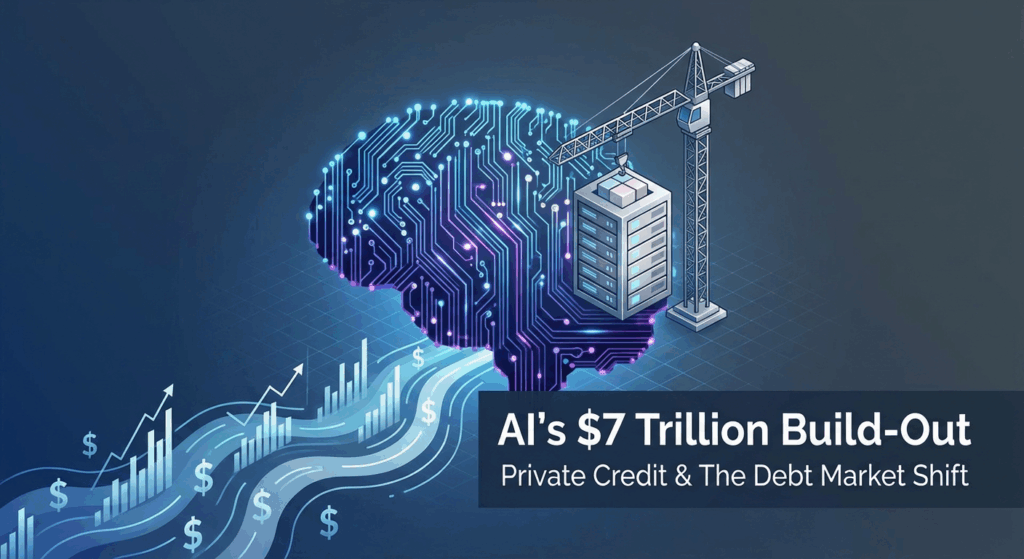
The honeymoon phase of the artificial intelligence boom (funded largely by equity and massive cash piles) is officially over. As we step into 2026, the narrative has shifted from software capabilities to the brutal economics of physical infrastructure. According to new data from JPMorgan Chase & Co., the total cost of the AI build-out is projected to reach between $5 trillion and $7 trillion, a figure that even the cash-rich balance sheets of Silicon Valley cannot absorb alone. The result is a historic flood of debt entering the market, fundamentally altering the landscape for borrowers and lenders alike.
We are witnessing a structural pivot. In 2025, AI-related project financing deals surged to $125 billion, up from a mere $15 billion the prior year. This exponential growth signals that the “hyperscalers” (Microsoft, Meta, Google, and Oracle) are no longer just spending cash; they are leveraging the future to pay for the steel, concrete, and copper required today.
The Great Risk Transfer
While the headline numbers are staggering, the structure of these deals reveals a more complex strategy. Major technology firms are actively engaging in financial engineering to protect their corporate credit ratings. As reported by the New York Times, companies like Meta and Microsoft are increasingly signing deals that push financial risk onto smaller, private intermediaries. For instance, Meta recently secured nearly $30 billion in financing to build data centers without taking the debt directly onto its own books.
This creates a “tube of toothpaste” effect regarding risk: squeezing it out of public Big Tech balance sheets merely forces it elsewhere, specifically, into the private credit markets. Morgan Stanley estimates that private credit and government sources will need to plug a $1.4 trillion funding gap left behind by public bond markets. Consequently, a shadow network of private data center operators is taking on significant leverage, betting that demand for compute power will remain insatiable for decades.
The Bond Capital Perspective: Asset Security in a Hype Cycle
The “frenetic” pace of issuance, characterized by JPMorgan as a market that will “dip into every debt market”, parallels the dot-com fiber build-out of the late 1990s. While public markets are buying into the growth story via Asset-Backed Securities (ABS) and Investment Grade bonds, cracks are appearing. Oracle’s credit default swaps (CDS) recently spiked to their highest levels since 2009, indicating that institutional investors are beginning to price in the possibility of overextension.
For the astute borrower and investor, the implication is clear: volatility is returning. As capital floods into digital infrastructure, liquidity for traditional sectors may tighten or become more expensive as lenders chase the AI premium.
At Bond Capital, we view this environment through a lens of asset security. While the AI sector offers tremendous growth, the physical build-out requires massive capital expenditure which carries inherent execution risk. We remain disciplined, focusing on lending against tangible assets and fundamental cash flows rather than speculative valuation metrics. In a market overheating with “projected” demand, the stability of private credit offers a distinct advantage, provided it is anchored in reality, not just the cloud.


