
The Story: Jack Jia Didn’t Want Your Money
For nearly a decade, venture capitalists kept calling Jack Jia. He kept not answering, or rather, he kept saying no. Jia, the co-founder and CEO of Musely, a direct-to-consumer telemedicine platform specializing in compounded skincare, hair, and menopause treatments, had built something quietly extraordinary: a cash flow positive business growing at 50% year-over-year, serving over 1.2 million patients, and carrying exactly $20 million in equity raised, all of it from a 2014 seed round. Not a single dilutive dollar since.
That discipline was a choice, not an accident. Jia understood the math of venture capital well enough to avoid it. Every equity round at Musely’s scale would have meant surrendering a meaningful slice of a business that had taken twelve years to build: to investors whose return timelines, governance preferences, and exit incentives might not align with his own.
But in early 2025, the business faced a tension familiar to every founder who has hit product-market fit at scale: growth itself becomes capital-hungry. In DTC healthcare, acquiring the next customer cohort requires upfront investment (paid media, clinical operations, customer success) long before that patient generates lifetime value. As Jia put it: “When you become a billion-dollar revenue company, you need another billion in order to grow to the next billion.”
The question wasn’t whether Musely needed capital. It was what kind, and at what cost.
The Decision: Revenue-Share Over Equity, and Why the Math Compelled Him
When General Catalyst’s Customer Value Fund (CVF) approached Jia, he was skeptical. He’d heard the VC pitch before. But CVF wasn’t offering equity, and it wasn’t offering a traditional loan. It was offering something structurally distinct: a fixed, capped revenue-share arrangement: capital deployed upfront, repaid as a small percentage of revenue generated from its use, with no interest accrual in the conventional sense and, critically, no equity stake changing hands.
Jia modeled it. The conclusion, in his words: “I found this absolutely compelling.”
Here’s the structure that made it work:
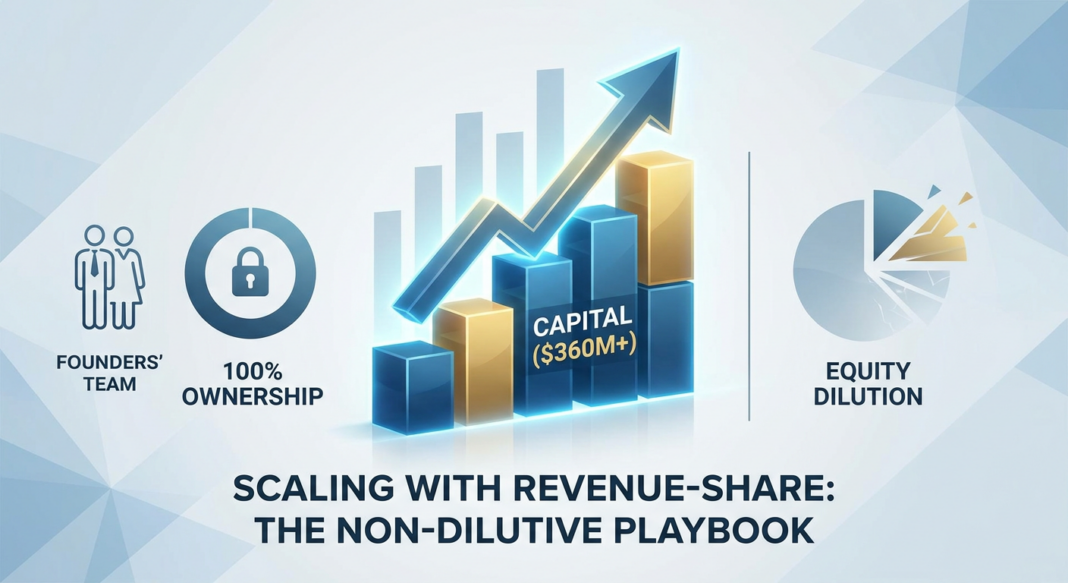
- Capital raised: $360 million in non-dilutive financing
- Equity dilution: 0%
- Board seats surrendered: 0
- Repayment mechanism: Capped revenue-share tied to use of the deployed capital
- Cost comparison: More favorable than a bank loan; dramatically less expensive than a dilutive equity round at Musely’s revenue scale
The comparison to an equity round is where the arithmetic becomes stark. At a company growing 50% annually with eight-figure revenue, a traditional Series B or C would likely price at a significant valuation, but would still transfer 15–25% ownership to new investors with board rights, liquidation preferences, and a mandate for a liquidity event within a defined horizon. CVF wanted none of that. It wanted repayment from the revenue it helped generate. Alignment by design.
Musely’s story, reported by techcrunch.com, is now one of the clearest public examples of how non-dilutive capital can function at institutional scale, not just as a bridge, but as a primary growth engine.
The Outcome: What Clean Cap Tables Make Possible
Musely is far from alone. Across the growth-stage landscape, founders who preserved equity through non-dilutive structures are arriving at inflection points (exits, expansions, acquisitions) with something their VC-backed peers often lack: a clean cap table and full negotiating leverage.
Consider Vyopta, the Austin-based collaboration intelligence software company founded in 2007. When COVID uncertainty rattled capital markets in March 2020, Vyopta secured a non-amortizing term loan from Vistara Growth: a lender whose underwriting model focused on business fundamentals rather than requiring a fresh equity round as a condition of lending. Vistara extended additional capital a year later when Vyopta wanted to accelerate product and go-to-market investment, again without mandating new equity from investors.
The result? Over four years of growth capital deployment, Vyopta incurred zero additional dilution. When the company began exploring strategic alternatives, it carried a simple cap table, minimal preference stack, and a profitable growth profile, exactly what strategic acquirers demand in the current market. In June 2024, HP acquired Vyopta as a strategic fit for its Workforce Experience platform. The founding team and investors at Elsewhere Partners captured the full value of what they had built, as reported by vistaragrowth.com.
At a smaller scale, the same principles hold. Hello Klean, a London-based bootstrapped beauty brand with 100% founder ownership and £200+ customer lifetime values, found itself constrained not by opportunity but by debt structure. Every short-term RBF provider it approached (Wayflyer, Uncapped, Shopify Capital, PayPal Capital) maxed out at six to twelve months. With a six-month customer payback period, this forced repayment before cohorts turned profitable, strangling acquisition investment. The fix? A £1.5M credit line from re:cap with up to 60-month repayment terms: finally matching the debt horizon to the actual business model. Co-founder Omer Ozener called it a “health seal”: if your business can support long-term debt and repay it, the debt itself signals operational strength. Hello Klean is now hiring, expanding into the Middle East and EU markets, and still carrying that 50-50 founder ownership split intact, per re-cap.com.
The Lessons: A Framework for Founders Facing the Same Decision
These stories converge on a set of principles that should inform any founder or operator evaluating a capital raise:
1. The Real Cost of Equity Is Not the Dilution Percentage: It’s the Compounded Value of What You Give Away
A 20% equity stake transferred at a $50M valuation is worth $10M at close. But if the company exits at $500M five years later, you’ve transferred $100M of value. Non-dilutive capital that costs 8–15% in revenue share or interest over the same period is almost always cheaper in dollar terms, and never transfers control.
2. Debt Structure Must Match Business Model, Not Just Capital Need
Hello Klean’s story is instructive here. The problem wasn’t debt; it was mis-structured debt. Six-month repayment terms on a business with six-month customer payback periods creates a cash flow trap, not a growth runway. The right debt instrument (matched to actual revenue cycle, LTV, and payback horizon) is a fundamentally different product. Founders should negotiate structure, not just rate.
3. A Clean Cap Table Is a Strategic Asset at Exit
Vyopta’s acquisition by HP was facilitated, in part, by the absence of a complex preference stack. Strategic acquirers and PE buyers pay for simplicity. Every unnecessary equity round adds preferences, pro-rata rights, and governance complexity that can reduce net proceeds to founders and early investors, or deter acquirers entirely. Growth debt preserves the clean structure that makes deals happen.
4. Revenue Predictability Is the New Collateral
The common thread across Musely, Vyopta, Hello Klean, and smaller cases like Inkle (which avoided two dilutive rounds entirely by financing against predictable SaaS revenue through ecaplabs.com) is that recurring, predictable revenue unlocks non-dilutive capital that simply wasn’t available to earlier generations of founders. Subscription models, SaaS ARR, and DTC cohort data are not just business metrics; they are underwriting inputs that open doors to better capital.
5. This Approach Works Best When You Don’t Need It: Which Is Exactly When to Use It
Jack Jia wasn’t looking to raise capital when General Catalyst’s CVF called. That’s precisely why the terms were favorable and the structure made sense. Founders who approach non-dilutive capital from a position of strength (cash flow positive, growing, with clear revenue visibility) negotiate better than founders who approach it as a lifeline. The time to build this capital structure is before you need it.
Key Insights
- Non-dilutive capital at scale is real: Musely’s $360M revenue-share deal with General Catalyst’s CVF demonstrates that non-dilutive financing is no longer limited to small bridge rounds; it can serve as a primary institutional-scale growth engine for the right business profile.
- Debt structure is as important as debt cost: Hello Klean’s experience shows that mismatched repayment terms, even from well-known providers, can undermine growth. Aligning loan duration to customer lifetime value and payback periods is a structural prerequisite, not a negotiating footnote.
- Clean cap tables command acquisition premiums: Vyopta’s HP exit illustrates how four years of growth debt, with zero additional equity dilution, produced a simpler cap table and stronger negotiating position than a comparable VC-backed path would have allowed.
- Recurring revenue is the new collateral class: Across DTC, SaaS, and subscription commerce, predictable revenue streams are now the primary underwriting basis for non-dilutive growth capital, replacing fixed assets and personal guarantees as the key lending input.
- Founders who model the math win: The shift from “should I raise equity?” to “what is the actual cost of each capital type over my projected growth curve?” is the single most important analytical move a founder can make, and as Jack Jia’s experience confirms, the math increasingly favors structured non-dilutive instruments over traditional VC rounds.


