
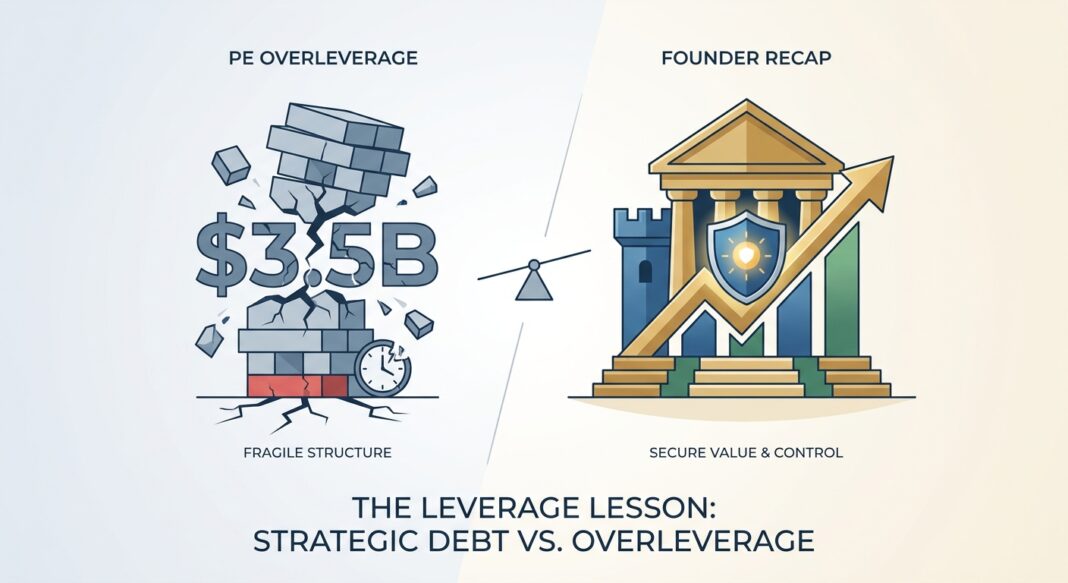
The Story: A $3.9 Billion Bet That Went to Zero
In early 2021, Vista Equity Partners acquired Pluralsight, an educational software platform for IT professionals, in a take-private deal valued at approximately $3.9 billion. For the founders who had built Pluralsight from a Utah-based startup into a publicly listed technology company, it looked like validation. For Vista, it was a calculated LBO thesis: stable recurring revenue, high switching costs, a defensible niche. The kind of software business private credit lenders had spent the decade enthusiastically financing.
By August 2024, lenders had taken 100% ownership of Pluralsight. The transaction wiped out Vista’s equity entirely and reduced the company’s funded debt by $1.3 billion through a debt-for-equity exchange, with lenders (including Blue Owl Capital, Ares Management, Golub Capital, Goldman Sachs, and BlackRock) simultaneously injecting $250 million in fresh capital just to keep the lights on. Reuters, citing people familiar with the matter, described it as a markedly swift unraveling of a private equity investment, completed just three years after close.
And the founder? Aaron Skonnard, who had co-built Pluralsight over two decades, stepped down as CEO in April 2024 as the restructuring took shape. The company he built, his company, was now owned by a consortium of shadow banks. He had no say in what came next.
This is the story of what happens when leverage is applied for the wrong reasons, at the wrong multiple, by owners whose incentives are structurally misaligned with the business they now control. And it is a story that has a direct, instructive contrast: the founder who used leverage differently (not as an extraction mechanism, but as a precision liquidity tool) and kept everything.
The Decision: What Vista Did, and What It Reveals
When Vista acquired Pluralsight, the deal included roughly $1.5 billion in debt financing, including a $1.175 billion recurring revenue term loan and a $100 million revolving credit facility sourced from direct lenders, against an implied $2 billion equity check. On a company generating approximately $390 million in annual recurring revenue at close, the leverage ratio was aggressive even before the rate environment shifted.
The model relied on a simple but fragile thesis: rates would stay low, the exit window would open within four to five years, and the debt would refinance before it became a problem. As one analysis noted of similar vintage deals, “the play during those years was hyper growth and the hope for a 3-to-4-year exit that would refinance all the debt.” When growth slowed and multiples reset in 2022 and 2023, the math broke.
This is the structural problem with PE-driven leverage. Private equity firms demonstrated overreliance on cost-cutting measures and aggressive financial policies with limited long-term prospects, and Pluralsight fit that pattern almost precisely. PE and venture capital portfolio companies accounted for 30% of all U.S. bankruptcy filings in 2024, up 15% from 2023. When the debt is PE-originated, the incentives are clear: maximize the exit multiple, load the balance sheet, return capital to LPs, and if the company eventually buckles: well, that is a portfolio company problem, not a fund problem.
Compare this to the decision faced by the founder-operator who does not sell. Instead of pursuing a full buyout, the founder-operator accesses a leveraged recapitalization: a capital structure transaction in which a company replaces a portion of its equity with new debt and pays the proceeds to shareholders, the owner extracts cash from the business without selling to a third party. The debt stays on the company’s balance sheet. The owner keeps the equity. The risk calculus, however, is entirely different: the operator lives with this debt, services it from operating cash flows, and has no fund exit timeline to chase.
Hypothetical Scenario, Illustrative, Not a Real Company: Consider a founder-owned vertical SaaS business generating $8 million in EBITDA with predictable, subscription-based revenue and minimal capital expenditure requirements. Valued at 6x EBITDA, $48 million enterprise value, the founder holds 100% equity but has 90% of her personal net worth concentrated in the business. She needs liquidity. She has three paths: (1) sell to PE and lose control; (2) raise a VC growth round and dilute significantly; (3) execute a founder-controlled leveraged recap. She chooses the third. Working with a private credit direct lender, she structures a $24 million unitranche facility at 4x EBITDA, priced at SOFR + 500 basis points, an all-in rate of approximately 10.3% in today’s market, consistent with lower-middle-market all-in rates of 10–11% for senior secured facilities. The $24 million proceeds are distributed to her as a tax-advantaged dividend. She retains 100% of the equity, 100% of her board seats, and 100% of operating control. Annual debt service: approximately $2.5 million, comfortably within her $8 million EBITDA. She has de-risked her personal balance sheet without creating an exit.
The contrast is not merely structural. It is motivational. Many founders want liquidity but are unwilling to sell control unless they are cashing out 100%. A leveraged recapitalization allows them to receive liquidity through borrowing to fund a dividend without ceding control. The incentive to service the debt, grow the business, and eventually exit on their own terms remains perfectly intact.
The Outcome: Numbers Tell the Story
For Pluralsight, the numbers are stark. Vista eventually marked down the value of its stake to zero and began discussions with lenders over a potential restructuring. The lenders took 100% ownership. The founder-CEO departed. A $2 billion equity check became worthless in approximately 36 months. The change-of-control transaction resulted in lenders taking 100% ownership and reduced Pluralsight’s funded debt by $1.3 billion. This is a complete equity wipeout by any measure.
The broader market data confirms this is not an isolated incident. In 2024, 110 PE-backed firms filed for bankruptcy, a 15% year-over-year increase and the highest total on record. Private equity firms played a role in 54% of the largest U.S. corporate bankruptcies during 2025; those with liabilities of $1 billion or greater, despite representing only 7% of the broader U.S. economy. The math of misaligned overleverage, applied at scale, creates outsized systemic losses.
In our hypothetical founder scenario, the trajectory diverges completely. With $24 million in personal liquidity extracted and $8 million in annual EBITDA continuing to compound, the founder’s remaining equity (assuming modest 12% revenue growth over four years and an exit at a conservative 5.5x EBITDA multiple) is worth approximately $55 million at exit. Total personal proceeds: $79 million. Total equity surrendered: zero. The disciplined application of leverage, sized to what the business can sustainably service, converts idle equity into immediate liquidity without sacrificing the upside.
Meanwhile, the dividend recap market has validated this approach at scale. PE-owned companies borrowed roughly $94 billion in leveraged loans and high-yield bonds to fund their own payouts over the full year 2025, a post-financial-crisis record according to Moody’s. PitchBook LCD tracked roughly $76 billion in dividend recap loans during 2024 alone, the third-highest annual total on record and a 240% jump versus 2023. The instrument is proven. The question is always who wields it, and why.
The Lessons: A Framework for Founders Facing Similar Decisions
The Pluralsight story does not indict leverage as a tool. It indicts leverage in service of someone else’s timeline. Vista needed to exit. The LPs needed distributions. The fund had a clock. Pluralsight (a real operating business with real customers and real employees) was the instrument through which those financial engineering needs were expressed. When the business underperformed, the PE sponsor’s primary obligation was to its fund, not to the company.
Founder-controlled leveraged recaps operate in an entirely different logic. The transaction is commonly used for partner buyouts, estate planning liquidity, and partial exits where the owner wants to de-risk personally while continuing to operate. The leverage is sized to what the business can afford, not to what maximizes the sponsor’s IRR. Dividend recaps are one of the few tools available to boost DPI without forcing asset sales, particularly when sponsors believe further value creation opportunities remain, and for the founder-operator, that calculus is even more direct.
The lower middle market stands out as a structurally underserved segment in private credit, offering greater control, stronger protections, and more resilient returns, particularly for operators who approach lenders with predictable cash flows and conservative leverage targets. According to the Pepperdine Private Capital Markets Report (2024), lower middle market leveraged recapitalizations typically close at 3x to 5x EBITDA in total debt, a ceiling that, when respected, keeps debt service well within operating cash flow. Pluralsight’s structure ignored this ceiling entirely.
The Three-Question Framework
Before any founder or operator considers a leveraged recap (or evaluates an inbound PE offer) three questions should anchor the conversation:
- Whose clock governs the capital? PE leverage is always beholden to a fund cycle. Founder leverage answers only to the business’s cash flows. Know which one you are accepting before you sign.
- Can the business service this debt in a downside scenario? Pluralsight could not. The hypothetical founder above could service her debt at 60% of current EBITDA and still be solvent. Stress-test the structure before you close it.
- What does control cost in this transaction? In a minority recap, you take some chips off the table while keeping a meaningful stake in the future value of the business. You have created liquidity without creating an exit. A leveraged recap goes further: you take chips off the table and surrender no equity at all. Quantify the value of that control before you trade it away.
Key Insights
- Leverage without alignment is the real risk. Pluralsight was not destroyed by debt per se; it was destroyed by debt in the service of a fund’s exit mandate rather than the company’s operating reality. The instrument is neutral; the incentive structure is everything.
- Founder-controlled leveraged recaps preserve all the upside. When sized correctly at 3x–4x EBITDA with predictable cash flows, a leveraged recap allows a founder to extract meaningful personal liquidity, eliminate wealth concentration risk, and retain 100% equity in the eventual exit.
- The market has validated this instrument at scale, but not all versions are equal. Leveraged loan issuance tied to sponsored dividend recaps grew to $74.3 billion in 2025 according to PitchBook. The volume is enormous. But PE-sponsored recaps serve the sponsor’s LP base. Founder-initiated recaps serve the founder. Understand which version you are executing.
- Overleverage in PE is systemic, not incidental. PE-backed companies accounted for 54% of the largest U.S. corporate bankruptcies in 2025. The pattern is structural: high acquisition multiples, maximum leverage, and a five-year exit clock create a fragile trifecta that fails whenever the macro environment shifts even modestly.
- The lower middle market remains the sweet spot for founder-friendly private credit. With all-in rates of 10–11% on senior secured facilities and direct lenders offering faster execution and flexible structures, the founder who builds to $5M–$15M EBITDA has access to a private credit market that can deliver real liquidity, on their terms, on their timeline.


