
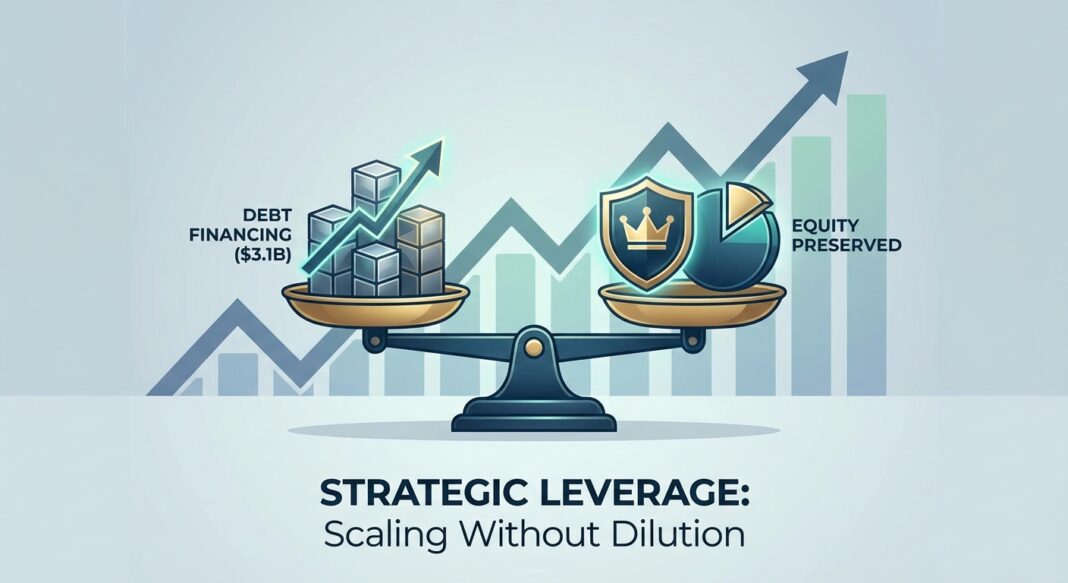
The Story: A Billion-Dollar Bet Without Giving Up the Table
In late 2024, Cohesity, a web-scale data management company founded in 2013 by Mohit Aron, stood at one of the most consequential crossroads a founder can face. The company had already raised over $1.9 billion in equity across multiple rounds, from Series A through Series H, with backers including Sequoia Capital, SoftBank Vision Fund, and The Carlyle Group. Its enterprise data protection platform served more than 12,000 customers globally, and its recurring-revenue base was durable, predictable, and growing.
Then came the Veritas opportunity: a chance to acquire Veritas’ enterprise data protection business and instantly become the world’s largest data protection software provider. The deal was transformational, but it required capital. A lot of it.
The question on the table wasn’t whether to do the deal. It was how to finance it, and who, if anyone, would have to give up a piece of the table to make it happen.
Most companies in Cohesity’s position reach for the default lever: another equity round. Bring in new investors, dilute existing holders, and let the board get a little more crowded. It’s familiar. It’s well-trodden. And for Cohesity’s founders and early equity holders, it would have been quietly, irrevocably expensive.
They chose something different.
The Decision: Debt Over Dilution at the Growth Inflection Point
Cohesity closed a $3.1 billion debt financing to fund the Veritas combination, structured around the company’s durable, subscription-based cash flows rather than the promise of future equity upside. The transaction came shortly after the company had raised a roughly $950 million Series H equity round, which itself included participation from Carlyle, Madrona Venture Group, and Haveli Investments. Rather than pile on additional equity issuances to fund the acquisition, Cohesity layered in approximately $2 billion in debt to complete the Veritas deal.
To anyone unfamiliar with capital structure, the move looked audacious, even reckless. The company was already carrying the weight of a major equity round. Now it was taking on billions in debt too?
To anyone who understands leverage, it looked like discipline.
The logic is straightforward once you run the numbers. Selling equity at any valuation below what the combined entity would ultimately command means permanently transferring ownership (and future upside) to new investors. Debt, by contrast, has a fixed cost. Pay the interest, repay the principal, and the economics of the business remain entirely with the people who built it. The lender gets a return. The founder keeps the company.
Cohesity’s structure matched the debt to what the business could support: recurring infrastructure contracts, enterprise SaaS revenue, and a post-merger ARR base that, according to public announcements, exceeded $1.5 billion. That kind of cash flow predictability is precisely what direct lenders underwrite. It’s not a bet on narrative, it’s a bet on contracted revenue, and it’s a bet lenders are increasingly willing to make.
The Runway Growth Capital and PitchBook Venture Debt Review highlighted Cohesity’s approach as a leading example of how debt can power ambitious growth plans without forcing founders to surrender equity, a distinction that matters enormously when the company eventually moves toward a liquidity event.
The Outcome: What Happened When Debt Did the Heavy Lifting
The Veritas combination closed in December 2024, and its impact was immediate. Cohesity emerged as the world’s largest data protection software provider, with more than 12,000 enterprise customers and annual recurring revenue exceeding $1.5 billion. A company that had been a strong independent player in a competitive market became the category-defining platform almost overnight.
Now consider the counterfactual. If Cohesity had funded the Veritas acquisition entirely through equity (say, another $2 billion equity round at a flat or modestly increased valuation) existing stakeholders would have faced substantial dilution. At a $7 billion pre-deal valuation (the combined entity’s publicly referenced figure), a $2 billion equity raise would have transferred roughly 28% of the company to new investors. That ownership is gone permanently; it rides all future upside, participates in any exit, and sits above common holders in the liquidation waterfall.
Debt at even a 10–12% all-in cost (consistent with the 2025 market, where McKinsey data shows all-in new-issue yields averaged approximately 9.3%) is far cheaper than that permanent equity transfer, especially for a company whose founders and employees still hold meaningful stakes.
This is the compounding math of capital structure: every point of ownership preserved today is worth multiples at exit. And Cohesity’s founders understood it.
The broader market validated the approach in real time. According to PitchBook data released in early 2025, total venture debt deal value hit a record $53 billion in 2024, even as deal count dropped to its lowest level in a decade. Founders were doing fewer, larger, and more deliberate debt transactions. The private credit market (estimated at $1.5 trillion in early 2024 and projected by some analysts to reach $2.8 trillion by 2028) had created a deep, competitive lending environment where founder-owned companies could access institutional capital on genuinely competitive terms.
The Lessons: What Cohesity Teaches Founders About Capital Structure
1. Debt Is Not a Sign of Weakness: It’s a Sign of Leverage Literacy
The persistent cultural narrative in venture-backed circles is that raising a large equity round is a badge of honor. It signals investor confidence. It generates press coverage. It makes LinkedIn feeds look good. But equity financing has a real, permanent cost that almost no press release ever mentions: dilution. Founders who understand their capital structure know that debt (used against durable, recurring cash flows) is often the cheaper, more ownership-preserving option. As David Spreng, Founder and CEO of Runway Growth Capital, framed it in the firm’s 2026 Venture Debt Review: debt, used well, is increasingly a sign of competitive advantage.
2. The Matching Principle: Debt Works When the Cash Flows Support It
Cohesity’s approach worked because the underlying business had the cash flow characteristics to support leverage: subscription-based recurring revenue, long-term enterprise contracts, and a sticky customer base. Debt financing is not a universal tool; it requires that a company’s cash flows can service the obligations without operational disruption. The moment a company borrows against unpredictable, project-based, or early-stage revenue, the calculus changes. Match the instrument to the cash flow profile. That is the core discipline.
3. The Private Credit Market Has Structurally Changed the Options Available to Founders
A decade ago, the choice between debt and equity was constrained by access. Bank debt required assets or profitability. Venture debt was a niche product with limited scale. Today, the direct lending market has matured to the point where founder-owned, non-sponsored companies can access bespoke structures (including delayed-draw term loans, recurring revenue facilities, and acquisition financing) from a deep pool of institutional capital. According to Akin Gump’s 2026 private equity outlook, private credit’s ability to provide capital structure flexibility allowed it to dominate refinancings and recapitalizations even as banks competed more aggressively on vanilla acquisition financing.
4. The Real Dilution Cost Is Invisible Until the Exit
This is the trap most founders don’t see until it’s too late. Every equity round that feels like a win in the moment (the valuation pop, the validation, the capital in the bank) quietly installs a new set of economic participants who will share in the eventual exit. Preferred liquidation waterfalls, anti-dilution provisions, and participation rights compound over multiple rounds into outcomes where founders and employees hold far less than their original stakes at exit. Debt has none of these features. It has a cost of capital. It has a repayment schedule. But it does not take a seat at the exit table.
5. The Market Is Shifting, But It Rewards Preparation
The dividend recapitalization market told a similar story on the sponsor side: total dividend recap volume climbed 128.8% year-over-year in 2024 and another 22.8% in 2025, according to PitchBook data cited by Capstone Partners, as PE firms and founder-owners alike discovered that debt could deliver partial liquidity without requiring a full sale. Activity moderated in early 2026 amid broader macroeconomic uncertainty, but the structural case for using leverage to manage ownership and liquidity remains intact. As the private credit market continues building scale, the advantage shifts toward borrowers who arrive prepared: with clean financials, understood credit stories, and a clear view of why they’re choosing debt over equity.
Key Insights
- Debt preserves the table. Cohesity’s decision to finance the Veritas acquisition with $2 billion in debt rather than additional equity meant existing founders and early investors kept their ownership stakes fully intact, and will capture the full upside at exit.
- The private credit market has created genuine optionality for founders. The U.S. direct lending market processed $380 billion in volume in 2025 alone. Founder-owned, non-sponsored companies now access the same institutional capital that once flowed only to PE-backed platforms.
- Recurring revenue is the key to unlocking non-dilutive scale. Lenders underwrite cash flow predictability, not narrative. A SaaS or infrastructure company with contracted ARR can support leverage that a project-based business cannot. Know your borrowable base before you know your options.
- The compounding math of dilution is the invisible tax on every equity round. Every percentage point of ownership transferred to a new equity investor today compounds into a much larger loss at exit: especially as preferred structures, waterfalls, and participation rights accumulate over multiple rounds.
- Structure the instrument to match the moment. Debt is not always the right answer; it requires cash flow discipline and a business that can service its obligations across market cycles. But for companies with durable revenue and strategic acquisition opportunities, the question should no longer be whether to consider leverage, it should be how much the business can responsibly support.


