
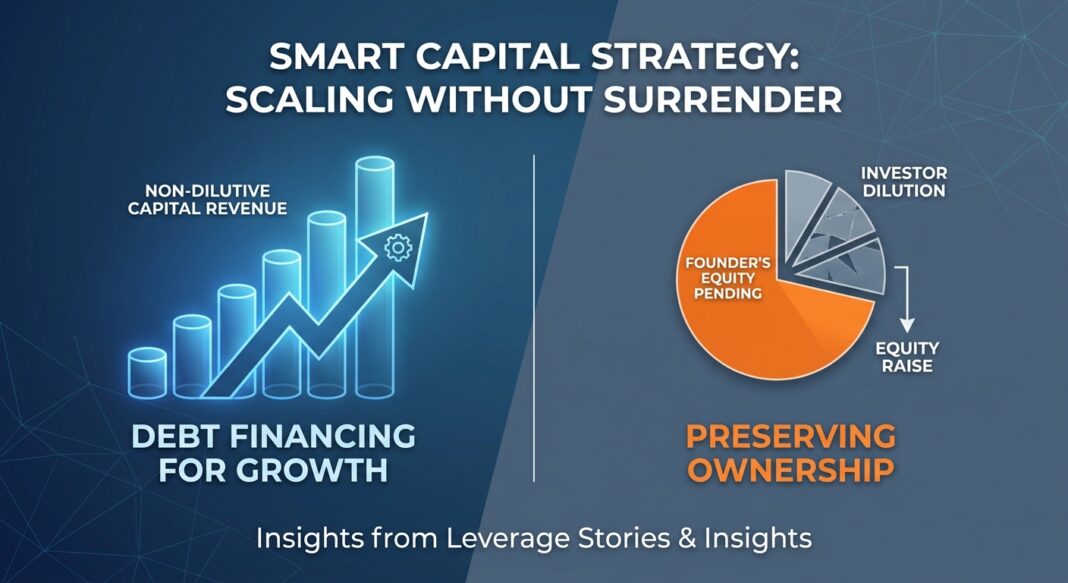
The Story: A Billion-Dollar Bet Without Giving Up the Table
In late 2024, Cohesity (a Santa Clara-based web-scale data management company with a recurring-revenue model and predictable infrastructure contracts) closed a $3.1 billion debt financing. The transaction came shortly after the company had already raised a $1 billion-plus Series G equity round. To the uninitiated, the move looked audacious. To anyone who understands capital structure, it looked like discipline.
Cohesity didn’t need to sell more equity to fund its next chapter. It used debt (structured to match the company’s durable, subscription-based cash flows) to scale aggressively while its founders and early equity holders kept their ownership stakes intact. The deal was highlighted in the 2024–2025 Venture Debt Review, produced by Runway Growth Capital and PitchBook, as a leading example of how debt can power ambitious growth plans without forcing founders to surrender equity.
Mohit Aron, Cohesity’s founder, built a company that by any measure had earned the right to grow on its own terms. Founded in 2013, Cohesity had scaled to over 5,700 employees and raised $5.93 billion in total financing across eleven rounds. The question at the growth inflection point wasn’t whether to raise capital; it was what kind of capital to raise, and at what cost to ownership.
Cohesity’s choice, debt over dilution, is no longer the exception. It is rapidly becoming the new playbook for scaling companies that have the fundamentals to support it.
The Decision: Equity vs. Debt at the Growth Inflection Point
Consider what Cohesity’s options looked like heading into this financing decision. The company had already taken on significant venture equity, 59 investors across 11 rounds. Another equity raise at this stage would have meant further diluting a cap table already populated with preferred holders, liquidation preferences, and investors with their own exit timelines and return targets.
The alternative was debt, specifically, a large-scale venture debt facility structured around the company’s predictable recurring revenue base. The mechanics are straightforward: borrow against the strength of future cash flows, service the debt from operations, and let equity holders, including the founder, keep their full proportional upside for the eventual exit.
This is exactly the calculus that more founders are running. According to PitchBook data released in early 2025, total U.S. venture debt deal value hit a record $53 billion in 2024: even as deal count dropped to its lowest level in a decade. Founders are doing fewer, larger, and more deliberate debt transactions. They are choosing capital that comes with a repayment schedule, not a board seat and a preferred liquidation waterfall that quietly erodes everything they’ve built.
The Runway Growth Capital and PitchBook 2024–2025 Venture Debt Review found that a majority of survey participants now view venture debt as a flexible, founder-friendly alternative to equity that supports growth without dilution, not a last resort. Nearly 60% of venture debt financings in 2024 occurred at the late or venture-growth stage, reflecting a decisive shift: founders are using debt to fuel growth, not merely to survive.
As David Spreng, Founder and CEO of Runway Growth Capital, put it in the review: “how you raise money matters more than how much.”
📊 Hypothetical Case Study: The Meridian Scenario, Two Paths, One Company
(Illustrative example only, not based on a specific real company. Numbers are representative of typical lower-middle-market SaaS deal structures.)
To make the decision framework concrete, consider a hypothetical founder-owned B2B SaaS company, call it Meridian Analytics, generating $12M in ARR and $4.5M in EBITDA, growing at 35% year-over-year with 92% gross margins and 110% net revenue retention. Meridian needs $15M to hire a new sales team, expand into two new verticals, and fund a small tuck-in acquisition.
Path A: Series B Equity
- Raise $15M at a $60M pre-money valuation (13x ARR, market rate for a 35% grower)
- Founder dilutes from 72% to approximately 55% ownership post-round
- New investors receive 2x liquidation preference, full participation rights
- Board now includes two new investors with blocking rights on exit decisions
- At a $120M exit in Year 3: founder receives approximately $55M after preference waterfall
Path B: Venture Debt + Private Credit
- Raise $15M via a senior term loan at SOFR + 400 bps (approximately 9.3% all-in) with a 4-year amortization
- Annual debt service: approximately $1.4M interest + $2.5M principal = $3.9M per year
- Founder retains 72% ownership: no new preferred stack, no liquidation waterfall, no investor veto rights
- At the same $120M exit in Year 3 (net of remaining debt): founder receives approximately $75M
The difference, roughly $20M more in founder proceeds: comes entirely from keeping the ownership percentage intact. No heroic assumptions required. The same exit. The same business. A different capital decision.
This is not a fringe scenario. Lower middle market leveraged recapitalizations typically close at 3x to 5x EBITDA in total debt, according to the Pepperdine Private Capital Markets Report (2024), with pricing tied to prevailing senior secured rates. For a company like Meridian with $4.5M in EBITDA and strong recurring revenue, $15M in senior debt sits comfortably within that range at approximately 3.3x EBITDA.
The Outcome: What the Market Is Telling Founders
Cohesity is not an outlier. It is the leading edge of a structural shift in how growth-stage companies think about their capital stack. The broader data validates the direction.
According to the Runway/PitchBook review, 61% of founders and investors no longer see venture debt as “rescue financing.” The stigma is fading. In 2024, in Spain alone, startups raised €2.3 billion in debt, surpassing €1.9 billion raised in venture capital. In the U.S., venture debt accounted for 18.6% of total VC funding in Q1 2024, marking debt’s emergence as a core component of startup capital strategies, not a supplementary one.
The private credit market is providing the infrastructure to support this shift. Global private debt assets under management reached approximately $1.7 trillion by late 2024, with direct lending representing the largest strategy. For the lower middle market specifically (companies with EBITDA between $7.5M and $30M) the market has matured to the point where bespoke structures, including delayed-draw term loans, hybrid overlays, and asset-based facilities, are available from institutional lenders who never required an equity stake to get in the door.
For founders operating with stable, recurring revenues and strong free cash flow, the private credit market has created a genuine third path: institutional capital on genuinely competitive terms, without the dilution, without the board dynamics, and without the preferred liquidation waterfall that can quietly extract value from every exit.
Importantly, the counterfactual matters too. A study of Italian small and mid-cap exits between 2022 and 2024 found that in 47% of cases, founders received less than 15% of the total transaction value, despite having built the company and managed it through to sale. In 23% of cases, founders received less than 10%. The culprit, consistently, was the accumulated preferred structure, the liquidation preferences, and the investor-favorable exit clauses built into successive equity rounds.
The Lessons: A Framework for the Capital Decision
Cohesity’s decision (and the framework it represents) comes down to one core principle: equity is the most expensive form of capital for founders who intend to win. You pay for it not with cash, but with ownership. And ownership, compounded over a successful exit, is worth far more than the interest rate on a well-structured term loan.
But debt is not universally correct. The instrument is neutral. The timing and structure are everything. Venture debt specialists have observed both outcomes: founders who raised debt at exactly the right moment and walked into a Series B twelve months later at a valuation three times higher, and founders who took on debt they couldn’t service, triggered covenants at month eight, and lost control of the business entirely.
The framework for when non-dilutive capital wins:
- Stable, recurring revenues: Debt is underwritten against cash flow predictability. SaaS, subscription healthcare, B2B services, and industrial services with long-term contracts are natural fits. Lumpy, project-based revenues are not.
- Interest coverage discipline: The critical constraint is not the leverage ratio; it is interest coverage. Maintain at least 2.0x coverage under a stressed scenario. A company generating $4.5M in EBITDA can comfortably service $1.4M in annual interest on $15M of debt. A company generating $1M in EBITDA cannot.
- Milestone clarity: Debt works when the capital is deployed toward a specific, measurable goal (a new market, an acquisition, a product launch) with a clear line to incremental EBITDA that accelerates repayment.
- No near-term liquidity crisis: Debt is most powerful in the hands of founders who need capital to grow, not founders who need capital to survive. The companies that need debt the least are the ones that can benefit from it the most, because they can actually service it.
And for the current market specifically: the window is open, but conditions are tightening. Spreads on middle-market direct loans widened by approximately 75 to 100 basis points between early 2023 and late 2024, with all-in yields running 11% to 13% on senior secured facilities. Founders who can access this market with a strong credit story today are operating in an environment where lenders are offering more borrower-friendly terms than the tighter conditions that have begun to emerge as deal flow improves in 2026.
Key Insights
- • Debt has gone mainstream for growth-stage companies. U.S. venture debt hit a record $53 billion in 2024 (PitchBook), with deals becoming fewer, larger, and more strategic, a sign of capital maturity, not desperation.
- • The equity waterfall is the hidden tax on founder outcomes. Every preferred round adds liquidation preference, participation rights, and investor veto dynamics that quietly erode founder proceeds at exit, often by tens of millions of dollars in mid-market deals.
- • Cohesity’s $3.1B debt round is the prototype. By sequencing equity for milestone-building and debt for scaling, growth-stage companies can preserve their cap table and capture full exit value for early stakeholders.
- • The private credit market now serves founder-owned companies directly. Non-sponsor direct lending went mainstream in 2025, with delayed-draw term loans, hybrid overlays, and asset-based facilities available to founder-operators who once had to choose between bank lines and institutional equity.
- • Structure and timing are everything. Debt destroys value when founders borrow against volatile cash flows or without covenant discipline. It creates extraordinary value when deployed against durable revenues, at the right leverage multiple, with a specific capital use case and a clear repayment path.


