
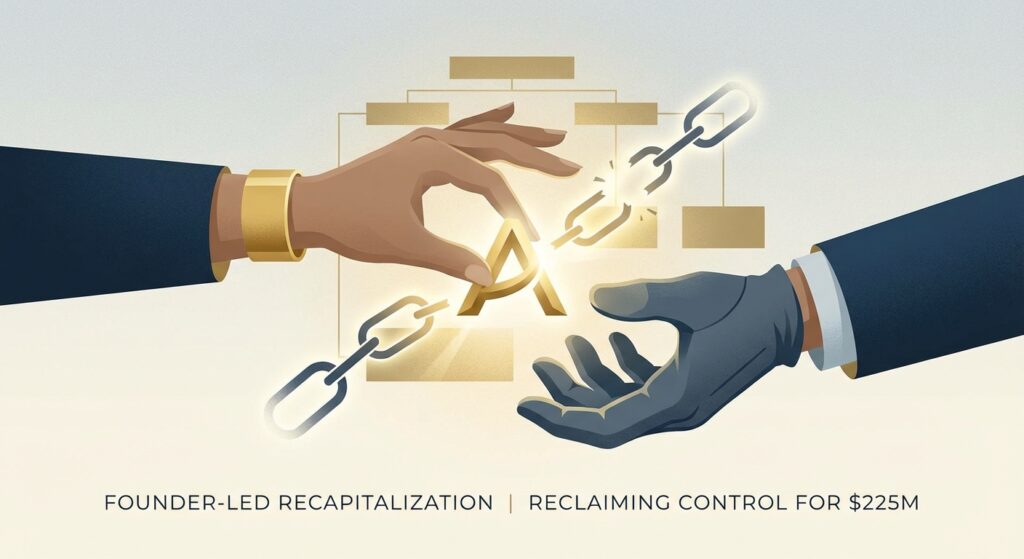
The Story: A Founder’s $225M Counter-Move
In the closing weeks of 2025, while the beauty industry was absorbed in holiday sell-through reports and retail foot traffic data, Anastasia Soare was quietly executing one of the most consequential capital moves in the history of founder-owned brands.
Soare, a Romanian immigrant who famously built a global empire from a Beverly Hills eyebrow studio, injected $225 million of her own capital into Anastasia Beverly Hills (ABH). The effect was swift and structural: TPG, one of the world’s most formidable private equity firms, watched its stake collapse from 38% down to approximately 6%. By early 2026, Soare had effectively reclaimed her company through a debt restructuring and recapitalization, without a traditional acquisition or secondary buyout. According to reporting by creatorsblueprint.co, she walked away with complete ownership of a company valued between $600M and $800M, and roughly $150M in net cash after accounting for what she had originally received in 2018.
This wasn’t luck. It was the delayed but inevitable consequence of a capital structure built on misaligned incentives, and a founder who understood exactly how to use that misalignment to her advantage when the moment came.
The Decision: $600M In, Control Out
Rewind to 2018. Anastasia Beverly Hills was generating approximately $500–600M in annual revenue with EBITDA margins near 20%, exceptional for a prestige beauty brand. TPG arrived with a compelling offer: $600M for a 38% minority stake at a $3 billion valuation. Anastasia retained 62% and her CEO title. TPG promised operational infrastructure, institutional scale, and a path to a $5–7B IPO or strategic sale by 2023–2024.
On the surface, the deal looked like the best of both worlds, massive personal liquidity for Soare while she retained nominal control. But the structure carried a hidden cost that would take years to fully reveal itself.
The problem wasn’t the equity percentage. It was the operational philosophy embedded in that equity. As creatorsblueprint.co detailed, PE firms deploying $600M at a $3B valuation need a defined exit path, and that pressure reshapes every business decision that follows. Hiring, SKU expansion, retailer relationships, marketing spend, all of it gets filtered through the lens of a future transaction, not long-term brand equity.
Revenue declined. Debt accumulated. By the time S&P downgraded ABH to a “D” credit rating, the exit thesis had evaporated, and the capital structure became the battleground.
The Outcome: Numbers That Tell the Full Story
Here is where the story becomes a masterclass in capital structure math:
- TPG invested: ~$600M in 2018
- TPG’s estimated recovery: $50–100M after dilution and restructuring
- TPG’s effective loss: $500M+ over eight years on a consumer brand that was profitable at entry
- Anastasia received in 2018: ~$600M (pre-tax), retaining ~$375M after taxes
- Anastasia reinvested in 2026: $225M to recapitalize and restore control
- Net position: +$150M cash plus full ownership of a $600–800M enterprise, debt-free
The counterfactual is instructive. Had Soare never taken the TPG investment, she would have retained 100% of a growing brand with no institutional pressure to chase an artificial exit multiple. She would have had less liquidity, but far more flexibility. Instead, the PE relationship introduced leverage, overhead, and misaligned time horizons that compressed the very brand value it was meant to expand.
What Soare demonstrated in 2026 is that a debt-fueled recapitalization (when timed correctly and executed with conviction) can functionally replicate a buyout without requiring a willing third-party acquirer. The restructuring mechanism did the work. Her $225M injection wasn’t a rescue; it was a precision repurchase at distressed prices driven by a capital structure she understood better than her counterparty.
The Lessons: What Every Founder Should Internalize
Soare’s story sits at the intersection of two powerful capital principles: the hidden cost of minority PE equity and the strategic optionality embedded in debt restructuring. But it doesn’t exist in isolation. Across the market, founders who avoided dilutive equity entirely have been quietly building and exiting on their own terms.
Consider the Holifield family, father and son founders of SafePointe, an AI-based weapons detection company. Rather than raise an equity round to scale, they secured a $1 million debt facility from TIMIA Capital. Within 12 months, SafePointe had tripled its monthly recurring revenue and was acquired by Nasdaq-listed SoundThinking (SSTI). As timiacapital.com reported, it was their fourth successful exit, each built on non-dilutive capital as the scaling tool of choice.
Similarly, Myagi co-founder Simon Turner faced a fork in the road in early 2021: take a significant equity round or find another path. He chose a $2.5M non-dilutive facility from TIMIA Capital, used it to accelerate his referral-based sales model, and positioned the company for an acquisition by Rallyware, with founders retaining a far larger share of exit proceeds than a diluted cap table would have allowed. As Turner himself noted, per timiacapital.com: “Debt is a powerful tool for capital-efficient businesses when used under the right circumstances.”
And for earlier-stage operators, the principle scales down elegantly. Inkle, a financial operations platform for VC-backed startups, used revenue-based financing from Efficient Capital Labs to avoid two full rounds of dilution, retaining 90% founding team equity and serving 500+ companies without surrendering a single board seat, as detailed by ecaplabs.com.
A Framework for Founders Facing Similar Decisions
Before accepting equity capital (minority stake or otherwise) operators should stress-test three structural questions:
- Does the investor’s required return timeline match your brand’s natural growth arc? PE funds operate on 5–7 year deployment cycles with hard return targets. If your business compounds best over 10–15 years, that misalignment is a structural landmine, not a partnership.
- Can debt service be supported by existing cash flows? Debt is only a tool when it is serviced without distorting operations. If cash flows are predictable and recurring, non-dilutive capital preserves far more long-term value than equity at a premium valuation that embeds someone else’s exit math.
- What is the restructuring optionality if the capital structure breaks? Soare’s story is exceptional, but it was only possible because she understood the mechanics of debt restructuring well enough to deploy her own capital at the precise moment of maximum leverage. Founders who understand their capital structure as a dynamic instrument, not a static agreement, hold a significant asymmetric advantage.
Key Insights
- Minority PE equity is not passive capital. When a firm deploys hundreds of millions at a defined multiple, every operational decision flows through their exit thesis, not yours. The equity percentage on paper understates the control shift in practice.
- Debt restructuring is a legitimate recapitalization tool. Anastasia Soare’s $225M injection wasn’t a bailout; it was a calculated repurchase at distressed terms, enabled by a broken capital structure that she was uniquely positioned to resolve.
- Non-dilutive capital has a proven track record across deal sizes. From SafePointe’s $1M facility to ABH’s nine-figure recapitalization, the principle scales: preserving equity at the growth stage translates directly into greater founder proceeds at exit.
- Timing and self-knowledge are the real leverage. Soare’s advantage wasn’t just financial; it was that she knew her company’s value, understood the counterparty’s constraints, and was capitalized well enough to act when the structure broke in her favor.
- The 2020–2022 PE vintage is creating a new wave of founder buybacks. Brands that took institutional money at peak valuations are now navigating broken capital structures. For founders who retained cash reserves and understand restructuring mechanics, this cycle is creating generational repurchase opportunities, just as Soare demonstrated.


