
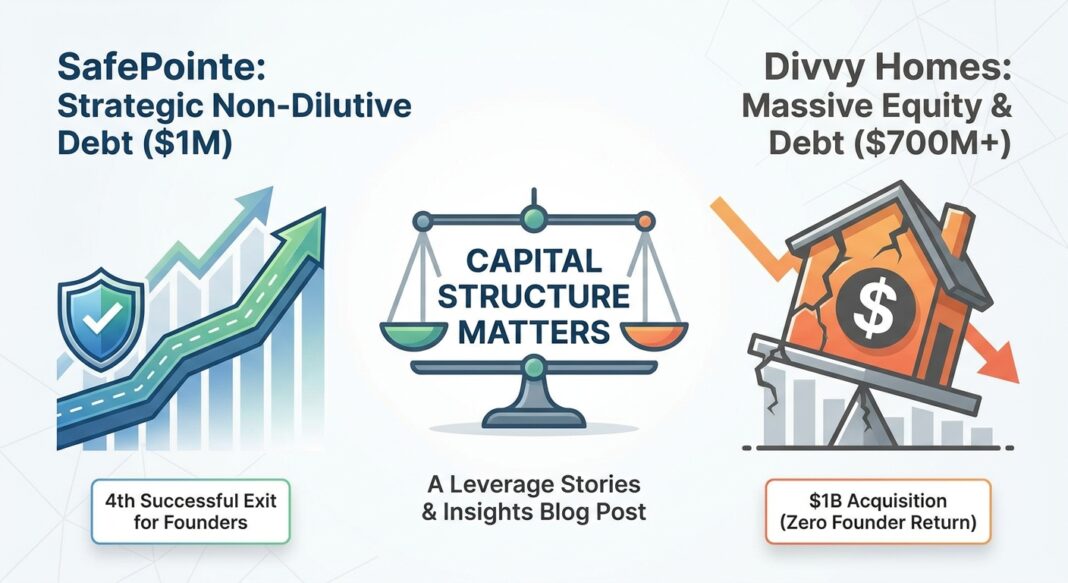
The Story: Two Companies, One Billion Dollars, and a Zero-Return Wake-Up Call
In January 2025, the proptech world got a gut-punch lesson in capital structure. Divvy Homes: a rent-to-own startup once valued at $2.3 billion, sold to Brookfield Properties for approximately $1 billion. That headline number sounded like a success. The reality was something else entirely.
After repaying outstanding debt and satisfying liquidation preferences owed to preferred shareholders, the company’s founders, employees, and common shareholders received nothing. Not a reduced payout. Not a modest return. Zero. A company that had raised over $700 million in debt and equity from Andreessen Horowitz, Tiger Global, and GGV Capital (and had genuinely helped 2,000 families become homeowners) produced no founder wealth whatsoever at the finish line.
CEO Adena Hefets wrote plainly to shareholders: “After repaying its outstanding indebtedness, transaction costs, and liquidation preference to preferred shareholders, we unfortunately estimate that neither common shareholders nor holders of the Series FF preferred stock will receive any consideration.”
Now, hold that story. Contrast it with a father and son in Florida who, around the same time, were proving that a $1 million non-dilutive debt facility: structured correctly, sized appropriately, and deployed with discipline, could build not just a successful exit, but a fourth successful exit. Different scale. Entirely different outcome.
The Decision: What SafePointe Got Right That Divvy Got Wrong
Greg and Timothy Holifield, a father-son pair who had been building companies together since 2010, founded SafePointe as an AI-based weapons detection company in Florida. By 2022, they had modest recurring revenue and a clear path to scale, but a structural problem: their hardware-enabled SaaS model required upfront capital to fulfill new government contracts before the recurring revenue could pay for them.
They could have raised equity. Their contract pipeline and technology likely would have attracted interest. Instead, they approached TIMIA Capital for a non-dilutive debt facility. The terms were straightforward: $1 million USD, drawn in three tranches, sized against their recurring revenue base. No equity transferred. No warrants attached. No board seats surrendered. No VC clock started.
Greg’s own assessment of the trade-off was characteristically direct: “They think the interest rate is too high, but when there are no warrants associated with debt, it is truly fantastic money, and much cheaper than equity.”
Divvy’s capital decision, by contrast, was not one bad call but a compounding series of them. After raising over $400 million in venture equity: each round layering in new liquidation preferences, the company took on approximately $735 million in debt financing in October 2021, at the peak of a property market that was about to be destabilized by rising rates. The structure was not sized to what the business could service under stress. It was sized to the opportunity as imagined at the top of the cycle. When rates surged in 2022, the model broke, and three rounds of layoffs followed. By 2023, Divvy had paused all new home acquisitions.
The structural difference between these two stories was not intelligence, mission, or ambition. It was the alignment between capital structure and business fundamentals: cash flow predictability, debt serviceability, and the true cost of the equity being displaced.
The Outcome: Numbers That Show the Real Cost of Capital
Within twelve months of deploying TIMIA’s facility, SafePointe had tripled its monthly recurring revenue. The company was then acquired by SoundThinking, Inc. (Nasdaq: SSTI), a leading public safety technology firm, marking the Holifields’ fourth successful exit since 2010. The debt was structured to the business, sized conservatively, and cleared cleanly at exit. The founders walked away whole.
The equity investors who invested alongside TIMIA’s debt facility reportedly earned 10x returns in approximately nine months. TIMIA’s debt, by comparison, cost a fraction of that in total outlay, confirming Greg Holifield’s underlying thesis: interest rates are not the real cost of debt. The real cost of equity is the ownership surrendered, compounded by the multiple at exit.
Consider the counterfactual math for SafePointe: if the Holifields had raised a $1 million equity round at a hypothetical $5 million post-money valuation to cover the same hardware deployment, they would have surrendered 20% of the company. If the exit valued SafePointe at, say, $10 million, that single round would have cost them $2 million in diluted value, twice the face value of the debt facility, before accounting for any preferences or pro-rata rights attached to the equity.
Divvy’s outcome requires no modeling. The numbers are public and unambiguous. A business that built genuine social impact, backed by the best names in venture capital, sold for $1 billion, and its founders, its employees, and most of its investors received $0. Preferred equity preferences and $735 million in debt absorbed the entire enterprise value before a dollar reached common shareholders.
This is not a story about Divvy’s founders making poor decisions under pressure. It is a story about what happens when capital structure assumptions are built on cycle-peak conditions, with insufficient buffer for a macro environment that few predicted but everyone should have stress-tested for.
The Lessons: A Framework for Founders Facing the Same Fork in the Road
The SafePointe and Divvy stories are not opposites on a risk spectrum. They are both stories about capital structure alignment, one that worked because it fit the business, and one that failed because it was sized to the aspiration rather than the reality.
1. Debt Is Not Inherently Dangerous: Misalignment Is
SafePointe’s $1 million facility was sized to existing recurring revenue, not to projected growth. It was drawn in tranches, giving the Holifields capital-deployment discipline. Divvy’s $735 million debt facility was sized to a property portfolio that required continued appreciation and low interest rates to remain solvent. The instrument was not the problem. The structure was.
2. Run the Equity Dilution Math Before Every Round
Equity investors who backed SafePointe alongside TIMIA’s debt reportedly earned 10x in nine months: which means the same capital, taken as equity by the founders instead of debt, would have cost them 10x its face value at exit. As the private credit market now offers direct lending facilities in the 9–12% range for growth companies with predictable cash flows, the all-in cost of debt remains dramatically lower than early-stage equity at almost any realistic exit multiple.
3. Liquidation Preferences Are Silent Until They Aren’t
Every equity round Divvy raised came with liquidation preferences, senior rights to exit proceeds that stack silently on the cap table until exit day. Combined with the $735 million in senior debt, those preferences consumed the entire $1 billion acquisition price before a cent reached common shareholders. Founders evaluating VC term sheets must model the preference waterfall at multiple exit scenarios, not just the optimistic one.
4. Debt Sized to Your Business Creates Leverage; Debt Sized to Your Dreams Creates Risk
The private credit market has grown to nearly $2 trillion in projected 2026 AUM, with direct lending dominating as the largest sub-strategy. Capital is available. The discipline required is sizing it to what the business can actually service, measured against stressed cash flows, not base-case projections. A well-structured facility that the business can repay from existing revenue is a tool. An overleveraged balance sheet built on assumptions about future conditions is a liability.
5. The Best Exits Are Built from Positions of Strength, Not Necessity
SafePointe controlled its exit timing. TIMIA’s facility fueled growth milestones that made the company an attractive acquisition target, on the Holifields’ schedule, not a VC fund’s return timeline. Divvy’s exit was a forced sale, driven by debt obligations and market conditions that eliminated all other options. Non-dilutive capital, when structured correctly, preserves that optionality.
Key Insights
- Capital structure is the story behind the headline. Divvy Homes sold for $1 billion and its founders received $0. SafePointe raised $1 million in non-dilutive debt and its founders achieved a fourth successful exit. The difference was not the companies; it was how they were capitalized relative to their underlying cash flows and market risk.
- The true cost of equity is not the interest rate, it’s the multiple at exit. Equity investors alongside SafePointe’s debt reportedly earned 10x in nine months. That same capital, raised as equity instead of debt by the founders, would have cost them 10x its face value in ownership transferred permanently from their cap table.
- Non-dilutive debt creates leverage without surrendering control. TIMIA’s $1M facility required no equity, no warrants, and no board seats. The Holifields retained full control, deployed capital into revenue-generating contracts, and tripled MRR within twelve months, on their own terms and timeline.
- Liquidation preferences are the invisible tax on every equity round. Founders often underestimate how preference stacks, combined with senior debt, consume exit proceeds from the top. Divvy’s $1 billion acquisition was absorbed entirely by debtholders and preferred shareholders before common equity saw a dollar. Modeling the preference waterfall at the time of each round is not optional; it is essential.
- The private credit market now offers a genuine third path. With the private credit market projected to approach $2 trillion in 2026, founders with predictable recurring revenue no longer face a binary choice between dilutive VC and restrictive bank financing. Direct lending facilities, revenue-based structures, and venture debt provide capital at 9–12% rates for qualifying companies, dramatically cheaper than early-stage equity when modeled against realistic exit multiples.


