
In the high-stakes world of startup financing, the “Series A” announcement is often treated as the ultimate badge of honor. It signals validation, war chests, and headlines. But for a growing class of founders who pay close attention to the math of ownership, the standard venture capital deal is looking less like a lifeline and more like a tax on their future success.
The story of James Slezak and his company, Swayable, illustrates a critical shift in how modern operators are evaluating the true cost of their capital.
The Scenario: The Valuation Trap
In 2018, James Slezak and Valerie Coffman founded Swayable, a platform using causal AI to predict how media content changes public opinion. By 2022, the company was in a position many founders dream of: they had a working product, big-name clients (including T-Mobile and Airbnb), and a market hungry for their data.
Naturally, the venture capital ecosystem took notice. Slezak was presented with what the industry considers the “standard” path: raise a significant equity round, capture a high valuation, and use the cash to blitzscale.
But Slezak, a former physics Ph.D. and researcher, ran the numbers differently. He realized that while equity creates no immediate burden on cash flow, it creates a massive burden on future wealth. If Swayable performed as well as he expected, the equity he gave away would become the most expensive money he ever touched.
The Decision: Calculating the True Cost
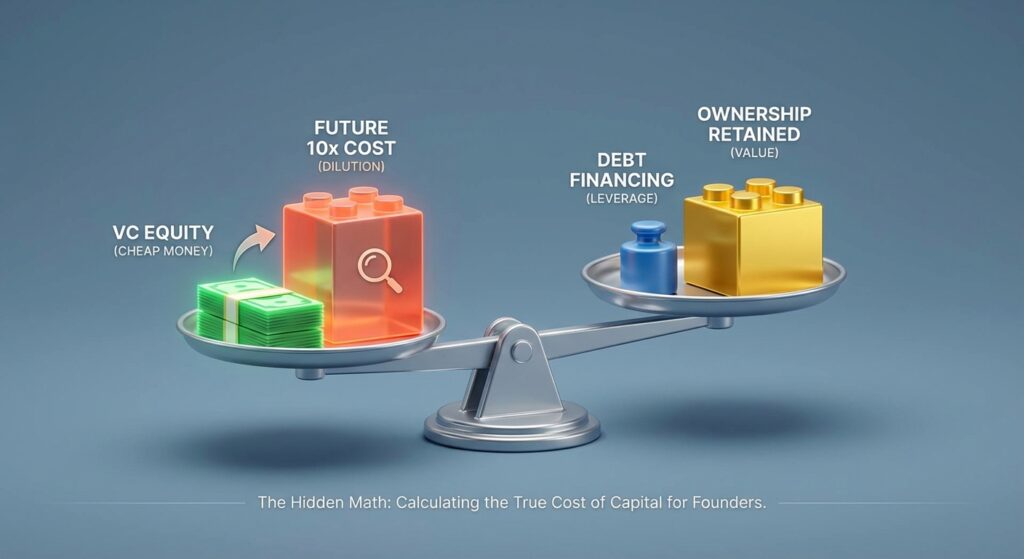
The core of the decision came down to a simple but often overlooked realization about venture math. A VC model relies on outliers; investors need their winning bets to return 10x or 100x to cover their losers. Therefore, the capital they provide essentially “costs” the successful founder that same 10x or 100x in lost value upon exit.
“The piece of paper you’re giving your VC is worth 10x more when they cash it out – their gain is your cost,” Slezak explained in a case study with Arc. “If we’re 10xing their money, they’re earning 1,000% returns, and that’s the cost of capital.”
Facing this reality, Swayable stood at a fork in the road:
- Option A (Equity): Take millions in VC cash. Dilute ownership by 15-25%. Gain “free” cash flow (no interest payments) but sacrifice a quarter of the upside.
- Option B (Debt): Utilize revenue-based financing or growth capital. Pay a fixed fee/interest rate. Keep the equity.
Swayable chose Option B. They partnered with Arc for growth capital rather than selling a slice of the company. This was a bet on their own execution, a belief that they could service the debt from revenue growth, thereby preserving their ownership stake for themselves.
The Outcome: Growth Without Dilution
The decision to bypass an early equity round allowed Swayable to maintain control and financial discipline. According to public reports, the capital injection helped the company achieve 73% quarter-over-quarter topline growth while maintaining “near zero” cash burn.
By using debt to fund predictable growth actions (like hiring key C-level executives and data scientists) Swayable turned capital into revenue without shrinking the founders’ pie. The financing acted as a bridge, allowing them to scale valuation before any potential future equity events, or simply to remain profitable and independent.
Secondary Case: The Debt-Backed Exit
Critics of this model often argue that debt encumbers a company, making it harder to sell. However, the counter-example of Myagi, a retail sales enablement platform, proves otherwise.
Like Swayable, Myagi’s co-founder Simon Turner opted for non-dilutive capital to bridge a growth gap. In 2021, Myagi secured a $2.5 million facility from TIMIA Capital. The goal was to fuel growth during a period of high demand without suffering the dilution of a flat or down round during the pandemic uncertainty.
“Debt is a powerful tool for capital-efficient businesses when used under the right circumstances,” Turner noted. Two years later, Myagi was successfully acquired by Rallyware. Because the founders had used debt rather than piling on more equity preferences, the exit math remained favorable for the common shareholders, the founders and employees.
The Lessons: The “Cost of Success” Framework
These stories suggest a framework for founders facing capital allocation decisions. The “cheapest” money depends entirely on your outcome.
- If you fail, specific debt is dangerous. Equity is “risk-free” in bankruptcy because you don’t pay it back. Debt must be serviced, even in bad times.
- If you succeed, equity is exorbitant. In a $100M exit, the $5M you took for 20% of the company effectively costs you $20M. That is a 300% effective interest rate.
- Control has a premium. Founders who retain equity retain voting power. Board disputes often arise from misaligned timelines between VCs (who need to return the fund in 7-10 years) and founders (who may want to build generationally).
For companies like Swayable and Myagi, where product-market fit was established and revenue was predictable, leverage wasn’t a risk; it was a mechanism to lock in the value they had built.
Key Insights
- Cost Inversion: Equity is cheap when you are failing, but the most expensive capital possible when you are winning.
- Revenue is Collateral: Modern tech companies with recurring revenue can leverage those contracts just like industrial companies leverage factories.
- Discipline Enforcer: Debt forces operational discipline (cash burn must be managed), whereas large VC rounds can encourage inefficient “blitzscaling.”
- Exit Optionality: A leveraged capital structure does not block M&A; in many cases, it simplifies the cap table, making the exit cleaner for acquirers.
- The 10x Rule: Before signing a term sheet, founders should calculate the dollar value of that equity stake at their target exit valuation, not the current one.


