
The Story: A $1 Billion Exit, Zero Dollars Home
In January 2025, Divvy Homes, a San Francisco-based rent-to-own proptech company, was acquired by Maymont Homes, a division of Brookfield Properties, for approximately $1 billion. On the surface, it sounded like a win. A clean exit. A billion-dollar outcome for a startup that had bent the arc of residential real estate toward affordability.
The reality was something else entirely.
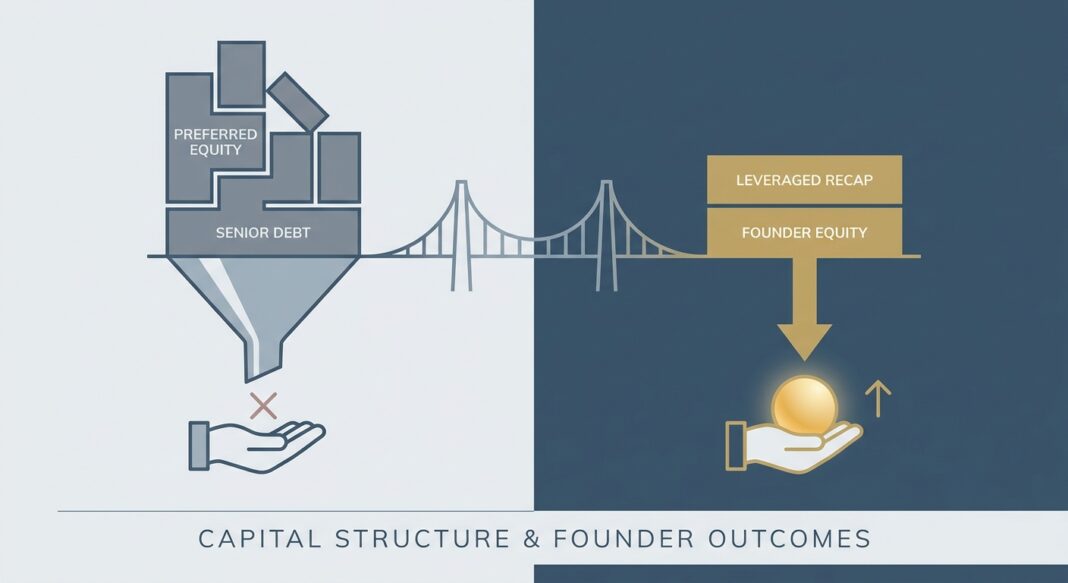
CEO and co-founder Adena Hefets wrote a letter to shareholders confirming what many feared: common shareholders and holders of Series FF preferred stock, the shares typically awarded to founders, would receive no proceeds from the sale. Debtholders were paid first. Preferred shareholders with liquidation preferences came next. By the time the waterfall finished flowing, the founders of a company that had been valued at $2.3 billion in 2021 walked away with nothing.
Hefets herself acknowledged she was “not proud of the financial outcome.” The company had once backed by Andreessen Horowitz, Tiger Global, GGV Capital, and GIC, some of the most prestigious names in venture capital. Many of those equity holders were zeroed out too.
This is not a story about a bad business. Divvy helped over 15,000 residents start their journey to homeownership. It is a story about what the wrong capital structure, layered in at the wrong moment, does to every stakeholder standing below the waterfall.
The Decision: When $735 Million in Debt Became a Trap
Divvy’s capital story had two distinct chapters. In the early years, the company raised VC equity in conventional rounds, a Series C of $110 million in early 2021, followed six months later by a $200 million Series D led by Tiger Global. Each round came with preferred stock carrying liquidation preferences, meaning those investors would be made whole before founders or common shareholders saw a dollar at exit.
Then, in October 2021, Divvy layered in roughly $735 million in debt financing to fund its portfolio of 7,000 homes. The logic was sound in isolation: match asset-backed debt to a real estate portfolio. But the structure assumed the rate environment would hold. It did not.
When interest rates surged in 2022, Divvy’s model fractured. Three rounds of layoffs followed. By 2023, the company had paused new home acquisitions entirely. The debt (expensive, senior, and secured) sat at the top of every payment priority. The preferred shareholders, armed with liquidation preferences, queued up behind the lenders. Founders and common shareholders stood at the end of a line that ran out of money.
The lesson embedded in this structure is not that debt is dangerous. It is that undisciplined capital stacking, equity with liquidation preferences piled atop rate-sensitive balance sheet debt, creates a waterfall that consumes value from the bottom up. Founders, employees, and common shareholders are, by construction, last in line.
The question for every founder reading this is not whether Divvy made mistakes. It is whether their own capital structure is quietly building the same trap.
The Outcome: What a Leveraged Recap Would Have Changed
[Hypothetical Scenario, for illustrative purposes. The company and structure below are constructed to demonstrate capital structure principles and are not based on a specific real transaction.]
Imagine a founder-owned B2B software business with $8 million in EBITDA, strong recurring revenue, and zero outside equity. Call her the founder of a vertical SaaS platform serving mid-market logistics companies. In 2022, she faces a familiar pressure: grow aggressively or watch better-capitalized competitors absorb her market. Her advisors suggest a Series B raise, $20 million at a $60 million post-money valuation, which would dilute her from 90% ownership to approximately 57% after accounting for a new option pool.
Instead, she chooses a leveraged recapitalization. Working with a direct lender, she structures a $24 million unitranche facility at 4.0x EBITDA, well within the 3x to 5x EBITDA range that the Pepperdine Private Capital Markets Report (2024) identifies as typical for lower middle market leveraged recaps. Of that $24 million, $16 million is distributed to her as a special dividend: personal liquidity, taxed at capital gains rates, fully de-risking her personal balance sheet. The remaining $8 million goes onto the balance sheet as growth capital, funding two targeted product acquisitions.
She retains 90% of her equity. She has taken meaningful personal liquidity. The company’s debt service, at approximately $2.4 million annually on the unitranche, is covered by existing cash flows with a comfortable fixed charge coverage ratio above 1.5x. When she sells the company three years later at a 7x EBITDA multiple on $12 million in grown EBITDA, the $84 million enterprise value, less $18 million in remaining debt, delivers $66 million in equity proceeds. She captures nearly all of it.
Compare that to the equity path: a Series B at $60 million, followed by pressure to raise a Series C at a higher burn multiple, with two additional preferred share classes stacking liquidation preferences above her. Even at the same $84 million exit, she may find that preferred liquidation preferences consume the first $30 million of proceeds before she reaches her pro-rata slice of what remains.
The numbers make the argument plainly. The discipline of structured debt, matched to durable cash flows, preserves the founder’s claim on the value she built.
The Lessons: Frameworks for Founders Facing the Same Fork in the Road
Divvy Homes is an instructive tragedy, but it is not a universal condemnation of debt or venture equity. It is a case study in what happens when capital instruments are misaligned with the underlying business model, when rate-sensitive leverage is stacked atop a model exposed to rate risk, and when preferred equity liquidation preferences quietly erode founder outcomes across multiple rounds.
The broader market validates a different approach. According to PitchBook data released in early 2025, total venture debt deal value hit a record $53 billion in 2024, even as deal count fell to its lowest level in a decade: meaning founders are doing fewer, larger, and more deliberate debt transactions. They are choosing capital that comes with a repayment schedule, not a board seat and a preferred liquidation waterfall. Private credit volumes in U.S. direct lending reached $380 billion in full-year 2025, and the private credit market, estimated at $1.5 trillion in early 2024, is projected to reach $2.8 trillion by 2028 according to Morgan Stanley, as cited by Akin Gump. The infrastructure for founder-controlled, non-dilutive capital has never been deeper or more accessible.
Three principles emerge from this comparison:
- Match debt structure to cash flow profile. Divvy’s mistake was not taking on debt; it was taking on rate-sensitive, asset-heavy debt against a model that collapsed when rates moved. Recurring revenue businesses with predictable cash flow are precisely the profiles that can service structured debt without existential risk.
- Understand the waterfall before you sign. Every round of preferred equity you raise inserts a new claimant ahead of common shareholders in any exit or distress scenario. A leveraged recap creates a single debt obligation with a fixed schedule: transparent, senior, and finite.
- Liquidity and control are not mutually exclusive. The leveraged recapitalization exists precisely for the founder who needs personal liquidity but is not ready to hand over governance, strategic direction, or the majority of future upside. According to the Pepperdine Private Capital Markets Report (2024), lower middle market recaps regularly close at 3x to 5x EBITDA, providing material liquidity without a forced exit.
The right capital structure is not the one that raises the most money. It is the one that leaves the builder of the business with the largest legitimate claim on the value they created.
Key Insights
- The liquidation waterfall is the hidden risk in venture equity. Multiple rounds of preferred stock with liquidation preferences can consume the majority of exit proceeds before founders see a dollar, as Divvy Homes demonstrated in its $1 billion Brookfield sale.
- Leveraged recaps deliver personal liquidity without a change of control. A unitranche or senior secured facility at 3x–5x EBITDA allows founders to extract meaningful cash, fund growth, or retire equity risk, while retaining operational control and future upside.
- Debt discipline forces revenue discipline. The obligation to service debt on a fixed schedule creates accountability that open-ended venture equity often does not. Founders funded by structured debt tend to prioritize margin and cash conversion earlier.
- The private credit market has created genuine alternatives. With U.S. direct lending volumes reaching $380 billion in 2025 and the overall private credit market projected to hit $2.8 trillion by 2028, founder-owned companies now have access to institutional capital on genuinely competitive terms, without surrendering governance.
- Capital structure misalignment, not business failure, killed Divvy’s founders. The company sold for $1 billion, a meaningful asset outcome. The founders received nothing because the capital structure consumed every dollar before they reached the waterfall. Structure is destiny.


