
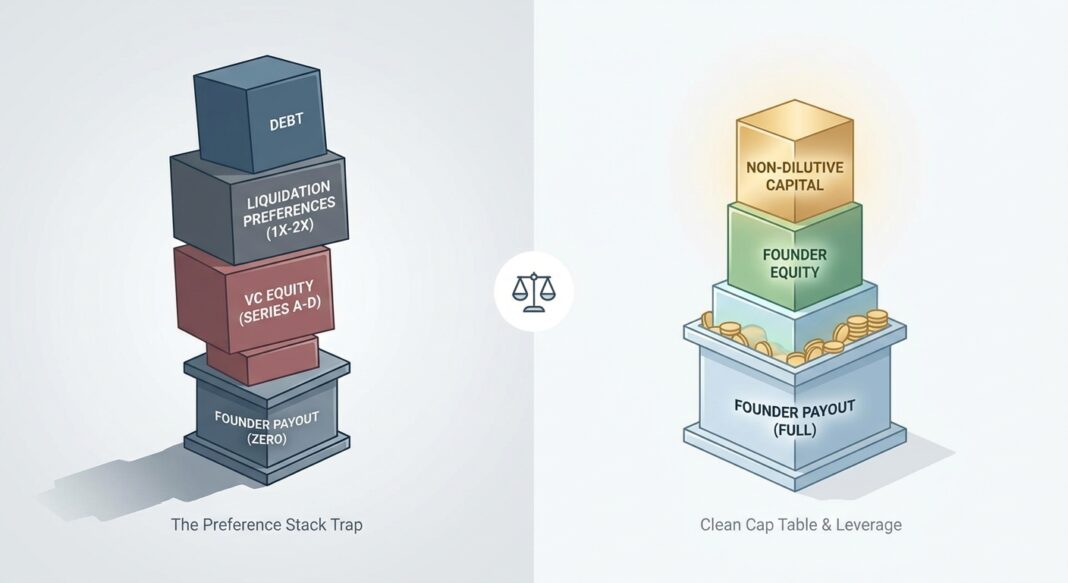
The Story: A Billion Dollars, Zero Dollars, and the Space Between
In January 2025, Divvy Homes (a rent-to-own proptech startup backed by Andreessen Horowitz, Tiger Global, and GGV Capital) was acquired by Brookfield Properties for approximately $1 billion. On paper, it looked like a win. The headline number was real. The payout to founders was not.
CEO and co-founder Adena Hefets sent a letter to shareholders that said, with blunt honesty, that after repaying outstanding debt, covering transaction costs, and fulfilling liquidation preferences for preferred shareholders, neither common shareholders nor holders of founders’ preferred stock would receive any consideration. The people who built the company received nothing. Most of the venture investors who had poured capital in at a peak valuation of $2.3 billion received nothing. A company that once employed hundreds of people, helped over 2,000 families on their path to homeownership, and appeared on every VC’s highlight reel, sold for a billion dollars, and the builders left empty-handed.
This is not a story about a bad business. It is a story about a capital structure that consumed the company’s exit before founders ever got to touch it.
It is also, when held against the right counterexamples, a masterclass in why the choice between equity and non-dilutive debt is one of the most consequential decisions a founder will ever make, not at the moment of fundraising, but at the moment of exit.
The Decision: Three Paths, Three Very Different Tables
Divvy’s model was capital-intensive by design. The company bought homes outright and leased them back to aspiring homeowners who were building toward purchase. That model required a large real asset base, which required large quantities of capital, which Divvy raised through a combination of equity rounds and, critically, significant debt facilities. By the time of its sale, the company had raised more than $700 million in combined debt and equity. When interest rates surged in 2022, the model’s unit economics broke. Three rounds of layoffs followed. By 2023, new home acquisitions had stopped entirely.
When the Brookfield deal closed, the math was unforgiving. Debt holders are first in line, always. Transaction costs and advisor fees follow. Then comes the liquidation preference stack for preferred shareholders, which in a heavily venture-backed company typically carries 1x to 2x liquidation preferences on every round. By the time the waterfall runs its course, a $1 billion headline number can produce exactly zero dollars for founders and common shareholders. That is not fraud. That is contract law and capital structure working exactly as written.
Now consider a different path, taken by a very different kind of founder, around the same time.
In September 2022, the same year rising rates began destroying Divvy’s model, Greg and Timothy Holifield, founders of SafePointe, an AI-based weapons detection company, needed growth capital. They had recurring government contracts, modest but real revenue, and a hardware-enabled SaaS model that required upfront capital to fulfill new customer deployments. Banks didn’t understand the model. VC firms would have taken equity and imposed a growth clock. Instead, the Holifields turned to TIMIA Capital for a $1 million non-dilutive debt facility, drawn in three separate tranches. No equity transferred. No warrants. No board seats surrendered.
The structure was straightforward: debt against recurring revenue, with repayment tied to the cash flows the contracts were already generating. The interest cost was real. The ownership cost was zero.
The Outcome: Triple the Revenue, a Clean Exit, and a Lesson the Cap Table Tells
Within twelve months of drawing on TIMIA’s facility, SafePointe had tripled its monthly recurring revenue. In 2023, the company was acquired by SoundThinking, Inc. (Nasdaq: SSTI), a leading public safety technology platform, the Holifields’ fourth successful exit as a founder team.
Greg Holifield was candid about the calculus in a post-acquisition case study published by TIMIA Capital: when there are no warrants and no equity transfer, debt is almost always cheaper than the equity it displaces. He noted that equity investors who came into SafePointe alongside TIMIA earned approximately 10x their money in nine months. TIMIA’s debt cost a fraction of that in real economic terms. The founders kept the upside. The lender got repaid. Everyone’s incentives were aligned.
The contrast with Divvy’s outcome is not subtle. Both were real businesses. Both used capital to grow. The difference was structure: one company loaded its cap table with round after round of equity carrying liquidation preferences, layered on top of substantial debt, at a peak valuation that the market later refused to validate. The other used modest, well-priced, non-dilutive debt to hit a specific milestone, kept its cap table clean, and walked into an acquisition conversation with maximum founder leverage.
The market data underscores how widespread both patterns have become. In 2025, private equity-owned companies borrowed $94 billion in leveraged loans and high-yield bonds in the US to fund shareholder payouts through dividend recapitalizations, a market that grew 128.8% year-over-year in 2024 and another 22.8% in 2025, before slowing sharply in early 2026. When that tool is used with discipline, it can generate real founder liquidity without triggering a sale. When it is used recklessly, it produces something closer to what happened at First Brands Group.
First Brands (the automotive aftermarket parts supplier behind brands like Raybestos, Autolite, and Fram) filed for Chapter 11 bankruptcy in September 2025 with liabilities estimated between $10 billion and $50 billion and less than $12 million in cash on hand. The company had entered bankruptcy with over $11 billion in total debt, comprising $6.2 billion in on-balance-sheet funded debt and $4.6 billion in off-balance-sheet financing. Prior to its collapse, a $1.31 billion recapitalization had reportedly extracted more than $658 million in payouts and fees before the Chapter 11 filing. The company reported approximately $5 billion in annual worldwide sales before it stopped being able to service its obligations. Founder and CEO Patrick James and a former senior executive were later criminally charged with fraud offenses. The case is still unfolding, but the capital structure story was already written long before the bankruptcy filing.
The Lessons: A Framework for Capital Decisions That Actually Protect Founders
These three stories (Divvy, SafePointe, First Brands) are not outliers. They are archetypes. And together they produce a usable framework for founders and operators facing a capital decision.
1. The preference stack is not an abstraction; it is a claim against your exit. Every round of preferred equity you raise carries a liquidation preference that must be satisfied before founders see a dollar. In 2025, median dilution was approximately 19.5% for seed rounds and 18% for Series A rounds. By the time a company has raised through Series A with an option pool, founders and early stakeholders typically retain around 50% ownership, and that number keeps falling with every subsequent round. Non-dilutive debt does not add to the preference stack. It sits ahead of equity in the waterfall, but it repays and disappears. Preferred equity doesn’t disappear. It compounds.
2. The real cost of equity is not the dilution percentage; it is the exit math. A founder who takes $10 million at a $50 million valuation gives up 20% of the company’s upside permanently. A founder who takes $10 million in debt pays interest, retires the obligation, and keeps the 20%. The difference is not visible at fundraising. It is only visible at exit. And by then, as Divvy demonstrated, it may be too late to undo.
3. Debt is a precision instrument. It rewards discipline and punishes excess. The SafePointe facility was $1 million against recurring revenue contracts. The First Brands recap was over $1 billion against a business generating $5 billion in revenue but carrying $11 billion in liabilities. The difference between those two numbers is not just scale; it is judgment about what the business can actually service. Academic research from NBER confirms the stakes: after accounting for positive selection, large leverage increases raise the chance of financial distress by 2.4 times the targeted firm mean. Leverage amplifies outcomes in both directions. Used with precision and tied to real cash flows, it is a founder’s most powerful tool. Used without discipline, it is the mechanism by which a billion-dollar exit produces a zero-dollar payout.
4. The market backdrop matters, but it does not change the principles. Private credit has evolved from a niche product into a dominant financing channel. Direct lenders now compete actively with traditional banks in the mid-market, offering speed, flexibility, and covenant structures that founders can actually negotiate. The Cliffwater Direct Lending Index returned 10.06% in the year through Q2 2025, with credit losses running at just 0.75% annually, well below long-term averages. Capital is available. The question is always whether the structure is built to serve the business’s growth or to extract value from it.
5. Timing and fit matter more than the instrument. Debt works best when cash flows are established, predictable, and sufficient to service the obligation without constraining the business’s ability to operate. Equity makes sense when the business has no near-term cash flows, when the risk genuinely requires a partner who shares the downside, or when the strategic value of a specific investor justifies the permanent dilution. The mistake most founders make is not choosing the wrong instrument; it is applying one instrument to a situation that calls for the other.
Key Insights
- Divvy Homes raised over $700 million in debt and equity at a peak valuation of $2.3 billion, and its $1 billion sale in January 2025 left founders, employees, and most VC investors with zero proceeds. The preference stack and outstanding debt consumed the entire exit. Capital structure is not a background detail. It is the exit.
- SafePointe used a $1 million non-dilutive debt facility from TIMIA Capital (no equity, no warrants, no board seats) to triple its monthly recurring revenue and achieve a Nasdaq-listed acquisition within 12 months. Equity investors who came in alongside earned 10x in nine months. The debt cost a fraction of that in real terms. Founders kept the spread.
- First Brands Group filed for Chapter 11 in September 2025 with liabilities between $10 billion and $50 billion, following aggressive debt-fueled acquisitions and a recapitalization that reportedly extracted over $658 million before the company ran out of cash. Leverage amplifies outcomes in both directions. Discipline and cash flow coverage determine which direction it goes.
- In 2025, median seed and Series A dilution ran at approximately 19–20% per round, according to Carta data. Founders who raise through four rounds with an option pool can arrive at exit holding as little as 20–30% of the company they built. Non-dilutive capital, applied at the right inflection points, compresses that erosion significantly.
- The framework is not “debt good, equity bad”; it is “match the instrument to the cash flow profile and protect the exit waterfall.” Debt that is modest, well-structured, and tied to real recurring revenue is a precision tool. Debt that exceeds what the business can service, layered on top of an already-complex cap table, is the mechanism by which billion-dollar companies produce nothing for the people who built them.


